Updated: March 29, 2026
Are there crocodiles in Sundarban?
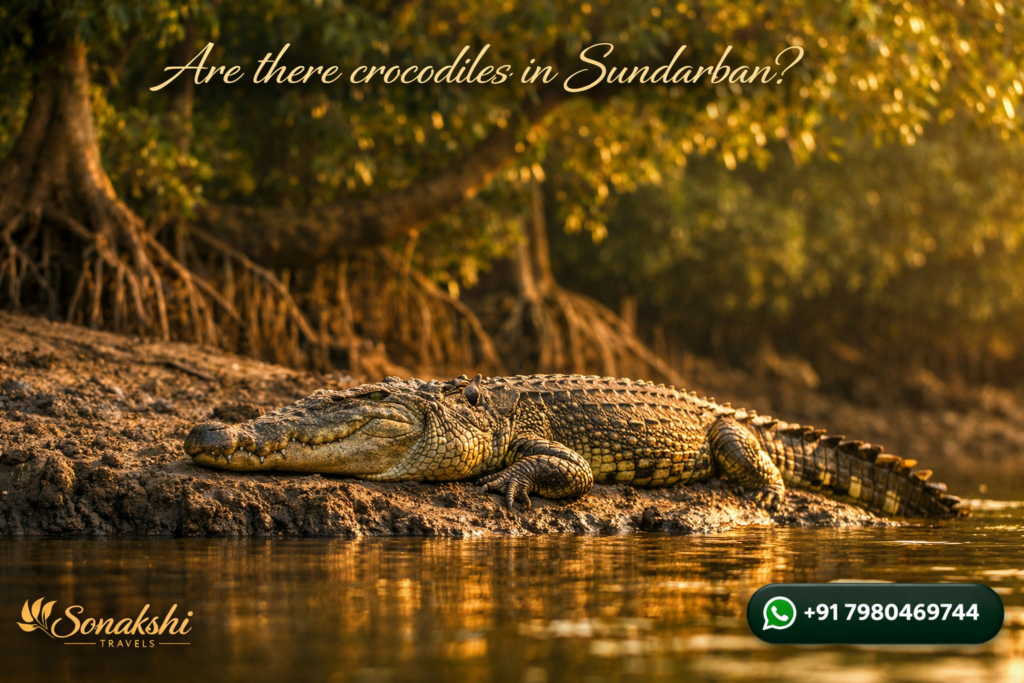
Yes, there are crocodiles in the Sundarban. This is a true and important part of the mangrove world. The Sundarban is not only a forest of trees, mud, and tides. It is also a living habitat for powerful reptiles that are well adapted to brackish water channels, soft mudbanks, and quiet creeks. So the honest answer is simple. Crocodiles do live in the Sundarban, and their presence is part of the natural balance of this delta.
But that simple answer needs deeper explanation. When people ask whether there are crocodiles in the Sundarban, they are often asking more than one thing. They want to know what kind of crocodiles are found there. They want to know whether they are common or rare. They want to know if tourists may see one during a Sundarbans tour. They also want to know whether crocodiles make the region dangerous. These are fair questions, because the Sundarban is not a controlled park made for easy viewing. It is a shifting tidal forest where animals live according to water, temperature, silence, and instinct.
The crocodile most closely linked with the Sundarban is the estuarine crocodile, often called the saltwater crocodile. This species is known for its strength, patience, and ability to live in tidal and coastal environments. The Sundarban, with its mix of river flow and saline influence, gives exactly the kind of habitat such a reptile can use. Wide rivers, hidden creeks, sloping mud edges, and still patches of water create places where a crocodile can rest, hunt, or move without being easily noticed.
Why crocodiles belong naturally to the Sundarban
A crocodile in the Sundarban is not an unexpected intruder. It is part of the ecological design of the place. The mangrove delta offers food, shelter, and breeding conditions that suit a large semi-aquatic reptile. Fish move through the channels. Crabs and other aquatic life remain active in muddy zones. Birds gather near banks. Small and medium animals sometimes come close to water. In such a system, a crocodile is one of the top predators. Its place is not accidental. It helps shape the food chain.
The physical form of the Sundarban also supports crocodile life. Many riverbanks are not hard or open. They are soft, curved, wet, and partly hidden by roots and low growth. This matters because crocodiles do not need dramatic cave-like shelters. They often depend on camouflage, stillness, and water access. A muddy edge under filtered light is enough for a large reptile to disappear from human sight. In the Sundarban, this kind of hiding place exists in many stretches.
The tide makes the habitat even more suitable. Water rises and falls through the day. Channels change shape. Mud appears and disappears. A place that looks open in one hour may look covered in another. This constant movement helps a crocodile remain difficult to detect. It also means that the same creek may feel completely different at different times. For this reason, the presence of crocodiles in the Sundarban is real even when direct sightings are not frequent.
Which crocodile is found in the Sundarban?
The main crocodile associated with the Sundarban is the estuarine crocodile. This is the largest living reptile in the world. It is built for both power and patience. Its body is heavy, but its movement in water can be smooth and quiet. Its eyes and nostrils sit in a way that allows it to remain mostly submerged while still watching the world above the surface. This makes it very effective in muddy tidal habitats.
In the Sundarban, the estuarine crocodile is especially important because the environment is neither fully freshwater nor fully marine in a simple way. It is a mixed tidal system. This suits the estuarine crocodile better than many other reptiles. The species can move through channels, rest on banks, and use areas where salinity changes over distance and time. That adaptability is one reason it belongs so strongly to this landscape.
The animal itself is not always easy to identify in the field unless a person has experience. From a distance, a large floating form may look like dark wood, wet mud, or a silent shape between roots. Sometimes only the head is visible. Sometimes only a line on the water gives away its movement. That is why many visitors on a Sundarban wildlife safari may pass through crocodile habitat without realizing how closely the place is connected to reptile life.
Are crocodiles common in the Sundarban?
The better answer is that crocodiles are present, but they are not seen all the time. This distinction is important. Presence and visibility are not the same. In a crowded zoo enclosure, an animal is expected to remain visible. In the Sundarban, the opposite is often true. The most successful wild animal is often the one that remains hidden. Crocodiles are masters of this kind of hidden existence.
Some parts of the Sundarban have stronger reptile presence than others. Quiet channels, broad muddy edges, less disturbed stretches, and areas with suitable prey may support more activity. But the public should not think in a simple map-like way, where one exact bend always has a crocodile and another never does. Wild habitats do not work like that. A crocodile moves according to heat, water level, food, breeding needs, and human disturbance.
This is why stories about crocodile sightings in the Sundarban often feel uncertain. One group may see nothing. Another may notice a large body slipping into the water. A third may only see tracks or bank marks. All three experiences can be true. The Sundarban often reveals wildlife in fragments rather than full display. A movement, a ripple, a sudden silence, a trail in mud, a heavy slide mark on a bank—these small signs can say as much as a full sighting.
How crocodiles behave in a mangrove landscape
To understand crocodiles in the Sundarban, it helps to understand their behavior. A crocodile is not always active in the way people imagine. It does not spend the whole day chasing prey or moving in dramatic ways. Much of its life depends on waiting. It may rest on a mudbank to regulate body temperature. It may remain still near the surface. It may stay quiet for long periods and move only when needed. In a mangrove forest, this behavior becomes even more effective because the environment is already full of shadows, roots, reflections, and broken shapes.
The crocodile depends on surprise and control. It does not need to be fast all the time. It needs the right moment. The Sundarban gives many such moments because the water is often opaque and the banks are irregular. Visibility is not clean or open. This means the crocodile’s natural style of hunting fits the landscape well.
There is also a psychological side to this. The Sundarban creates a feeling that something may be present even when nothing is visible. That feeling is not imagination alone. It comes from the structure of the place. Water hides depth. Mud hides tracks. Roots break the line of sight. Sound travels strangely. In such a place, a crocodile does not need to announce itself. The whole environment already supports secrecy.
Why they are hard to see
Many people think a large animal should always be easy to spot. In the Sundarban, size does not guarantee visibility. A crocodile can match the color of wet mud, old bark, dark water, and shadow. Its stillness adds to this effect. Human eyes often notice movement first. When movement is absent, even a large reptile may go unseen.
Light also plays tricks in tidal forests. Reflections break shape. The surface of the water can hide form. A head may appear for a moment and then vanish. From a moving boat, these brief signs are easy to miss. This is one reason why crocodile sightings during a Sundarban tour from Kolkata are possible, but never guaranteed.
Do crocodiles make the Sundarban dangerous?
Crocodiles are powerful wild animals, so they should always be treated with seriousness. But seriousness is not the same as panic. The presence of crocodiles does not mean every visit to the Sundarban is unsafe. It means the region must be respected as a true wild habitat. That is a more accurate and mature understanding.
The greatest mistake is to imagine the Sundarban as a place where humans control the rules. They do not. Water channels, mud edges, and forest margins are shared spaces shaped by wildlife. Crocodiles use these spaces according to instinct. So safety depends on discipline, distance, and correct behavior near water. In other words, danger increases when people forget that they are in a living habitat, not a decorative landscape.
From a research and field perspective, crocodiles are generally most risky when humans become careless around riverbanks, shallow edges, or isolated water points. This is why trained operators and responsible local systems matter. The problem is not the simple existence of the reptile. The problem begins when human behavior ignores the logic of the habitat.
For this reason, a well-managed Sundarban private tour can sometimes give a calmer observational setting, because controlled movement and closer attention to surroundings help people remain more aware of water behavior and animal space. The important point, however, is not luxury or privacy. It is respect for wild conditions.
What signs suggest crocodile presence?
People often expect a direct sighting, but direct sight is only one kind of evidence. In the Sundarban, presence may be understood through indirect signs. Slide marks on muddy slopes can suggest that a large reptile has moved between bank and water. Disturbed soft mud may show body weight. Unusual stillness in a narrow stretch may cause experienced boatmen to read the place more carefully. Even the shape of certain resting banks can signal that the habitat suits crocodiles.
Field awareness in a mangrove region is often based on pattern, not spectacle. Experts notice where the tide leaves clean mud, where shade stays longer, where bank angle is suitable, and where prey movement is likely. Crocodile knowledge is often built from many small observations rather than one dramatic event. That is why local experience remains valuable in interpreting the Sundarban.
Crocodiles and the deeper mood of the Sundarban
The idea of crocodiles in the Sundarban affects how people feel about the forest even when they do not see one. It changes the emotional reading of the landscape. A calm creek no longer feels only peaceful. It also feels alert. A silent bank no longer looks empty. It feels occupied by possibility. This double feeling—beauty with caution—is part of the real character of the Sundarban.
That is why the crocodile matters beyond biology. It shapes the human experience of the delta. It teaches that not all beauty is soft. Some beauty carries warning, distance, and power. In the Sundarban, such beauty feels honest. The forest does not ask to be loved only as scenery. It asks to be understood as a complete living system where large predators, hidden movement, and uncertain edges are normal.
This does not make the place dark or frightening in a simple way. Instead, it makes it serious. Serious landscapes stay longer in memory because they do not let the visitor remain careless. The crocodile adds to that seriousness. It reminds people that life in the delta is ancient, physical, and older than tourism language.
Are crocodiles important for the ecosystem?
Yes, they are important. A top predator has ecological value because it helps maintain balance in food relationships. Such animals affect prey behavior, habitat use, and the larger structure of ecological interaction. In a wetland or estuarine system, this role becomes especially meaningful because many life forms depend on linked aquatic networks. A crocodile is not only one animal among many. It is part of the regulating force of the habitat.
When people ask whether there are crocodiles in the Sundarban, the answer should not stop at fear or excitement. It should include ecological respect. A forest without its major predators becomes biologically poorer in meaning, even if it appears easier for humans. The presence of crocodiles shows that the habitat still supports complex wild life.
In that sense, crocodiles are not separate from the identity of the Sundarban. They are one expression of its depth. The delta is famous for secrecy, tension, water movement, and hidden strength. The crocodile belongs to all of these qualities. It is one of the animals that makes the Sundarban feel truly untamed.
So, are there crocodiles in Sundarban?
Yes, there are crocodiles in the Sundarban, and their presence is fully natural to this mangrove ecosystem. The estuarine crocodile is the species most strongly associated with the region. It is not always visible, but it is part of the real life of the delta. Mudbanks, creeks, tidal channels, and hidden water edges all support the kind of habitat this reptile needs.
The right way to understand this is calm and clear. Crocodiles are not a myth of the Sundarban. They are not a tourist story added for drama. They are a genuine part of the forest’s ecology, mood, and power. A person may not always see one, but the landscape itself carries the signs of such life. That is why the question matters. It opens the door to a deeper truth about the Sundarban: this is a living mangrove wilderness where silence can hold more life than the eye first sees.
So the final answer remains simple, but now it is fuller. Yes, there are crocodiles in the Sundarban. They belong there. They help define the seriousness of the habitat. And they remind every careful observer that the Sundarban is not only beautiful. It is also ancient, watchful, and alive in ways that remain partly hidden.