Updated: March 29, 2026
Where Silence Has Weight and Roots Have Rhythm—Sundarban Tour Transforms Time
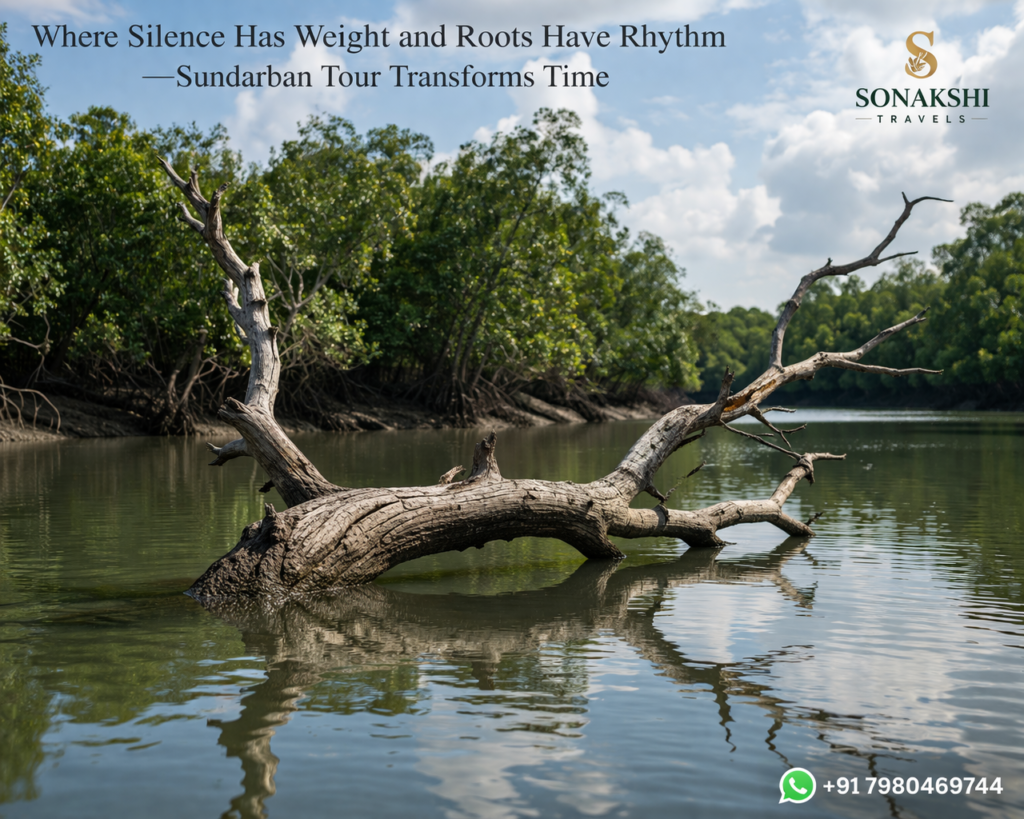
There are places where time feels light. It moves fast, leaves little mark, and disappears before the mind can hold it. Then there are places where time feels heavy. It gathers around the body. It sits in the air, in the water, in the pause between two sounds. A Sundarban tour belongs to the second kind. It does not pass like a quick trip. It settles slowly and deeply. In this mangrove world, silence is not empty, and stillness is not the absence of life. Everything seems quiet at first, but the quiet carries pressure, meaning, and movement.
The title of this journey is not a metaphor alone. In the Sundarban, silence truly has weight. A person begins to feel it in the river air, in the soft drag of the tide, in the way the forest does not reveal itself quickly. The roots, too, seem to have rhythm. They rise from the mud like written marks, repeated again and again, forming patterns that look still but speak of breath, survival, and response. The land itself appears to move in a slow language. That is why a Sundarban travel guide can describe routes and names, yet it cannot fully prepare the mind for what happens when the body enters this silence. The real understanding begins only inside the landscape.
Silence Here Is Not Empty
Many people think silence means nothing is happening. In the Sundarban, the opposite is true. Silence here feels dense because it is full of hidden action. The mud is alive with small creatures. The channels are changing with every pull of water. Leaves respond to salt, moisture, and wind. Birds may be unseen but not absent. The forest does not present itself in loud scenes. It remains active behind a soft surface. This is one reason why the emotional effect of Sundarban tourism is so different from travel in places shaped by noise and speed. The visitor is not pushed by spectacle. The visitor is asked to wait, notice, and listen.
That waiting changes human attention. At first, the mind searches for one big event. It wants a clear sign, a dramatic view, a quick reward. But the Sundarban works in another way. It teaches the eye to accept smaller truths. A ripple near a muddy edge becomes important. A line of roots becomes a pattern worth reading. A brief stillness in the air feels like an event in itself. This is how silence gains weight. It presses on the senses until ordinary habits of looking begin to change.
Researchers who study mangrove ecosystems often note that these forests are built through adaptation, tension, and exchange. Salt and fresh water influence each other. Sediment settles and shifts. Plant life survives in unstable ground. That ecological truth can also be felt emotionally. The silence of the Sundarban is heavy because it is formed by pressure. The place exists through constant adjustment. What seems calm is actually full of response. A careful Sundarban nature tour therefore becomes more than visual travel. It becomes an education in how quiet systems live under strain and yet remain balanced.
The Rhythm of Roots and the Shape of Survival
The roots of mangrove trees are among the most striking forms in this landscape. They do not hide beneath the earth in the usual way. They rise, spread, bend, and return. They seem to write on the surface of the mud. In some places they stand like thin dark fingers. In others they form arches, knots, and low tangled walls. Their shapes are practical, but they also appear musical. They repeat with variation. They create intervals. They seem to pulse through space.
To watch these roots with patience is to understand the deeper rhythm of the delta. They are not only botanical structures. They are records of struggle. Mangrove roots help trees breathe in wet, oxygen-poor soil. They help hold unstable ground. They reduce erosion and slow the force of water. In other words, their rhythm is not decorative. It is functional survival made visible. This is one of the deepest lessons within a Sundarban travel experience. Beauty in the Sundarban often comes from necessity. What looks graceful is often the result of pressure, adaptation, and endurance.
That is why the roots seem to alter time. A person looking at them does not feel the quick time of traffic, deadlines, or screens. One feels layered time. The roots suggest years of tidal contact, repeated flooding, salt exposure, and careful persistence. They remind the visitor that life does not always grow in straight lines. Sometimes it survives by bending, branching, and returning. The visual rhythm of the roots becomes a mental rhythm. The mind slows down and begins to follow the pattern.
Why the Forest Changes Human Time
Modern life trains people to think of time as a sequence of units. Minutes are counted. Hours are divided. Days are filled. In the Sundarban, that structure loses some of its force. The place has its own timing. Water rises and falls according to lunar and tidal patterns, not human plans. Light changes the reading of distance. Mudbanks appear and disappear. The forest does not move by clock language. It moves by relation. This is one reason the title says that the tour transforms time. It does not merely consume a day. It changes the way a day is felt.
During a Sundarban tour from Kolkata, many travelers carry with them the speed of the city. The mind arrives crowded. It is full of unfinished thought. But once the river space opens and the mangrove edges begin to repeat themselves, another measure begins to take over. Duration becomes more sensory than numerical. A long quiet stretch may feel deep rather than empty. A short movement of light on water may feel complete. Instead of asking how much time has passed, the mind begins to ask what the moment contains.
This is not fantasy. It is a known effect of environments that reduce noise, visual clutter, and constant interruption. Attention scholars often note that natural settings can restore directed attention by allowing the mind to rest in softer forms of focus. The Sundarban does this in a special way because its quiet is not plain. It is textured. There is always subtle movement, but rarely a violent demand for attention. This balance between stillness and gentle variation creates a powerful mental shift.
Silence as an Ecological Signal
Silence in the Sundarban should also be understood as ecological meaning. The forest is a place where many species survive by restraint, camouflage, timing, and distance. Loudness is not always useful here. Presence is often hidden. Movement is often careful. The visitor who enters with the expectation of constant visible action may misunderstand the landscape. The deeper truth is that this ecosystem depends on forms of control. Even the plants reveal this principle. Mangroves conserve, filter, and adapt. Nothing is careless.
That gives a serious tone to the experience. A Sundarban wildlife safari is not important only because of the chance of seeing animals. It is important because it teaches a way of reading signs. A broken pattern in mud, a sudden stillness among birds, a change in water texture, a brief tension in the air—these subtle shifts matter. The forest trains the visitor to value signals that urban life usually ignores. In that sense, silence has weight because it carries information.
When people speak too quickly about nature, they often reduce it to pleasure alone. But the Sundarban asks for a more exact response. Its beauty is real, yet that beauty is mixed with difficulty, caution, and constant negotiation between land and water. The silence is not soft in a simple way. It is disciplined. It contains memory of storms, salinity, erosion, and recovery. Therefore the emotional power of a Sundarban exploration tour comes from this union of grace and tension.
The Body Learns Before Language Does
One of the most remarkable things about this landscape is that the body often understands it before the mind can explain it. A person may not have the scientific terms for mangrove adaptation or tidal sediment movement, yet the body senses that this place is organized differently. The air feels thicker. Sound travels in a softer way. Distance becomes uncertain. The eye cannot always judge depth through water and green shade. These physical sensations change thought.
That is why memory from a Sundarban tour package often remains strong even when only a few visible events are remembered. The body keeps the pressure of the silence. It remembers the pause before a turn in the river. It remembers the strange authority of roots holding mud together. It remembers the feeling that the landscape was watching as much as it was being watched. Such memories last because they are not built only from sightseeing. They are built from altered perception.
This also explains why many travelers struggle to describe the place fully after returning. Language likes fixed outlines. The Sundarban resists them. It is neither land nor water in a simple sense. It is neither still nor moving in a simple sense. It is neither open nor closed in a simple sense. The experience remains powerful precisely because it escapes easy categories. The title’s idea of transformed time comes from this same difficulty. The forest interrupts ordinary labels, and with them it interrupts ordinary thought.
The Moral Force of a Quiet Landscape
There is also an ethical dimension to this silence. The Sundarban reminds people that not all valuable things announce themselves loudly. In a culture shaped by display, speed, and constant expression, the forest teaches another model of importance. Here, restraint carries force. Hidden systems support visible life. Roots do great work without spectacle. Mud stores history without language. Water draws boundaries and erases them without apology. A serious Sundarban eco tourism perspective must begin from this humility.
Such humility changes the traveler’s role. One is not the center of the scene. One is not the master of meaning. The forest remains older, slower, and more exact than the visitor. This realization can be deeply calming. It reduces the pressure of self-importance. It allows the mind to participate rather than dominate. In that way, the Sundarban does not only offer natural beauty. It offers correction. It places human urgency beside a far older rhythm and quietly reduces its size.
This is part of what makes a strong Sundarban travel narrative so different from a simple holiday account. The real subject is not only where the traveler went. The real subject is what the landscape did to the traveler’s sense of pace, meaning, and scale. The forest becomes a teacher not through speech, but through arrangement.
Private Quiet and Shared Quiet
There is another subtle truth in this experience. Silence in the Sundarban can feel deeply personal, but it can also become shared. When two or more people face the same mangrove channel and fall naturally quiet, something rare happens. The place creates a common attention without the need for many words. This is one reason an exclusive Sundarban private tour can feel emotionally intense. Privacy in such a landscape is not luxury alone. It is a condition that allows the quiet to remain unbroken long enough to enter the mind fully.
In ordinary social life, silence often feels awkward. In the Sundarban, silence can feel complete. It becomes a shared respect toward the place. It can join people rather than separate them. A careful Sundarban private tour package may therefore give something beyond comfort or exclusivity. It may give the rare chance to stay inside the forest’s rhythm without constant interruption. The emotional value of that is often greater than expected.
The same is true for couples, families, or close companions who enter the delta with patience. The landscape reduces unnecessary talk and sharpens meaningful presence. That is why forms of quiet travel can sometimes reveal relationships more honestly than loud entertainment spaces do. The Sundarban does not distract people from themselves. It slows them enough to notice themselves more clearly.
Why This Experience Stays in Memory
Many journeys fade because they are built from surfaces. They give quick pleasure but leave little depth. The Sundarban often works in the opposite way. It may appear restrained during the experience, yet it grows larger in memory. Days later, the mind begins to understand what the body had already felt. The silence returns. The roots return. The slow pressure of the place becomes clearer. A Sundarban travel package that truly allows contact with this atmosphere does not end at departure. It continues in reflection.
This after-effect is not accidental. Environments that combine sensory subtlety, ecological complexity, and emotional quiet often leave strong cognitive traces. The Sundarban does all three. It offers visual pattern without excess. It offers biological intelligence without display. It offers emotional stillness without emptiness. As a result, it enters memory in a layered way. One does not merely remember seeing a place. One remembers being reshaped by a place.
That is the deepest meaning of the title. Where silence has weight and roots have rhythm, time cannot remain ordinary. The traveler who enters such a landscape is asked to live for a while inside a different order of attention. Hours become fuller. Quiet becomes meaningful. Roots become visible thought. Water becomes moving structure. The self becomes smaller, but not poorer. It becomes more alert, more patient, and more able to recognize value in what does not shout.
In the end, a Sundarban tour transforms time because it transforms the way a person receives the world. It replaces hurry with observation, noise with listening, and shallow motion with deeper rhythm. It reveals that a forest does not need loud drama to be powerful. Sometimes the greatest force lies in what seems quiet. Sometimes the strongest movement lies in roots that hold their ground in mud and tide. And sometimes the most lasting journey is the one that teaches the heart to feel weight in silence and rhythm in stillness.