Protecting Camera Gear from Humidity and River Spray During a Sundarban Tour
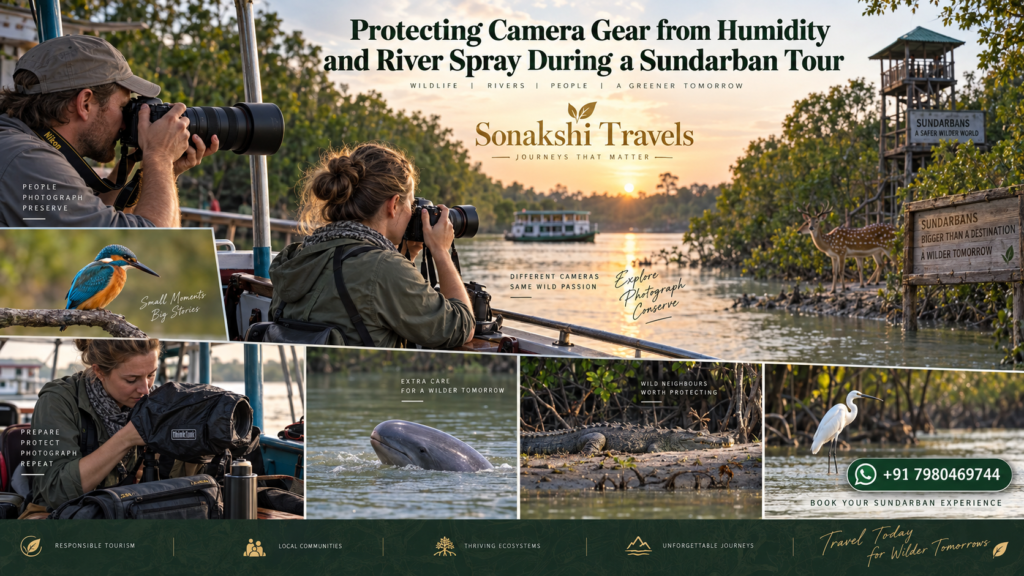
A camera in the Sundarbans faces a very different environment from a camera used in a city, hotel, studio, or dry wildlife reserve. High moisture in the air, tidal rivers, light river spray, sudden rain, muddy boat surfaces, and regular movement between air-conditioned rooms and warm outdoor conditions can all affect photography equipment. Protecting the camera is therefore part of good planning for any Sundarban Tour, especially for travellers carrying expensive mirrorless cameras, DSLR bodies, telephoto lenses, binoculars, drones, or other optical equipment.
The main danger is not necessarily a dramatic accident such as dropping a camera into the river. Small amounts of moisture can create problems slowly. A fine mist may settle around buttons and lens barrels. Condensation may appear when a cold camera is taken from an air-conditioned room into warm, humid air. Repeated damp storage can also encourage fungus inside lenses. The good news is that most of these risks can be reduced with simple preparation and careful daily habits.
This guide explains how photographers from the USA, France, and other countries can protect their equipment before, during, and after a Sundarban boat safari without making photography difficult or stressful.
Why the Sundarban Environment Needs Special Camera Care
The Sundarbans mangrove region is shaped by rivers, creeks, tidal channels, mudflats, islands, and salt-tolerant vegetation. A wildlife journey here is mainly experienced from a boat. That places cameras much closer to water for long periods than on many land-based wildlife tours.
A photographer may spend several hours beside an open window, on a deck, or near the side of a safari boat. Even when the weather is clear, boat movement, passing vessels, wind, or choppy water can create a light spray. Rain can also arrive quickly during humid periods. None of this means that photography is unsafe, but it does mean that cameras should not remain completely exposed simply because the sky looks clear.
Humidity is another issue. Moist air itself does not normally destroy a camera during a few hours of normal use. The greater concern is repeated exposure, trapped moisture, poor drying, and sudden changes in temperature. Good Sundarban travel planning should therefore include a simple system for keeping equipment protected while still keeping it ready for wildlife.
Condensation Can Be a Bigger Problem Than Rain
For many international travellers, condensation is one of the most overlooked camera risks. Imagine that your camera has spent the night inside a strongly air-conditioned hotel room. Early in the morning you take that cold camera directly outside into warm and humid air. Moisture from the surrounding air may then collect on cold surfaces.
The front of a lens may fog, but visible fog is only part of the concern. Moisture may also form around internal or less visible areas. The risk varies with the equipment, temperature difference, humidity, and how quickly the camera moves between environments.
Do Not Rush a Cold Camera Into Humid Air
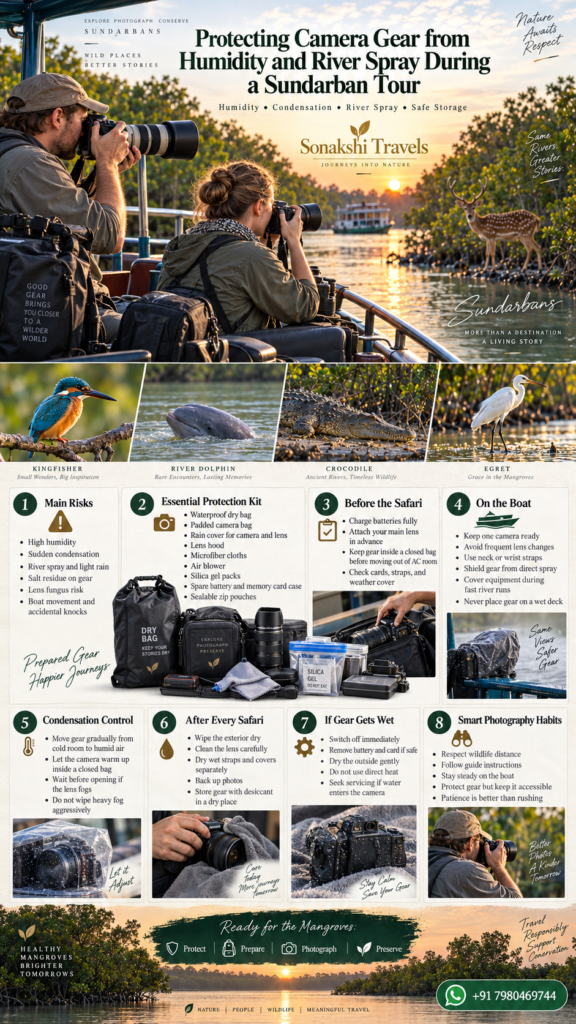
A simple solution is to allow the camera to adjust gradually. Before leaving a strongly air-conditioned room, place the camera and attached lens inside a closed camera bag or large sealed protective bag. Take it outside while it is still protected and give it time to move closer to the outdoor temperature before opening the bag.
There is no single waiting time that applies to every camera or every morning. A large telephoto lens may take longer to adjust than a small compact camera. The aim is not to follow a stopwatch. The aim is to reduce the sudden temperature change.
If visible condensation appears, avoid repeatedly wiping the camera and immediately continuing to shoot. Turn the equipment off and allow it to dry in a protected place. If you suspect that moisture has entered the camera, follow the manufacturer’s instructions rather than testing the camera by repeatedly switching it on.
Use a Dry Bag, but Keep a Camera Bag Inside It
A waterproof or water-resistant dry bag is one of the most useful items for river-based photography. However, a dry bag should normally be used as an outer protection layer rather than as the only camera bag.
A practical arrangement is:
- a padded camera bag or camera insert for impact protection;
- a larger dry bag or waterproof cover around it when spray or rain becomes a concern;
- small sealed cases for batteries and memory cards;
- microfibre cloths stored separately in a dry pouch;
- desiccant packs for controlled storage after the equipment has been dried externally.
The padded bag protects against movement and knocks. The outer dry layer protects against water. This combination is especially useful on a Sundarban tourism journey because the boat may move through broad rivers as well as narrow creeks during the same safari.
Do not keep the dry bag tightly closed around equipment that is already wet. First move to a sheltered area, wipe away external water, and allow the equipment to dry as much as possible. Sealing wet equipment can trap the moisture you are trying to remove.
Keep a Rain Cover Ready Before You Need It
A fitted camera rain cover can be very useful in the Sundarbans. It can protect the body and much of the lens while leaving access to the viewfinder and important controls. A simple protective cover also works better when it is fitted before heavy rain begins rather than after the camera has already become wet.
Keep the cover in an outside pocket where it can be reached in seconds. If the sky becomes dark, wind increases, or visible spray starts reaching the boat, fit the cover early.
A lens hood also offers useful basic protection. Its main photographic job is to reduce unwanted light, but it can also help keep small droplets away from the front element. It should not, however, be treated as a replacement for proper rain protection.
Weather-Sealed Does Not Mean Waterproof
Some professional and enthusiast camera bodies and lenses are designed with seals around selected joints, buttons, mounts, or compartments. This can improve resistance to difficult weather, but photographers should not automatically treat a weather-resistant camera as a waterproof camera.
The level of protection differs between models. Protection can also depend on the lens, battery door, memory-card cover, accessory connections, age of the seals, and whether all covers are properly closed.
Before travelling, check the manual for your exact camera and lens. If a manufacturer does not clearly state that equipment can tolerate a certain kind of water exposure, do not assume that it can.
River Spray Needs Different Thinking from Fresh Rain
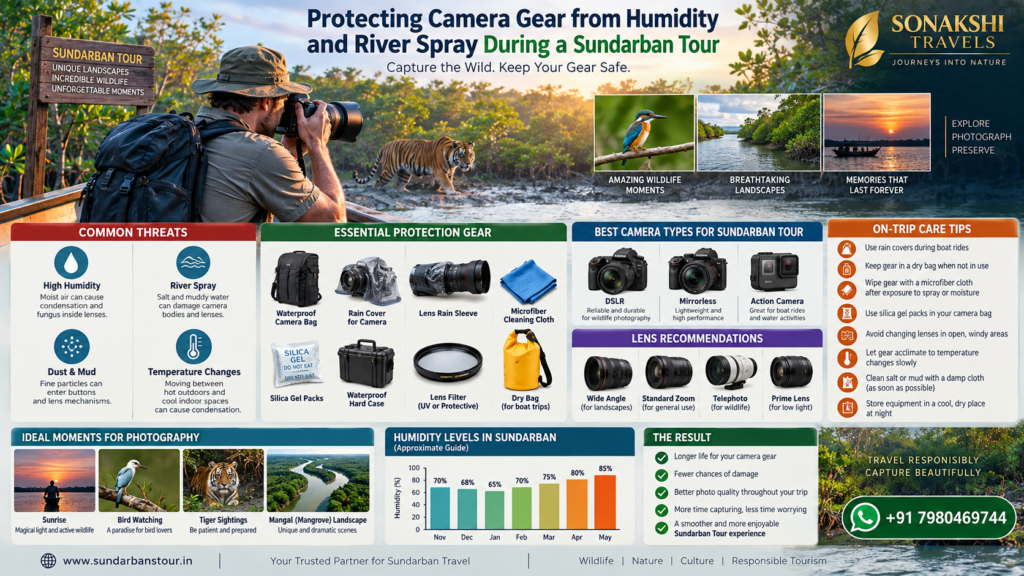
Water around a tidal mangrove region can contain salt and other natural material. Fine spray can therefore leave marks after the water itself has dried. This is one reason photographers should not wait until obvious drops are covering the camera before using protection.
If light spray reaches the outside of the camera, move it away from continued exposure and gently remove visible moisture with a clean cloth. After returning to a dry environment, check the camera body, lens barrel, hood, tripod collar, strap fittings, and other exposed surfaces.
If you believe salty water has reached external metal or plastic surfaces, follow the cleaning advice supplied by the equipment manufacturer. A clean cloth only lightly dampened with fresh water may be suitable for some external surfaces, followed by careful drying, but water should never be pushed into switches, ports, joints, battery compartments, or lens openings.
The front lens element needs separate care. First remove loose dirt with an appropriate blower. Then use a clean lens cloth and suitable optical cleaning method. Rubbing a wet or dirty lens immediately can move fine particles across the glass and may damage coatings.
Avoid Unnecessary Lens Changes on the Boat
Changing lenses repeatedly on an open river creates several problems at the same time. Moist air can enter the camera chamber, dust or small particles may reach the sensor, and an unexpected splash can arrive while the camera mount is open.
Whenever possible, decide on your main lens before the safari starts. For wildlife photographers, this may be a telephoto zoom. A second body can be useful for travellers who want both wildlife and wide landscape photographs, because it reduces lens changes.
If you must change a lens, wait for a calm part of the journey. Move away from the open side of the boat, keep the camera pointed slightly downward, prepare the second lens first, and keep the camera mount open for as little time as possible.
This approach is particularly useful for photographers following Sundarban birdwatching guidance for international nature travellers. Birds may appear quickly, so a lens that is already attached and ready often matters more than carrying several lenses that require constant changing.
Keep One Camera Ready Instead of Exposing Everything
A common mistake is to unpack the full photography kit as soon as the boat safari begins. There is usually no need to have two bodies, four lenses, chargers, batteries, filters, and accessories sitting openly on a seat.
Keep one working camera ready and the remaining equipment inside a protected bag. If conditions become rough, the working camera can then be covered quickly while the rest of the kit is already safe.
This also reduces confusion when wildlife appears suddenly. Sundarban wildlife photography often rewards patience rather than constant equipment handling. The broader principles explained in this guide to wildlife watching, patience, probability and habitat are useful for photographers as well. When you understand that sightings develop according to habitat, tides, distance, movement, and chance, there is less pressure to keep changing equipment every few minutes.
Protect Memory Cards and Batteries Separately
A camera body can sometimes be protected while small accessories are forgotten. Memory cards, batteries, card readers, power banks, cables, and adapters should have their own dry storage.
Use small weather-resistant cases or sealed pouches. Keep used memory cards separate from empty cards so that there is no need to open several containers while sitting on the boat.
It is also sensible to make a second copy of important photographs when possible. A memory card is small enough to be lost even when it has not suffered water damage. International travellers carrying a laptop or portable backup drive can create a backup after returning to the hotel.
Do not leave batteries or cards loose on boat seats. Apart from moisture, normal boat movement is enough to send small items onto the floor or near the water.
Carry More Than One Microfibre Cloth
One cloth is often not enough in a humid river environment. If the first cloth becomes damp, continuing to use it may simply spread moisture across the lens.
Carry several clean microfibre cloths in separate sealed pouches. Keep one for optical surfaces and another for the outside of the camera or lens hood. Do not use a cloth that has already collected mud, salt, sunscreen, insect repellent, food, or skin oil on the front lens element.
A small air blower can also be valuable. If dust or a dry particle is present on the lens, remove it before wiping. Avoid blowing directly with your mouth because your breath contains moisture.
Store Equipment Properly Every Evening
Protection should continue after the boat safari ends. A camera that appears fine during the day can remain damp inside its bag if the bag itself has absorbed moisture.
At the hotel or resort, inspect the gear in a clean, dry area. Check the camera body, lens, lens hood, strap, tripod mount, and bag. Allow damp straps and covers to dry separately rather than folding them around the camera.
For longer trips, controlled dry storage can be useful. Sony’s guidance on storing interchangeable-lens cameras explains the use of dry boxes and desiccants and gives about 40% to 50% humidity as an optimal storage range for its guidance. Photographers should still check instructions for their own equipment, especially when using electronic dry cabinets.
Silica gel or another suitable desiccant can be useful inside a closed storage box, but do not depend on old sachets that have already absorbed moisture. Recharge or replace reusable packs according to their instructions.
A Multi-Day Tour Needs a Daily Camera Routine
The need for camera care becomes more important on a two-night, three-night, or longer journey because moisture exposure can build over several days. Travellers considering how many days are really needed for a meaningful Sundarban tour should therefore think about equipment management as part of the itinerary.
A simple evening routine can take only a few minutes:
- Check the camera and lens for water marks.
- Dry the exterior before storing it.
- Inspect the front and rear optical surfaces where appropriate.
- Allow damp straps, rain covers, and bags to dry separately.
- Charge batteries in a dry indoor location.
- Back up important photographs.
- Place dry camera equipment in suitable controlled storage.
- Prepare the next morning’s main lens before leaving the room.
This routine also makes the next safari easier. You are less likely to discover a fogged filter, damp cloth, empty battery, or full memory card after the boat has already entered the forest waterways.
Do Not Risk Your Camera Because a Tiger Appears
A Royal Bengal tiger is naturally an exciting possibility, but a sudden wildlife sighting can make photographers forget basic equipment safety. Someone may lean too far over the side, place an unprotected lens on a wet surface, or change lenses in a hurry because the subject is at an unexpected distance.
The better approach is to keep the camera ready before the opportunity develops. Use a secure strap, keep the main lens attached, and know your basic settings before entering a promising creek.
It is equally important to remember why tiger sightings should not define the success of a Sundarban journey. The landscape offers birds, crocodiles, deer, monkeys, river dolphins, mudflats, mangrove details, fishing activity, changing light, and wide river scenes. A photographer who values the whole environment is less likely to make rushed equipment decisions for one uncertain sighting.
Think About Your Position on the Boat
Your seat can affect how much spray reaches the equipment. Conditions vary according to boat design, wind direction, speed, river width, and water movement. If spray repeatedly reaches one side of the boat, move the camera to a more protected position when possible.
Never place expensive equipment directly on the deck unless it is inside a suitable protective case. Deck surfaces may be damp even when they appear dry. Use a padded bag and keep zips or openings facing away from likely spray.
On a private boat, photographers may have more freedom to organise equipment and choose a suitable shooting position. Travellers who want this type of control can consider private Sundarban tour options when planning their journey. Whatever type of boat is used, all movement and photography should follow the instructions of the boat crew and forest authorities.
A Simple Camera Protection Kit for the Sundarbans
You do not need a huge technical kit. A small group of well-chosen items can solve most normal problems.
- Camera rain cover: for unexpected rain and repeated light spray.
- Padded camera bag: for normal carrying and impact protection.
- Dry bag: for an additional water barrier during difficult conditions.
- Several microfibre cloths: kept clean and individually protected.
- Air blower: for removing loose particles before touching optical glass.
- Lens hood: useful for both photography and limited protection from droplets.
- Desiccant packs: useful for controlled dry storage when correctly used.
- Sealed battery case: to keep spare batteries organised and dry.
- Memory-card case: preferably with separate positions for used and unused cards.
- Large sealable plastic bags: useful when equipment needs gradual adjustment between different temperatures.
- Small clean towel: for the camera bag, hands, or surrounding work area rather than optical glass.
Travellers arriving through Kolkata can organise these items before departure rather than trying to buy specialised accessories near the forest. When arranging a Sundarban Tour from Kolkata, prepare batteries, storage cards, rain protection, and cleaning materials along with normal clothing and travel documents.
Special Advice for Photographers Arriving from the USA or France
Long-distance travellers often arrive with equipment that has passed through several controlled environments: airports, aircraft cabins, air-conditioned cars, city hotels, and finally the warm river environment. The camera may therefore experience several changes in temperature before the wildlife photography even begins.
Do not unpack every lens as soon as you reach the Sundarbans. Give equipment time to adjust naturally. If your accommodation is strongly air-conditioned, be especially careful before the early morning safari. Preparing the camera in a closed bag before leaving the room is easier than dealing with a fogged lens while the boat is departing.
International travellers should also check insurance terms for professional or expensive photography equipment. Travel insurance and camera insurance differ greatly, and normal travel policies may have limits on individual high-value items. Keep serial numbers and purchase records stored digitally where possible.
Electrical charging also deserves simple planning. Carry the correct Indian plug adapter for your charger, but avoid charging equipment in a damp area. Charge batteries indoors on a stable, dry surface and pack them only after charging is complete.
What to Do If the Camera Becomes Seriously Wet
If the camera receives more than a few surface drops and you believe water may have entered the body, continuing to test it can make the situation worse.
Move the camera to a safe, dry place and switch it off. Remove the battery if this can be done safely and according to the manufacturer’s instructions. Remove the memory card if appropriate. Wipe external water without opening unnecessary covers in a wet environment.
Do not use strong direct heat from a hair dryer, heater, open flame, or other high-temperature source. Heat can damage seals, adhesives, screens, plastics, and internal parts.
If there is evidence that water entered the camera, professional inspection is safer than assuming that a night beside a packet of silica gel has solved the problem. This is particularly important after exposure to brackish or salty water.
Photography Should Not Interfere with Safe Wildlife Viewing
Camera protection is also connected with safe behaviour. Photographers sometimes become so focused on the viewfinder that they stop noticing the movement of the boat or instructions from the guide.
Keep straps, bags, tripod legs, and long lenses arranged so that other passengers can move safely. Avoid blocking narrow passages. Never place equipment where a crew member may need to work. A camera can be replaced; an unsafe movement beside a tidal river can have much more serious results.
The most productive photography often comes from being calm and prepared. Instead of constantly opening bags and changing equipment, watch the riverbank, listen to the guide, observe bird movement, study the exposed mud at low tide, and remain ready for short moments of activity.
Good Protection Can Actually Improve Your Photography
Protecting equipment is not only about preventing repair bills. A clear protection routine makes a photographer more relaxed. When you know the unused lenses are dry, memory cards are safe, batteries are organised, and a rain cover is within reach, more attention can be given to the landscape.
This matters in the Sundarbans because many useful photographic moments are subtle. A kingfisher may remain on a branch for only a short time. A crocodile may be visible on exposed mud before the tide changes. A deer can appear between mangrove roots and disappear again. Reflections may last only until the boat changes direction.
Being prepared does not guarantee better wildlife sightings, but it helps you make better use of the opportunities that conditions provide.
Keep the Camera Ready, but Keep It Protected
Humidity and river spray should not stop travellers from bringing serious photography equipment to the Sundarbans. They should simply change the way that equipment is handled. The most important steps are simple: reduce sudden temperature changes, keep rain protection ready, avoid unnecessary lens changes, protect accessories separately, clean equipment carefully, and create a dry storage routine at the end of each day.
The Sundarbans rewards photographers who work patiently. It is a landscape of tidal rivers, mangrove edges, changing light, birds, reptiles, mammals, village life, and uncertain wildlife encounters. Protecting the equipment means that the photographer can concentrate on those moments instead of worrying about a wet camera bag or fogged lens.
For Sonakshi Travels guests and other international visitors, camera preparation should begin before leaving Kolkata. A few inexpensive protective items can be far more useful than carrying another lens that remains exposed to moisture throughout the journey. Good equipment care also becomes more important during multi-day safaris, when the same camera may spend many hours beside tidal waterways on consecutive days.
A well-planned Sundarban Tour should therefore treat photography protection as part of normal travel preparation. Keep the gear accessible, keep it dry whenever possible, allow it to adjust slowly to changing conditions, and remember that the purpose of protecting the camera is ultimately very simple: to keep you ready when the Sundarbans gives you a photograph worth taking.