Updated: March 28, 2026
My First Boat Ride During the Hilsa Festival Felt Like Stepping into a Painting — Green, Grey, and Golden with Ilish
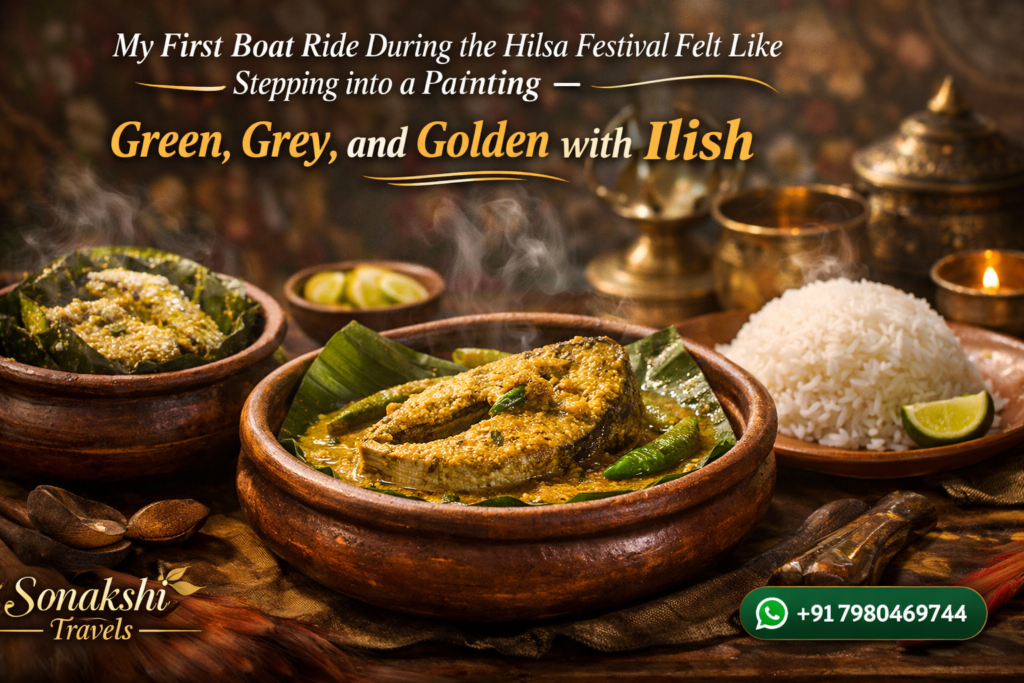
Some journeys begin with noise. This one began with color. My first boat ride during the Sundarban hilsa festival did not feel like an ordinary movement from one point to another. It felt like entering a painted world where the river held soft grey light, the mangrove edges stood in deep green silence, and every warm golden reflection seemed to float around the idea of ilish. The boat moved, but the mind became still. That is the first truth I remember. I was not only seeing a river journey. I was slowly entering an atmosphere shaped by food memory, wet light, shifting water, and the slow rhythm of a living delta.
The title of a festival may suggest crowds, music, and excitement, but what touched me first was not loudness. It was the strange calm that held everything together. On that first ride, the river did not look empty. It looked full in a quiet way. The water carried broken lines of light. The banks seemed to breathe under layers of leaves, mud, roots, and shadow. The decorated meal on board, with its shining ilish preparations, did not feel separate from the landscape. It felt born from it. That is why the boat ride stayed in my mind as an image, almost like a hand-painted scene, where food, river, and silence belonged to one frame.
The Moment the Boat Left the Bank
The first emotional shift happened when the boat slowly pulled away from the shore. That small separation from land changed the quality of attention. On land, the eye moves quickly. It looks from object to object. On water, the eye learns patience. Distance grows softer. Sound spreads differently. The body also changes its rhythm. One becomes aware of drift, vibration, and space. During the Sundarban ilish utsav, that movement gained another layer because the ride was not only scenic. It carried expectation. The very idea of ilish on the river created a cultural mood. The meal was still ahead, but its presence already shaped the experience.
I remember looking at the river surface and noticing how no single color remained fixed. Grey passed into silver. Silver caught gold. Green from the banks entered the water and broke into darker shades. The changing palette was so delicate that it did not look natural in the usual sense. It looked composed, almost arranged like a painting. Yet the scene had no artificial stillness. It kept moving. Tides shifted. Tiny waves hit the side of the boat. Reflections stretched and dissolved. This made the experience richer. A painting usually stays still. Here the painting was alive.
That first departure also brought a quiet mental release. On water, ordinary habits lose force. The mind no longer follows the same speed as daily life. Instead, it begins to respond to repetition: the sound of the engine, the brushing of water, the rustle of river wind, the distant call of birds. Such repetition has a psychological effect. It clears inner noise. It opens room for notice. A person begins to see details that would normally remain hidden. The curve of exposed roots, the heavy stillness of a muddy edge, the shine on a metal plate, the smell of fish and spice rising softly from the cooking area of the boat—each part begins to matter.
Why the Landscape Felt Painted
The feeling of “stepping into a painting” came not from beauty alone, but from the way separate elements held a visual balance. The green of the mangroves was not bright in a simple way. It was layered. Some leaves looked dark and heavy. Some seemed washed with light. Some parts of the bank disappeared into shadow so fully that the eye had to wait before it could read the form. The grey of the sky and water acted like a soft background tone. It lowered sharpness and gave depth to the gold that appeared in moments—on utensils, on food, on sunlight, on a passing edge of wave.
This balance matters because the human mind reads harmony through contrast. Green alone can become dense. Grey alone can become dull. Gold alone can become decorative. But when these three tones meet in one moving river frame, they create mood. During my first boat ride, ilish became part of that mood. The fish was not just a dish served at a festival table. Its silver body, golden mustard gravies, fried edges, and aromatic steam joined the visual language of the river. The meal belonged to the same color story that the landscape was already telling.
There is also an ecological reason why the river scene feels so textured. Mangrove zones do not produce one flat view. They are formed by tide, silt, roots, changing water levels, and plant structures that interact in layers. Because of this, the eye never meets a plain surface for long. It meets depth, interruption, and reflection. A boat journey through such a place naturally creates an artistic impression because the landscape is already composed through many fine variations. On that day, the festival mood sharpened my awareness of those variations. I was not simply traveling through scenery. I was reading a visual language shaped by river life.
The Presence of Ilish on the Water
Ilish has cultural weight in Bengal, but on that boat ride I understood something more subtle. On the river, ilish feels less like a famous food item and more like a bridge between environment and memory. The smell of mustard, green chili, fresh oil, and warm rice did not cancel the smell of the river. It entered into dialogue with it. The wet air carried both. This created a rare sensory unity. The meal did not distract from the journey. It deepened it.
Food often becomes more meaningful when it is eaten near the landscape that gives it context. That is one reason the Sundarban hilsa festival 2026 leaves such a strong impression on visitors. The act of eating ilish on a boat in the delta changes the emotional meaning of the dish. It is no longer only about taste. It becomes connected to tide, mud, river breeze, silence, and horizon. My first boat ride made this clear. Even before the first bite, the dish had already been prepared by the setting itself.
When the plates arrived, the experience became almost ceremonial. Steam rose into the moist air. The color of the fish seemed richer against the softer tones of the river. The golden shades of mustard-based preparation echoed the golden flashes on the water. White rice looked brighter in that dim, moving environment. Even the act of serving felt slower and more attentive because no one wanted to break the mood. People spoke, but softly. The river remained the larger presence.
What stayed with me most was the fact that ilish on the boat did not feel heavy or crowded, though it was full of richness. Instead, it felt placed within a wider rhythm. One bite, one look at the river, one pause, one drifting line of light—this became the pattern. It was almost meditative. In that sense, the meal was not an interruption to observation. It was another form of observation. Taste joined sight. Aroma joined movement. The festival became complete through this joining.
Silence, Motion, and the River Mind
Water travel changes thought. This is not a romantic claim. It is a clear human response to rhythm and environment. On roads, movement is divided by signals, turns, stops, and rush. On a boat, movement often becomes longer and more continuous. The body accepts this continuity. Breathing slows. Attention widens. During my first ride, that slowing of the mind made the whole Sundarban travel experience feel deeper than an ordinary outing. It was not only visually beautiful. It was mentally rearranging.
The river teaches a person to look without demanding quick reward. For several minutes, nothing dramatic may happen. Then a reflection changes, a bird crosses, a cluster of leaves brightens, or a patch of water turns suddenly metallic under light. This pattern of waiting and small revelation creates a different kind of satisfaction. It is more lasting because it is built from attention rather than excitement. That is why the boat ride felt painterly. A painting also asks the viewer to stay, to look again, and to notice relationships between parts.
The soundscape played a major role. The low engine hum gave a steady base note. Water touching the hull created a soft repeating edge. Wind moved through the open sections of the boat in uneven lines. Somewhere beyond sight, birds called across the wet air. No single sound dominated. Together they formed an acoustic background that supported reflection rather than distraction. This mattered because silence is rarely pure absence. In river landscapes, silence is made from gentle layers. On that day, those layers held the festival mood in a very refined way.
When Looking Became a Form of Listening
At one point I realized that I was no longer “watching scenery” in the usual tourist sense. I was trying to understand how the scene was behaving. The water was not passive. The banks were not static. The air itself seemed to soften outlines and connect surfaces. In such a setting, vision becomes almost like listening. One watches for mood, pattern, and interval. This is one reason the first boat ride left such a strong impression on me. It trained the senses into a slower form of awareness.
That awareness also made the meal more meaningful. The shine of ilish skin, the texture of gravy, the color of chili and turmeric, the steam rising and dissolving into moist air—all these details became more vivid because the mind had already slowed down. It is possible that the same dish on land would have been delicious, but it would not have carried the same depth. The river had prepared the senses to receive it differently.
The Festival as Mood, Not Just Event
Many people hear about the festival and think first of menu, celebration, and seasonal taste. Those things matter, but the emotional truth goes further. The Sundarban tour connected with a river meal during the festival becomes memorable because it creates a total atmosphere. It is not just that one sees the river and also eats ilish. It is that both experiences begin to explain each other. The river gives the meal setting, depth, and silence. The meal gives the river intimacy, warmth, and cultural meaning.
On my first boat ride, I understood that festivals in river regions often work through mood rather than spectacle. The power lies in how ordinary elements are arranged into a heightened experience. Rice, fish, water, trees, clouds, light, and shared presence—none of these is rare by itself. But when they meet under the right conditions, they create something unforgettable. That is exactly what happened on that ride. The whole scene felt composed without feeling staged.
There was also a quiet social grace on board. People did not behave as if they were racing through a checklist. They looked outward, spoke with attention, and allowed pauses to remain. That matters in a river setting. A boat ride becomes meaningful when human behavior matches the pace of the landscape. If the mind remains hurried, much of the place stays closed. During the festival ride, I felt that the pace of serving, eating, speaking, and watching had all been shaped by the river itself.
What the First Ride Taught Me About Memory
Memory does not keep everything. It selects what carries emotional structure. From that first ride, I do not remember every spoken sentence or every exact turn of the river. I remember tones, textures, and relationships. I remember green banks pressing into grey water. I remember gold on food and sunlight. I remember the delicate smell of ilish mixing with moist air. I remember the way the boat seemed to move through a world painted in slow brushstrokes. This kind of memory is strong because it is sensory, not abstract.
That is also why a festival boat journey can stay alive in the mind for a long time. It touches many layers at once—taste, smell, sight, sound, rhythm, and cultural feeling. Such experiences do not sit in memory as simple facts. They return as atmosphere. Even later, when one thinks of ilish, the mind may not first recall a kitchen or dining room. It may recall water, reflected sky, and the side of a boat gliding past green edges.
In that sense, my first ride during the festival became more than a pleasant episode. It became a frame through which I understood river dining, seasonal culture, and visual memory. The painting-like quality of the journey was not an exaggeration. It was the most accurate description available. Paintings often gather light, tone, and emotion into one balanced surface. That boat ride did the same, except it did so in living time.
A Lasting Image of Green, Grey, and Gold
When I look back now, the strongest image is not of one object, but of harmony. Green stood for the dense life of the mangrove edge. Grey held the softness of river and sky. Gold carried warmth—sunlight, cooked fish, mustard tones, metal shine, and the human feeling of nourishment. Together they formed the emotional palette of that day. The ilish was not placed against the landscape as decoration. It rose from the same world.
That is why my first boat ride during the Sundarban hilsa festival 2026 felt like stepping into a painting. It was not because the scene looked unreal. It was because everything within it seemed held in right proportion. Nothing shouted. Nothing felt separate. The river, the meal, the colors, and the silence all belonged to one another. Even now, the memory returns not as a sequence of travel events, but as a complete visual mood—green, grey, and golden, with ilish at the center like a quiet, shining note in a larger river song.
For me, that first ride remains one of the clearest examples of how a landscape can shape taste, and how food can shape vision. The river gave the meal its depth. The meal gave the river a human warmth. Together they created a rare and balanced experience. In that moment, the festival was not simply something I attended. It was something I entered, slowly and fully, as if crossing from the ordinary world into a painted one that had been waiting on the water all along.