Updated: April 1, 2026
Where Dusk is Painted in Golden Roar – Stand Still, Breathe Deep on a Sundarban Tour
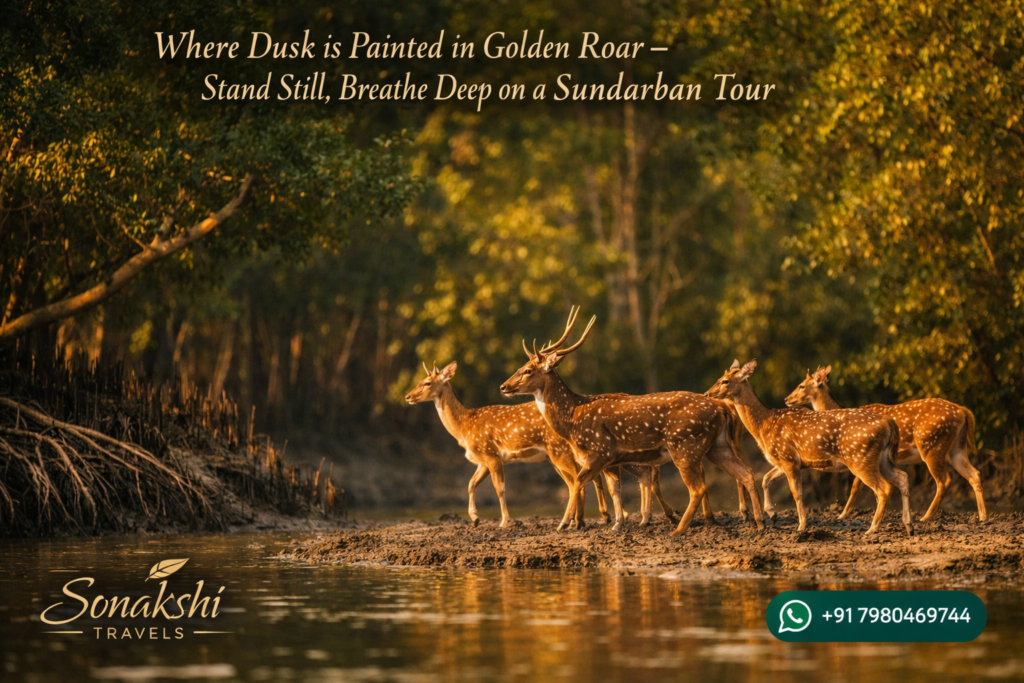
There are landscapes that ask to be seen quickly. A person looks once, takes a picture, and moves on. The mangrove delta does not work in that manner. Its deeper meaning appears when movement becomes slow and the eye becomes patient. That is why a Sundarban tour often reaches its most powerful moment when the day begins to fade. At that hour, the forest is not becoming less visible. It is becoming more truthful. Light stops behaving like a bright surface and begins to move like a living layer over water, mud, leaves, and roots. What seemed separate in the afternoon starts to join together. The river reflects the sky, the trees darken into shape, and every sound grows sharper because the world is entering a slower state.
In such an hour, a person does not need to do much. The right response is not noise, haste, or constant talking. The right response is to stand still and breathe with care. Dusk in this tidal forest has a strange strength. It is quiet, yet it does not feel weak. It is soft, yet it does not feel empty. It spreads like a golden force over the channels and gives even silence a strong presence. This is why many people remember not only the places they saw, but the feeling that entered them at day’s end. A true Sundarban travel experience is often made from such moments, when the mind becomes calmer and the landscape begins to speak in a language beyond ordinary sightseeing.
Dusk Changes the Meaning of the Land
During the brighter part of the day, the eye often looks for objects. It notices a branch, a bird, a curve of river, a line of roots, or the passing mark of tide on soft mud. But dusk changes this habit. The eye stops chasing separate things and begins to understand relation. One patch of water carries the sky inside it. One shadow on the riverbank explains the height of a tree. One line of golden light on a channel shows how gently the current is moving. In the Sundarban, this change is especially deep because the land itself is not stable in the way city land is stable. It is a living border between earth and water, between growth and erosion, between seen shape and hidden motion.
At dusk, this unstable beauty becomes clear. The forest is not a still wall of green. It is a breathing system. Mangrove roots rise like fingers from the mud, holding soil, slowing water, and helping life continue in a difficult environment. The evening light touches these roots in a way that makes their work visible. The land seems to say that survival here is not simple, yet it is elegant. A thoughtful Sundarban nature tour helps a visitor feel this truth without forcing it into loud explanation. The fading light itself becomes a teacher.
This is one reason the delta leaves a deep mark on memory. Many landscapes impress people with size, height, or dramatic shape. The Sundarban often works through rhythm. It teaches through repeated lines of creek and bank, through slow bends of water, through light that stretches and thins rather than explodes. Dusk gathers these rhythms into one quiet lesson. It tells the visitor that beauty can be patient, and that power does not always arrive with noise.
The Golden Roar of Silence
The title of this feeling may sound like a contradiction. How can dusk roar when it is silent? Yet this is exactly what many people feel in the mangrove world. The silence is not blank. It carries pressure, richness, and depth. It surrounds the body so fully that it feels almost audible. The golden light adds another layer to that experience. It turns the river bright in one place and dark in another. It makes distant foliage glow and near shadows deepen. The result is not calm in a weak sense. It is calm with force inside it. That is why the silence feels like a roar.
Human minds are not used to this kind of fullness. In ordinary life, silence often means lack. It may mean no conversation, no traffic, no device sound, no outside interruption. But in the Sundarban at dusk, silence means presence. It means that the place is active in its own way. Mud holds the memory of the tide. Water carries small ripples that catch the evening light. Birds shift their pattern of movement. Leaves no longer flash in full brightness; they hold light in a softer and deeper manner. The whole landscape becomes inward, and the visitor is invited inward as well.
This is why a serious Sundarban tourism package should never be understood only as movement through a place. Its real value lies in the changing states of attention it creates. At dusk, attention becomes finer. A person begins to notice not only what is there, but how it is there. A branch over water is no longer just a branch. It becomes a gesture. A widening channel is no longer just a route. It becomes a breathing space in the body of the forest. A quiet riverbank is no longer empty. It becomes charged with the weight of life that may be hidden from the eye.
Why the Body Slows Down Here
There is also a physical side to the dusk experience. Human breathing often changes with landscape. In crowded places, the breath can become shallow without a person even noticing it. In spaces of stress, the body prepares for quick reaction. But in a wide tidal setting where the eye can travel far over water and rest on soft lines of forest, the breathing pattern often becomes deeper. This is not only emotion. It is a bodily response to rhythm, openness, and reduced visual pressure.
On a Sundarban tour from Kolkata, this change can feel especially strong because the contrast is so clear. Urban life trains the senses to defend themselves. The mind keeps jumping. The eye keeps scanning. The ear keeps filtering. But dusk in the delta gently lowers that inner guard. The pace of water and the soft decline of light invite a slower mode of being. When a person stands still and breathes deeply in such a place, the act is not symbolic. It is practical. The body is answering the landscape in the most direct way it can.
This slowing is important because it changes how people understand nature. Many visitors arrive expecting to collect sights. Yet the deeper encounter begins when collection stops. Dusk teaches that not every meaningful experience can be counted as an object seen. Sometimes the most valuable part of a Sundarban travel moment is the inward change that happens while almost nothing seems to happen outside. The river continues. The light fades. A call comes from one side of the bank and disappears. The mind, without being ordered to do so, becomes quieter.
The Ecological Meaning of Evening Light
Dusk is not only beautiful. It is revealing. The mangrove forest is one of the most complex ecological zones in the world because it survives where river and sea meet. Salinity, tide, sediment, root structure, plant adaptation, and animal behavior all shape the life of this region. Evening light helps a visitor notice that complexity in visible form. When the light lowers, surfaces become easier to read. One can see how exposed roots rise from unstable mud, how creek edges hold their line, and how plant forms are built not for decorative beauty but for endurance.
The Sundarban is a place where resilience has shape. The trees do not stand here by accident. They stand because they have adapted to a difficult, shifting ground. The channels do not merely divide land. They feed, cut, carry, and remake it. Dusk brings a kind of visual discipline to this truth. The lowering sun takes away excess brightness and reveals structure. What remains is not confusion but pattern. A careful Sundarban eco tourism approach helps the traveler see the forest not as a scenic object but as a system of relationships held together by delicate balance.
That balance can even be felt emotionally. The beauty of dusk in the delta does not come from decoration. It comes from fitness. Everything seems shaped by need, yet the result is beautiful. This is a powerful lesson. It reminds the visitor that elegance in nature often comes from adaptation, not display. The golden hour in the Sundarban is therefore not only a visual pleasure. It is a quiet education in how life persists under pressure.
How Water Holds Memory at Day’s End
Water behaves like a memory surface in the Sundarban. It receives light, movement, shadow, and sound, then returns them in softened form. At dusk, this quality becomes stronger. The river no longer shines with the sharp energy of full daylight. Instead, it seems to remember the sun while also preparing for night. Gold spreads over one current, breaks on another, and then settles into grey-blue depth. Such shifts can happen within a few moments, yet they feel unhurried.
Because the delta is built through channels, creeks, and tidal passages, water is never only background. It is the main language of the place. It carries the shape of the land and the feeling of the hour. During a sensitive Sundarban exploration tour, the visitor begins to understand that every reflection is temporary and every current is meaningful. One patch of stillness may sit beside a narrow line of motion. One open stretch may suddenly narrow into a more intimate channel. Dusk makes these differences emotionally vivid.
This matters because memory often chooses mood over detail. Long after exact sequences are forgotten, people remember the way the river looked when evening entered it. They remember the feeling that the forest was both near and unreachable, both open and secret. They remember that the water did not merely reflect the sky. It seemed to absorb the whole hour and carry it onward. This is one of the deepest gifts of the mangrove evening. It gives a person something to remember that is larger than a scene and quieter than a story.
The Mind Learns Humility in the Mangrove Twilight
Modern life often encourages the belief that everything must become clear at once. People want instant understanding, fast judgment, and complete explanation. The Sundarban at dusk offers another model. It allows partial seeing. It accepts mystery. It teaches that not all truth arrives in full light. Some truth appears only when edges soften and certainty becomes less proud.
This is one reason the experience feels almost moral in nature. The visitor begins to realize that the forest does not exist to explain itself. It exists in its own order. To stand in that order, even briefly, is to become smaller in a useful way. A thoughtful Sundarban tourism encounter can therefore become an exercise in humility. The land does not flatter human speed or demand for control. It asks for attention, respect, and restraint.
When dusk arrives, this lesson grows stronger. Darkness is approaching, but it is not yet here. Vision remains possible, but it is no longer dominant. A person must rely more on atmosphere, relation, and feeling. This does not make the experience vague. It makes it honest. The world is not fully available, and that fact becomes part of its beauty. Such an hour teaches that wonder is often born not from total possession, but from standing near what cannot be fully possessed.
Bird Calls, Leaf Texture, and the Grammar of Evening
The evening life of the delta also becomes meaningful through small signals. A call from above the creek may sound sharper in fading light. The movement of a bird across the channel may appear more exact against a softer sky. Leaf surfaces that looked uniform earlier begin to show difference in tone and density. Even the darkening line of the mangrove edge becomes expressive. It is no longer only a border. It becomes a sentence written against the last gold of day.
Such details matter because they form the grammar of dusk. The beauty of the hour is not built from one dramatic event. It is built from many precise changes. A serious Sundarban wildlife safari is not only about searching for a single famous animal. It is also about learning how an environment communicates through quieter forms of life and motion. Evening is one of the best times to feel that communication at an emotional level. The forest seems to gather its meanings rather than scatter them.
This makes the Sundarban especially valuable for people who wish to relearn attention. The world today often rewards fast looking and quick reaction. The mangrove twilight rewards steadiness. It asks the eye to rest longer, the ear to listen more gently, and the mind to stop demanding immediate reward. In return, it offers depth rather than spectacle. It offers the rare feeling that a place is becoming more alive as it grows less bright.
Standing Still Is Part of the Journey
Travel is often described through movement. People speak of routes, stops, and changing views. Yet in the Sundarban, one of the most important acts is stillness. To stand still at dusk is not to pause the journey. It is to enter the journey more fully. The body stops moving, but perception starts moving in a deeper way. Smell becomes clearer. Sound becomes layered. Light becomes textured. Time itself seems to change shape.
This is why a well-imagined Sundarban tour package should leave room for the experience of quiet absorption. The value of the landscape does not lie only in how much it can show. It also lies in how fully it can be felt. Dusk gives that feeling its strongest form. It teaches that standing still is not laziness and silence is not absence. Both can be forms of understanding.
At such a moment, breathing deeply becomes more than advice. It becomes the natural answer to what the place is doing. The lungs open because the mind is less crowded. The gaze settles because the light itself is settling. The person standing there may not be able to explain why the hour feels so large, yet the body already knows. It has entered a rhythm older and slower than the routines of ordinary life.
Why This Dusk Stays in Memory
People forget many things from travel. They forget exact sequences, formal names, and the order of events. But they often remember the evening feeling of a place if that feeling was true enough. The Sundarban has this power. Its dusk does not depend on grand display. It depends on alignment. Light, water, root, silence, and inward attention meet for a brief time and create an experience that feels complete without feeling closed.
That is why the title feels right: dusk here is painted in a golden roar. The gold is visible, but the roar is inward. It is the force of stillness, the pressure of silence, the depth of an ecological world that does not need to become loud in order to feel immense. A genuine Sundarban travel guide should help a person understand this truth: the most unforgettable part of the delta may not be the moment of greatest action, but the moment when action grows quiet and the whole landscape enters the breath.
To stand still there is to feel that the day is not ending in loss. It is ending in concentration. The forest gathers itself. The river gathers light. The mind gathers calm. And for a brief, serious, beautiful hour, the visitor understands that travel can be more than seeing a place. It can be learning how to receive it. In the Sundarban, dusk teaches that lesson with rare grace. One only has to stop, breathe deep, and let the golden silence do its work.