Sundarban Travel for Peaceful Retreat Seekers – Find silence away from city noise
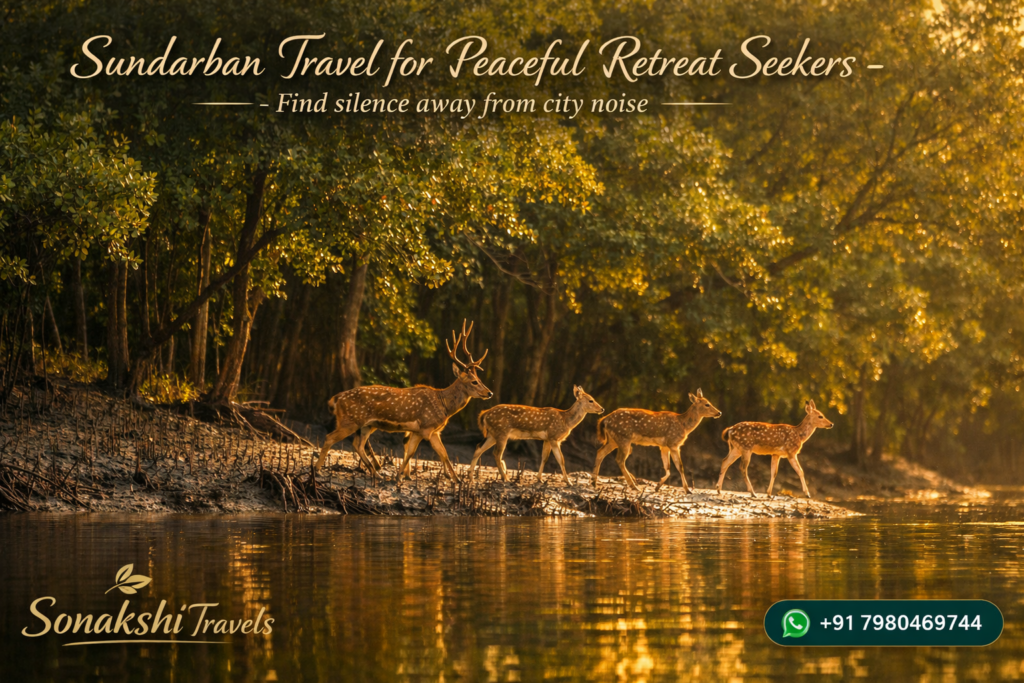
Not every journey begins with excitement. Some begin with exhaustion. A person may not be searching for crowds, movement, or constant activity. Instead, the deeper need may be for distance from pressure, from repeated sound, from screens, from concrete, and from the restless pace that slowly hardens the mind. In that condition, Sundarban travel becomes meaningful in a very specific way. It offers not only a destination, but a rare environment where noise begins to lose its control over thought. For retreat seekers, this matters more than spectacle. Silence is not a small comfort. It is the beginning of recovery.
The idea of a peaceful retreat is often misunderstood. Many places use the language of calm while still surrounding the visitor with background music, crowded common areas, constant traffic, and the pressure to consume experiences quickly. Real quiet is different. It is not decorative. It changes the rhythm of the body. It slows breathing. It lengthens attention. It allows the mind to settle without force. In the delta, this form of quiet is shaped by tidal water, mangrove edges, wide skies, distant bird calls, and long stretches where the human presence becomes smaller than the landscape. That is why the region speaks so strongly to people who are not looking for entertainment, but for inner stillness.
Why silence feels deeper in the delta
Silence in the Sundarban does not feel empty. This is one of its most important qualities. In many urban settings, silence can feel artificial or temporary, as if sound might return at any moment with greater force. Here, quiet has structure. It is built from water movement, shifting light, the slow behavior of mudbanks, the soft contact of wind with leaves, and the measured sounds of life that do not overwhelm the senses. The result is not total absence of sound, but release from mechanical sound. That difference changes the emotional experience of rest.
A peaceful retreat depends on the quality of the surrounding environment. If the eye is constantly interrupted, the mind remains tense. If the ear is constantly occupied, inner thought cannot open properly. The Sundarban reduces interruption. Lines are softer. Distances are wider. Human construction does not dominate every view. The landscape encourages observation rather than reaction. For this reason, a reflective Sundarban tour can feel unusually restorative for people who have been living too long inside alertness, deadlines, and urban repetition.
Research in environmental psychology has repeatedly shown that natural settings with low sensory overload can support mental restoration, reduce stress load, and improve directed attention. What makes the Sundarban particularly distinctive is that this restoration is not produced by manicured calm. It comes from an active natural world that remains quiet without becoming lifeless. The visitor does not feel shut away from reality. Instead, one feels placed inside a larger rhythm that asks less, interrupts less, and restores more.
The retreat value of slow water and open space
One of the deepest sources of calm in the Sundarban is movement that is slow enough to be noticed. Water does not rush toward spectacle. It advances, turns, widens, narrows, and reflects. For retreat seekers, this matters because the mind often imitates its surroundings. In a city, everything teaches speed. In the delta, movement teaches patience. A person begins by watching the surface of the river. After some time, that watching becomes less external. Thought itself begins to soften. The pressure to do something every moment starts to weaken.
Open space also plays an important role in emotional quiet. Urban life compresses perception. Buildings, traffic lines, cables, signs, and constant human proximity reduce the feeling of internal room. In contrast, the broad stretches of river and sky in the Sundarban reopen perception. This widening effect is not merely visual. It creates psychological relief. Problems that felt sharp in the city can begin to lose their edge when seen from within a landscape that does not hurry to answer them.
That is why a retreat-oriented journey here should not be judged only by what is “covered.” Its value lies in what it allows the traveller to stop carrying for a while. The setting supports a gentler form of awareness. It does not demand constant reaction. It allows stillness to become practical. In this sense, the quietest form of Sundarban private tour is often not about exclusivity for its own sake. It is about protecting mental space, preserving silence, and giving rest a real environment in which to deepen.
How the mangrove landscape changes the quality of attention
The mangrove environment asks the eye to become patient. It does not reveal itself through immediate drama alone. Branches bend in unusual ways. Roots rise from mud with sculptural force. Reflections alter the shape of what is seen. Dense green edges hold both stillness and hidden movement. This subtle visual world encourages a quieter type of concentration. Instead of consuming the landscape quickly, the visitor learns to remain with it. Such looking is deeply valuable for retreat seekers because it turns attention away from mental noise and toward grounded perception.
Many people today live inside fractured attention. Messages, notifications, deadlines, and repeated switching between tasks weaken the mind’s ability to stay with one thing fully. In contrast, the delta encourages unbroken looking. One patch of light on water, one line of shadow under a mangrove bank, one distant call across a creek can hold awareness for longer than expected. This is not boredom. It is the rebuilding of concentration through calm observation.
In that process, the journey becomes more than escape. It becomes correction. The visitor begins to experience what attention feels like when it is not scattered. This is one reason the quiet side of Sundarban luxury tour appeals to travellers who value reflection, privacy, and mental clarity. Comfort matters, but the deeper luxury is uninterrupted space in which the senses do not feel attacked.
Silence is not the same as emptiness
For peaceful retreat seekers, one important truth must be understood clearly: the Sundarban is not silent because nothing is there. It is peaceful because life is expressed differently. The sound of a paddle, the distant movement of water against wood, the soft stirring of leaves, the call of birds, and the occasional sound carried from a distant village do not break the quiet in the same way as engines, horns, or crowded commercial environments. These sounds remain proportionate to the place. They do not dominate it.
This proportional sound matters deeply. Human stress often increases when sound arrives without meaning and without rest. Urban noise tends to be repetitive, involuntary, and unavoidable. It occupies the mind even when one wants to withdraw from it. The Sundarban offers another relationship with sound. One listens without feeling invaded. That alone can feel profoundly healing.
A retreat for those who feel overexposed to modern life
Peaceful retreat seekers are often not people avoiding life. They are often people who have had too much exposure to the wrong kind of life: too much traffic, too much demand, too much screen time, too much social performance, too much compressed routine. In such a condition, the body may continue functioning, but the mind remains crowded. Rest then requires more than sleep. It requires environmental relief.
The Sundarban provides this relief by reducing excess. It does not ask the visitor to perform joy. It does not demand constant reaction. It does not fill every hour with stimulation. The retreat value lies in its refusal to overwhelm. This is especially meaningful for travellers who no longer find peace in ordinary holidays. For them, calm must be structural. It must be present in the air, the space, the pace, and the mood of the surroundings.
That is why some people are drawn not merely to a standard journey, but to a quieter, more carefully held Sundarban travel for couples setting, where conversation can become softer and more honest because the environment itself is not noisy. The landscape does not interfere with closeness. It supports it. Words do not need to compete with traffic or distractions. Silence becomes shared, and shared silence often says more than constant talking.
The emotional effect of distance from city noise
City noise does more than irritate the ear. Over time, it trains the body toward alertness. Even when no immediate danger exists, constant sound pressure can keep the nervous system from fully settling. This is one reason many people return from conventional breaks without feeling restored. Their location has changed, but their sensory environment has not changed enough. A true retreat requires a different acoustic condition.
In the Sundarban, the absence of urban layering can create a rare emotional experience: the mind begins to hear itself again. This does not mean dramatic insight will arrive all at once. More often, the change is quiet. Thoughts become less tangled. Inner speech becomes less hurried. One notices simple feelings that were previously buried under routine. Sadness may feel clearer. Gratitude may feel simpler. Fatigue becomes more visible. The retreat succeeds because it creates room for honest inner contact.
This is also why the region can appeal to solo travellers, reflective pairs, and even quiet-minded groups looking for meaningful separation from city life. When shaped thoughtfully, Sundarban travel for family can also support intergenerational calm, especially for families who want less noise and more presence with one another. The important point is not activity volume, but emotional tone. A peaceful retreat works when the environment helps people become more patient, less reactive, and more available to the moment.
Rest through rhythm rather than entertainment
Many destinations try to create satisfaction through accumulation. More things to see, more things to do, more features, more speed, more options. The Sundarban can offer something more valuable to retreat seekers: rhythm. Rhythm is different from activity. It gives shape without pressure. It allows the day to feel held together by natural progression rather than by constant stimulation.
This rhythm comes from repeated contact with water, still horizons, pauses between sounds, gradual changes in light, and the quiet awareness that nature does not perform on command. For a retreat seeker, such rhythm restores trust in slowness. One remembers that meaningful experience does not have to be loud. Attention becomes less hungry. The mind stops chasing novelty every minute.
In this way, the finest Sundarban luxury travel experience is not defined by excess. It is defined by balance. It protects privacy, reduces noise, respects atmosphere, and gives the traveller enough quiet to feel the place fully. The true refinement lies in not disturbing the peace that one came to find.
Why retreat seekers remember the feeling more than the checklist
People who travel for peace rarely return home speaking first about a list of features. They remember a feeling. They remember the way their breathing changed. They remember an evening stretch of river that seemed to absorb mental noise. They remember how conversation became less forced. They remember how sleep felt heavier, how morning felt clearer, how silence stopped feeling strange and began to feel necessary.
This memory pattern is important because it reveals what the journey actually provided. A peaceful retreat is successful when the traveller carries back a changed inner tempo. That is the deeper value of a quiet Sundarban tourism experience shaped around reflection rather than rush. The landscape remains in memory not only as scenery, but as a condition of mind.
The human need for places that do not argue with the senses
Modern life places the senses under constant negotiation. Every day, the eye is pulled by signs, screens, speed, and clutter. The ear is filled by traffic, machines, and layered public sound. The body moves through environments that often value efficiency over calm. In such conditions, people begin to forget what it feels like to exist in a place that does not argue with perception. The Sundarban can restore that memory.
Its quiet power lies in agreement between setting and sensation. What is seen does not fight for attention. What is heard does not demand reaction. What is felt in the air, in the openness, and in the landscape supports rather than disturbs the search for peace. This agreement is rare. It is also why retreat seekers often respond so strongly to places where the environment itself behaves gently.
Even the visual language of the delta contributes to this effect. Water holds light instead of breaking it into hard surfaces. Vegetation creates texture without urban sharpness. Distance softens edges. The result is an atmosphere where the senses can remain awake without becoming overloaded. This is one of the strongest reasons a carefully chosen exclusive Sundarban private tour can feel so restorative for those who need more than a break. They need release from sensory pressure itself.
A landscape that teaches inward quiet
There are some places where peace is merely offered, and there are others where peace is slowly taught. The Sundarban belongs to the second kind. At first, a visitor may still carry city habits into the landscape. The mind may continue to rush, compare, plan, and expect immediate stimulation. But if one remains present, the place begins to reshape that habit. The water does not hurry. The horizon does not hurry. The mangrove line does not hurry. Over time, the mind receives the lesson.
This is the deeper meaning of retreat. It is not only stepping away from noise. It is relearning how to live, even briefly, without answering noise from within. A peaceful journey here can therefore become quietly transformative. It does not transform through drama. It transforms through reduction, through stillness, through repeated contact with a world that continues without urgency.
For those who are tired of crowded escapes and decorative calm, this is the true promise of the delta. Sundarban travel safety for the mind is found not in withdrawal from reality, but in entering a landscape where reality moves at a humanly breathable pace. That is what peaceful retreat seekers are often searching for, even if they do not yet have the words for it.
Conclusion: peace as the real destination
To seek peace is not a lesser form of travel. It is often a wiser one. It means the traveller understands that exhaustion cannot be cured by more stimulation, and that true rest depends on the quality of place. For such travellers, the Sundarban offers uncommon value. Its silence is living silence. Its calm is ecological, spatial, and emotional at once. Its atmosphere supports not display, but inward repair.
That is why this landscape remains so powerful for people who long to step away from city noise without entering an artificial version of calm. The retreat does not have to be explained loudly. It is felt in widening attention, softened thought, quieter speech, and the return of mental room. In the end, the most meaningful form of Sundarban travel guide for beginners for retreat seekers may be very simple: go where the senses are not attacked, where silence has shape, and where peace is not advertised as an idea but experienced as a condition. In the Sundarban, that condition can still be found.