Sundarban luxury tour for deeper journeys – Beyond sightseeing, into feeling
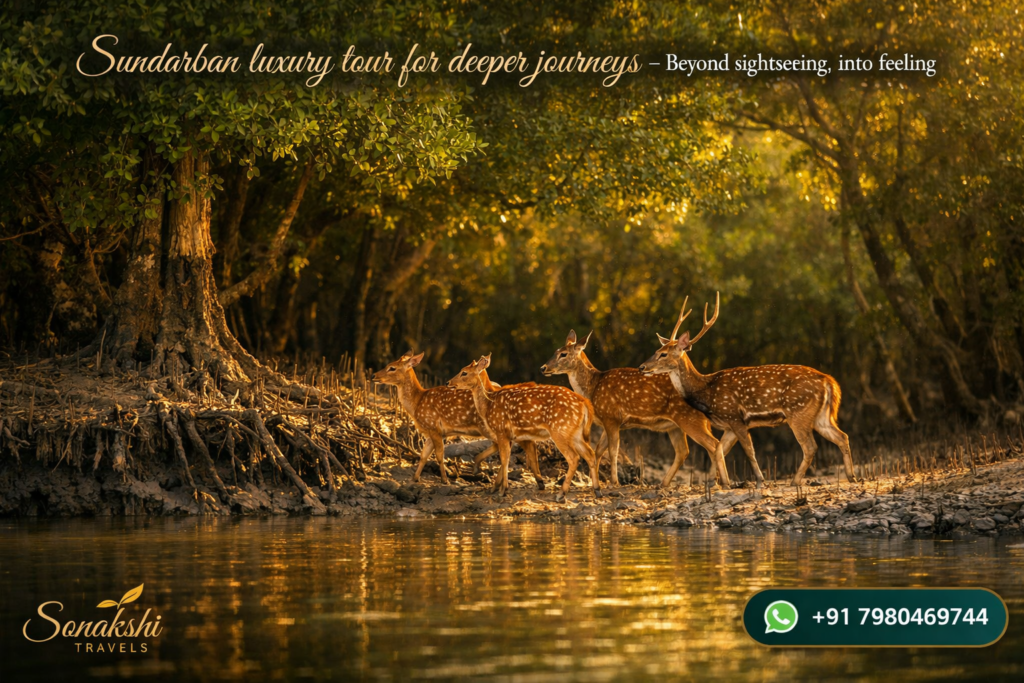
Not every journey is remembered because of how much it shows. Some journeys remain in the mind because of how deeply they are felt. A Sundarban luxury tour belongs to that second kind of travel. It is not only about looking at a landscape from a distance and collecting moments like items on a list. It is about entering a living environment slowly enough to feel its tone, its restraint, its movement, and its emotional weight. In the mangrove world, sight is only one part of experience. Sound, silence, air, reflection, rhythm, and waiting all become equally important.
That is why a deeper journey through the delta feels very different from ordinary travel. The place does not immediately reveal everything. It asks the visitor to become attentive. Water does not behave like a fixed road. Light does not remain stable for long. The edges between river and forest are always shifting. A traveler who comes only to see may notice beauty. A traveler who stays mentally open begins to sense something larger. The landscape starts affecting mood, pace, and thought itself. In that sense, a Sundarban travel experience can become inward as much as outward.
Why deeper journeys matter in the mangrove delta
Many famous destinations give meaning through immediate visual drama. Mountains rise at once. Monuments stand clearly before the eye. Urban places explain themselves through movement, architecture, and noise. The Sundarban behaves differently. Its power lies in gradual recognition. At first, the visitor may notice broad tidal water, muddy banks, and low green lines of forest. But as time passes, the eye becomes more sensitive. Differences in texture begin to appear. Patterns in roots, leaves, currents, and shadows become more visible. The mind adjusts to a subtler vocabulary.
This is one reason why a Sundarban luxury tour package can support a more meaningful encounter with the environment. Comfort, when handled properly, does not weaken the wild character of the place. Instead, it creates the mental space needed for careful observation. When the body is at ease, the mind becomes more receptive. The traveler is less distracted by discomfort and more capable of noticing changes in water tone, bird movement, distant calls, and the silence that often arrives between visible events.
A deeper journey is therefore not about adding spectacle. It is about subtracting hurry. In landscapes like this, depth comes from patience. The forest is not a stage built for constant performance. It is a living ecological system shaped by tide, salinity, sediment, and adaptation. To feel it properly, the traveler must accept a slower relationship with place. That acceptance often changes the emotional quality of the entire journey.
The emotional architecture of silence
Silence in the Sundarban is never empty. It has layers. It may contain the low pressure of humid air, the faint brushing sound of leaves, the quiet slap of water against wood, or the distant call of a bird carried across open river space. What feels silent at first gradually reveals itself as delicately inhabited. This is one of the most important reasons why the region affects people so strongly. The mind, used to louder environments, begins to reset.
On a deeper journey, silence becomes an active force. It slows thought. It reduces inner noise. It also sharpens perception. Research in environmental psychology has long suggested that lower-noise natural settings can improve attention recovery and emotional steadiness. In the Sundarban, that effect is not abstract. It is felt directly in the body. Breathing becomes quieter. Observation becomes less aggressive. People stop trying to control every moment and begin to receive experience more openly.
This makes a refined Sundarban luxury travel experience more than a comfortable outing. It becomes a setting for heightened awareness. The traveler may begin to feel that the place is not demanding admiration in obvious ways. Instead, it creates a condition in which inner restlessness starts dissolving. That shift is important. Once the urge to constantly seek the next image becomes weaker, the landscape starts entering more deeply into memory.
Water as movement, memory, and meaning
In the Sundarban, water is not background. It is the central medium through which the landscape thinks, moves, and speaks. Rivers, creeks, inlets, and tidal channels do not simply surround the forest. They shape it. The mangrove ecosystem depends on repeated cycles of immersion and exposure. Saline flows, mud deposition, and tidal pressure influence plant growth, animal movement, and the appearance of the entire terrain. To travel here is to move through a world written by water.
This is why the emotional experience of the place is also fluid. There is no hard separation between stillness and motion. Even when the surface looks calm, the tide is changing conditions underneath. The traveler senses this instability, though often without using scientific terms for it. A deeper journey means allowing that constant change to influence one’s perception. The river does not behave like a simple route from one point to another. It behaves like a living process.
Such movement gives special meaning to a luxury Sundarban river cruise. The word luxury, in its strongest sense, should not mean distance from nature. It should mean the ability to witness nature without agitation, interruption, or crude speed. In the Sundarban, gentle passage through tidal space allows the mind to register changing reflections, widening bends, narrowing channels, and the way mangrove edges appear and disappear. These are not minor details. They are the structure of the feeling itself.
Seeing less, feeling more
One of the most unusual qualities of the Sundarban is that it often produces strong emotion through partial visibility. Many places reward the visitor with grand, complete views. Here, concealment is part of truth. Forest lines break and close. Mudbanks interrupt perspective. Channels curve before the eye can fully understand what lies ahead. Even wildlife presence is often sensed through signs, traces, silence, alertness, or atmosphere rather than through continuous visual access.
This limited visibility deepens feeling because it keeps the imagination involved. The visitor learns to value suggestion, not only display. A branch moving in still air, a sudden flock response, a changed tone in the waterline, or an unexpected hush in bird activity can alter the mood of the journey. The place trains attention toward indirect meaning. In such a setting, a luxury Sundarban safari becomes psychologically richer than a simple exercise in seeing as much as possible.
The deeper traveler begins to understand that not all meaningful encounters are visual. Sometimes the strongest impression comes from tension, waiting, or awareness. The landscape teaches restraint. It also teaches humility. Human beings are not in command of revelation here. The forest gives only what it gives. That balance between presence and withholding is one of the reasons the Sundarban feels profound rather than merely attractive.
The ecology behind the feeling
The emotional power of the Sundarban is not separate from ecology. It grows out of ecological reality. Mangroves are among the most specialized plant communities in the world. They survive where many other trees cannot, in saline and shifting conditions that demand adaptation. Aerial roots, salt management strategies, sediment-trapping structures, and tidal tolerance all contribute to a landscape that looks unusual because it is biologically unusual. The forest’s strangeness is real, not decorative.
When travelers speak about feeling mystery in the Sundarban, part of that feeling comes from this ecological distinctiveness. The trees do not stand like inland forests. The ground is not firm in a familiar way. The boundary between land and water is often unstable. The air carries moisture and fine organic scent. Even stillness feels shaped by tidal life. A thoughtful luxury mangrove forest tour becomes deeper when the traveler understands that beauty here is built from survival, adaptation, and interdependence.
The region is also ecologically important on a global level because mangrove systems support biodiversity, protect coastlines, and store significant amounts of carbon in their soils and biomass. Yet these facts matter not only scientifically. They also matter emotionally. When one realizes that the calm view before the eye is part of an intricate protective system, the landscape gains moral seriousness. The journey becomes not just pleasurable but respectful.
Atmosphere and the psychology of immersion
Some landscapes remain outside the traveler. They are observed, admired, photographed, and left behind. The Sundarban often creates a different relationship. Its atmosphere enters the body. Humidity touches the skin. The filtered light changes the mood of the eyes. The broad sky over water alters a person’s sense of scale. The smell of river and mud creates memory in a direct, almost physical way. This is immersion in the fullest sense.
Because of this, a deeper journey cannot be reduced to sightseeing language. It is closer to atmosphere than to inventory. The traveler remembers not only what was seen but how the place felt while being there. This is where the value of a carefully shaped Sundarban premium tour package can be understood in an editorial sense. True refinement lies in preserving continuity of feeling. It allows the traveler to remain inside the mood of the landscape rather than being repeatedly pushed out of it by noise, disorder, or unnecessary interruption.
Immersion also changes time perception. Many travelers report that time in tidal landscapes feels slower but fuller. This happens because the mind is not being forced through constant artificial stimulation. Instead, it begins to measure duration by light, current, silence, and subtle activity. A short stretch of quiet movement on water can feel more memorable than a crowded day filled with rapid transitions. The Sundarban teaches depth through duration.
Beyond observation toward relationship
To go deeper in the Sundarban is to move from observation toward relationship. Observation keeps the landscape outside oneself. Relationship allows mutual influence. The traveler does not change the forest, but the forest changes the traveler’s mood, breathing, thoughts, and level of attention. That shift may sound philosophical, yet it is grounded in ordinary experience. People become quieter. Their speech becomes slower. They look longer before commenting. They begin to respect pauses.
This is why a Sundarban private tour or a more refined private luxury journey can feel especially intimate. Privacy, when used well, protects the continuity of perception. It gives room for quiet looking, private reflection, and undistracted listening. In a place where feeling is built through nuance, that kind of space matters. The traveler is not separated from the environment by luxury. The traveler is allowed to meet it more honestly.
Relationship also means accepting that the place has its own order. The forest is not there to satisfy every expectation. Tidal geography, wildlife behavior, and shifting light all operate according to ecological logic, not tourist desire. A deeper journey respects that fact. Instead of treating unpredictability as a failure, it recognizes uncertainty as part of the truth of the place. That recognition often leads to a more mature form of wonder.
Why memory of the journey lasts
Experiences remain in memory for different reasons. Some remain because they were loud or dramatic. Others remain because they entered emotional life more quietly and more deeply. The Sundarban often belongs to the second category. The traveler may return home and discover that what remains most strongly is not a single scene but a pattern of feeling: still water under changing light, shadow along a mangrove edge, the slow turning of the river, the hush before sound returns.
This kind of memory lasts because it is not superficial. It has been formed through atmosphere, repetition, and inward response. A meaningful Sundarban luxury eco tour therefore continues after the physical journey ends. It lingers in the mind as a change in emotional rhythm. One remembers how different thought felt in that setting. One remembers that beauty did not arrive through excess. It arrived through attentiveness.
The deepest journeys often leave behind a new measure for future travel. After such an experience, noise can feel thinner, rush can feel less necessary, and spectacle can feel less satisfying on its own. The traveler begins to understand that value in travel is not always created by abundance of sights. Sometimes value is created by intensity of perception. The Sundarban, precisely because it is subtle, can teach that lesson with unusual force.
The meaning of luxury in a place like this
Luxury in the Sundarban should be understood carefully. It is not best defined by display. It is best defined by depth of encounter. In a mangrove landscape, true refinement means preserving peace, supporting attention, and allowing the traveler to feel protected without losing closeness to the living environment. That is why the finest form of a Sundarban luxury private tour is one in which comfort serves perception rather than replacing it.
Such travel does not push the visitor away from mud, tide, silence, and uncertainty. Instead, it creates a calm framework within which those realities can be felt more fully. The result is not a softer version of the Sundarban, but a more legible one. The mind becomes free to notice emotional detail. The journey becomes less about consumption and more about presence.
That is why the phrase “beyond sightseeing, into feeling” expresses something precise. In the Sundarban, deeper journeys are possible because the landscape itself is layered, tidal, restrained, and psychologically powerful. To move through it with patience is to discover that travel can be more than movement across geography. It can become a change in awareness. And that, finally, is the lasting gift of a true Sundarban luxury tour: not merely that it shows a remarkable place, but that it teaches the traveler how to feel a place more deeply.