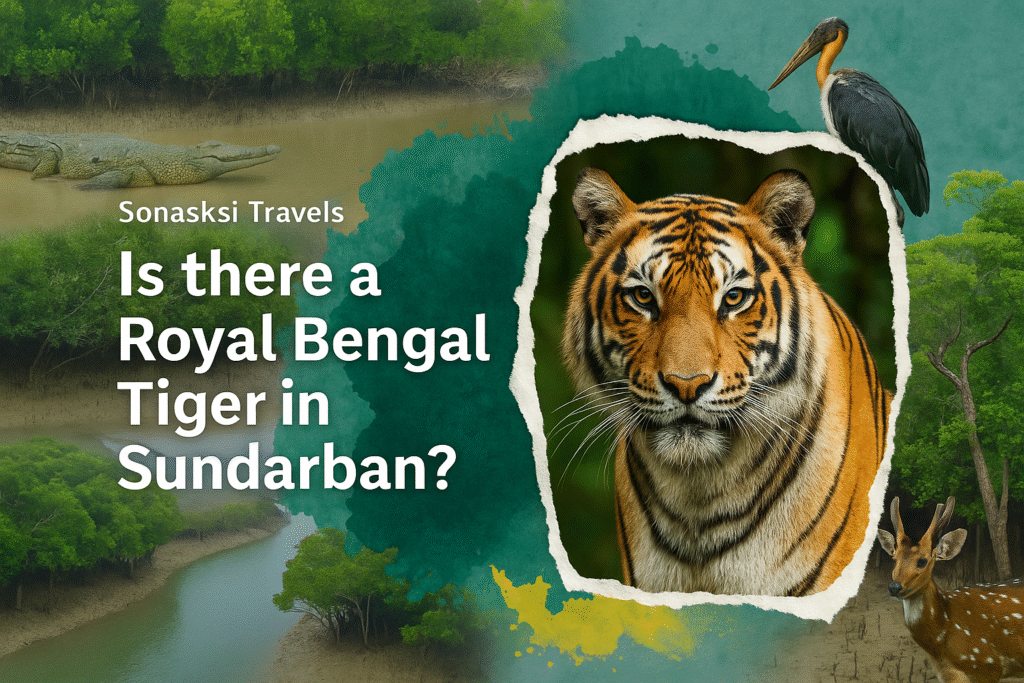
The Tiger as a Living Pulse of the Sundarbans
Yes, the Royal Bengal Tiger exists in the Sundarbans, but existence here is not a census number or a photograph pinned to a wall; it is a living rhythm that moves with tides and moon cycles. The Sundarbans tiger is not merely a subspecies roaming a map-marked reserve; it is an adaptation sculpted by centuries of brackish water, shifting islands, and human reverence mixed with fear. Each stride it takes presses history into mud.
Scientific studies conducted across Indian and Bangladeshi portions of the delta confirm the presence of a stable yet elusive population, uniquely adapted to a mangrove ecosystem unlike any other tiger habitat on Earth. Unlike forest tigers of central India, Sundarbans tigers swim across wide rivers, drink saline water when necessary, and patrol territories that vanish and reappear with erosion. Their presence transforms a Sundarban Tour into something deeper than travel—it becomes an encounter with evolutionary resilience.
Mangrove Adaptation: The Science Behind the Myth
Research from wildlife institutes reveals that Sundarbans tigers have slightly leaner bodies, longer limbs, and extraordinary swimming endurance, adaptations essential for survival in tidal forests. Their prey patterns are dictated not by grasslands but by deer trails etched into mudflats and riverbanks. This ecological specialization explains why sightings are rare yet signs are abundant, making every Sundarban Travel experience charged with anticipation rather than spectacle.
The tiger’s invisibility is not absence; it is mastery. Camera traps often capture fleeting stripes dissolving into darkness, proving that the forest does not reveal its crown easily. In Sundarbans, the tiger chooses when to be known.
The Sundarbans: Where Geography Shapes Destiny
Spanning over 10,000 square kilometers across India and Bangladesh, the Sundarbans is the world’s largest mangrove delta, a geography written by the Ganges, Brahmaputra, and Meghna rivers. Here, land is temporary, but survival is permanent. The Royal Bengal Tiger thrives not despite this instability but because of it, evolving alongside a landscape that refuses to stand still.
Satellite tracking and genetic studies indicate that Sundarbans tigers form one of the most distinct tiger populations globally, isolated yet enduring. This scientific reality elevates the region from a travel destination to a conservation epicenter, where every Sundarban Tour Package becomes a silent witness to coexistence between predator, prey, and people.
Human–Tiger Interface: A Fragile Equilibrium
Villages here do not expand toward the forest; they lean away from it, acknowledging an ancient boundary. The tiger is not romanticized as a symbol alone but respected as a force that governs behavior, rituals, and livelihood patterns. Studies on human–tiger conflict show that community awareness and regulated tourism have significantly reduced negative encounters, proving that reverence can coexist with research-backed management.
To step into this land on a Sundarban Private Tour is to enter a living negotiation between survival and sanctity, where the tiger is both guardian and judge.
Royal Bengal Tiger: Not a Legend, but a Scientific Certainty
The tiger of the Sundarbans is documented through rigorous methods—camera traps, pugmark analysis, DNA sampling from scat, and satellite telemetry. According to conservation assessments, the Indian Sundarbans alone hosts dozens of adult tigers, while the transboundary population strengthens genetic diversity. This is not folklore; it is peer-reviewed reality.
The species, Panthera tigris tigris, is listed and described in detail in global biodiversity records, including its unique mangrove-adapted population, as documented by Wikipedia. Yet numbers alone fail to express the gravity of their presence, for each tiger represents centuries of ecological balance holding firm against climate pressure.
Why Sightings Are Rare—and Why That Matters
Tourists often ask why they may not see a tiger during their visit, but this question misunderstands the Sundarbans. The forest’s success lies in concealment. A tiger that remains unseen is a tiger that remains alive, territorial, and undisturbed. Conservation science confirms that low visibility correlates with healthier predator populations, making patience a mark of responsible travel.
Thus, a well-designed Sundarban Tour Package emphasizes ecosystem interpretation rather than guaranteed sightings, aligning tourism with ecological ethics.
Climate Change and the Tiger’s Future
Rising sea levels and increased salinity threaten mangrove composition, indirectly affecting tiger prey density. Yet adaptive management, mangrove regeneration projects, and cross-border conservation initiatives are actively mitigating these risks. The tiger’s continued presence is not accidental; it is defended daily by science, policy, and local guardianship.
When travelers choose informed Sundarban Travel experiences, they become contributors to this resilience, funding protection efforts through regulated eco-tourism.
The Role of Responsible Tourism
Responsible tourism does not chase the tiger; it honors its space. Boats follow designated channels, noise is regulated, and human curiosity yields to ecological humility. Research shows that such discipline reduces stress indicators in wildlife, ensuring that the tiger’s reign remains uninterrupted.
A thoughtfully curated Sundarban Tour thus becomes a partnership with conservation, not an intrusion into it.
Conclusion: The Tiger Still Walks the Tides
So, is there a Royal Bengal Tiger in the Sundarban? Yes—resolutely, scientifically, and spiritually. It walks where rivers breathe, where mangroves kneel to tides, and where humanity has learned that dominance is less powerful than respect. The tiger does not announce itself, yet its presence shapes every ripple and rustle.
To visit the Sundarbans is not to seek a sighting but to acknowledge a sovereign existence that continues, unseen yet undeniable. The Royal Bengal Tiger remains the soul of the delta, alive in shadow, ruling without spectacle, enduring beyond the noise of the world.