Updated: March 24, 2026
How Does a Sundarban Luxury Tour Enhance Wildlife Experiences?
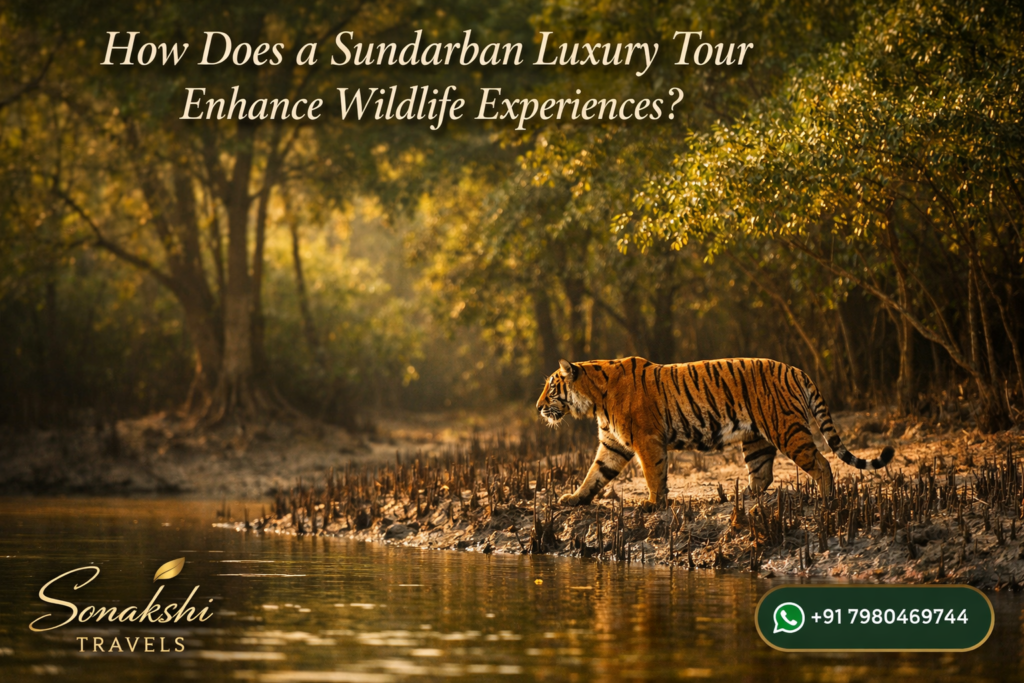
Wildlife observation is never shaped by sight alone. It is shaped by time, silence, distance, physical comfort, emotional steadiness, and the quality of attention a traveler is able to give to the landscape. This is especially true in the tidal forest. The Sundarbans does not reveal itself through constant spectacle. It reveals itself through intervals, pauses, sounds carried across water, small signs on muddy banks, changing bird movement, and the slow appearance of life at the edge of mangrove shadow. That is why the structure of the journey matters so deeply. A carefully designed Sundarban luxury tour can significantly deepen the way wildlife is experienced, not because it turns nature into something artificial, but because it allows the human observer to become calmer, more patient, and more receptive.
In a demanding ecological environment, discomfort narrows attention. Noise breaks concentration. Crowding fragments observation. Fatigue reduces emotional sensitivity. By contrast, privacy, thoughtful boat design, better spatial control, smoother movement, and a more composed travel rhythm help the visitor remain observant for longer periods. In practical terms, this means that a refined wildlife journey is not merely about comfort in the ordinary sense. It is about creating the right human conditions for noticing what the forest is actually expressing. The value of a premium wildlife journey lies in this shift. It improves not only how travelers move through the landscape, but how they see, hear, interpret, and remember it.
For that reason, the finest wildlife encounters in a Sundarban luxury private tour are often linked to atmosphere rather than drama. A distant deer pausing near the tree line, a kingfisher cutting across reflected light, a crocodile resting almost invisibly against the shore, or a sudden silence in the birdsong can become profoundly meaningful when the traveler is not rushed, distracted, or physically strained. Luxury, in this context, is not excess. It is the removal of friction between the traveler and the wild world.
Why Wildlife Perception Depends on the Quality of the Journey
Wildlife does not appear on command. In mangrove environments, this truth becomes even more important. The forest is dense, water routes are fluid, animal behavior is cautious, and many signs are subtle rather than obvious. As a result, a person’s experience of wildlife depends greatly on their ability to remain mentally open and physically comfortable over long stretches of observation. A refined Sundarban tour supports this process by reducing the ordinary stresses that quietly weaken attention.
When seating is more comfortable, movement is less chaotic, and personal space is respected, the body relaxes. When the body relaxes, the mind becomes more patient. When the mind becomes patient, ecological details begin to emerge. The traveler notices ripples that do not match the current, bird calls that repeat from one side of the channel, mud impressions that suggest recent movement, and sudden stillness in a section of bank where a predator may have passed earlier. These are not dramatic luxuries. They are interpretive advantages. They allow the visitor to participate more fully in the real pace of the habitat.
This is one reason a high-quality Sundarban private tour can transform wildlife viewing from a simple outing into a deeper environmental experience. Privacy reduces unnecessary conversation. It removes the repeated interruptions that come from different expectations within a large mixed group. It creates a setting where the guide’s observations can be heard clearly, where silence can be maintained when needed, and where the traveler can remain immersed in a single moment without social disturbance.
Silence as a Wildlife Advantage
In the Sundarbans, silence is not empty. It is full of information. A serious wildlife experience depends on hearing as much as seeing. The slap of water against roots, the restless call of birds, the warning note of a monkey, the break in background sound, and the low movement of the boat through tidal channels all contribute to environmental reading. A well-managed Sundarban luxury tour package often protects this sensory field far better than a crowded or loosely controlled journey.
Noise is one of the least appreciated barriers to wildlife perception. Even when animals do not immediately flee, noise alters the emotional quality of the encounter. It turns the forest into a backdrop rather than a living system. It weakens the listener’s ability to notice pattern and interruption. In a quieter setting, however, even small changes become legible. Travelers begin to recognize that the forest communicates through subtle shifts. They learn that quiet is not passive. Quiet is a method of seeing.
This is especially important in a Sundarban luxury wildlife safari, where the purpose is not only to travel through protected waters but to become sensitively aware of how wildlife occupies those waters. The most rewarding moments may arrive without announcement. A reptile may appear as texture before it becomes shape. A bird may first be known by its call and only later by its flight. An elusive mammal may never fully present itself, but traces of its presence may still create a powerful sense of encounter. Luxury strengthens this form of engagement by creating the acoustic and emotional stillness necessary for careful observation.
The Role of Space and Privacy in Wildlife Attention
Wildlife encounters are shaped by where the observer stands, how freely they can turn, whether they can remain in one place without pressure, and whether their attention is continuously pulled by the movement of others. Personal space matters. On a thoughtfully arranged luxury Sundarban cruise, travelers are more likely to have clear visual lines, easier access to shifting viewpoints, and enough room to pause without being pushed into hurried reactions.
That physical ease has direct psychological value. Instead of competing for position, the observer can settle into the environment. Instead of rushing to identify everything, the observer can stay with one scene and watch it develop. This slower visual discipline often leads to a more truthful wildlife experience. The forest ceases to be a checklist and becomes a field of relationships: tide and root, bird and branch, mud and movement, silence and alertness.
An exclusive Sundarban private tour further enhances this condition because the journey can be adjusted around the mood of observation rather than the needs of a larger group. If a stretch of river is unusually active with bird movement, the attention of the journey can remain there. If a bend in the water creates a powerful atmosphere of expectancy, the group does not have to move on for the sake of a preset social rhythm. This flexibility does not guarantee sightings. What it does guarantee is a greater respect for natural tempo, which is often the foundation of meaningful wildlife encounters.
How Comfort Strengthens Patience
Patience is one of the most important qualities in wildlife observation, yet patience is not simply a personal virtue. It is often supported by environment. Heat, stiffness, fatigue, hunger, physical strain, and repeated distraction reduce patience quickly. Once patience weakens, the observer begins to seek instant reward, and the forest may start to feel uneventful. A carefully designed Sundarban luxury travel experience addresses this problem in a very practical way. By offering greater physical ease, it lengthens the traveler’s capacity to remain attentive without frustration.
That extended patience changes the character of the journey. The traveler stops asking, “What will appear next?” and starts asking, “What is the landscape already telling me?” This is a major shift. It allows wildlife experiences to become more layered and mature. The visitor begins to appreciate not only visible animals, but also behavioral signs, habitat structure, feeding patterns, territorial tension, and the relationship between water level and biological activity. These are the kinds of observations that often remain invisible in less composed travel settings.
In this sense, a refined luxury Sundarban safari is not about softening the wild. It is about preparing the traveler to receive the wild with more steadiness. True wildlife appreciation requires stamina of attention. Good design protects that stamina.
Seeing More Than the Obvious Animal
One of the greatest benefits of premium wildlife travel is that it helps visitors move beyond the narrow idea that wildlife means only a rare or famous sighting. In the Sundarbans, ecological richness lives in patterns of coexistence. Crabs in wet sediment, raptors circling above open water, mudskippers at the margin, smaller birds using low branches, and mammals leaving signs rather than full appearances all belong to the wildlife experience. A more composed and observant journey widens the meaning of what is worth noticing.
This broader form of perception is often supported by guide interaction as well. In a quieter and more intimate setting, ecological explanation becomes easier to follow. Instead of hearing fragmented information, travelers can absorb connections: why certain birds choose particular edges of habitat, how tidal movement affects feeding behavior, why stillness in one zone may signal alertness in another, and how the forest’s structure protects both concealment and survival. Such interpretation can make a Sundarban private wildlife safari feel intellectually richer and emotionally more satisfying.
The result is a wildlife memory that is not dependent on one dramatic image. It becomes a complete sensory understanding of place. The traveler remembers the tonal quality of the river, the density of the green, the smell of tidal earth, the strange tension of calm water, and the way even small life forms seemed fully adapted to a difficult and shifting environment. That kind of memory is far more durable than simple excitement.
Emotional Readiness and the Experience of the Wild
Wildlife encounters are never only visual events. They are also emotional events. People bring expectation, anxiety, curiosity, wonder, and even disappointment into natural spaces. If the journey is uncomfortable or socially chaotic, those emotions become harder to manage. But when the travel environment is calm, dignified, and spacious, the observer becomes emotionally steadier. This steadiness matters because it allows wonder to emerge without pressure.
A thoughtful Sundarban premium wildlife tour creates a feeling of trust. The traveler feels held within an organized and respectful setting. Once this sense of trust is established, the mind opens more naturally to uncertainty. That is vital in a place where much of the beauty lies in not knowing exactly what will happen next. Emotional security allows ecological uncertainty to feel exciting rather than irritating. In this way, luxury does not compete with wilderness. It gives the traveler the inner balance needed to meet wilderness honestly.
This is especially valuable for those who are sensitive to atmosphere. Many people discover that the most powerful part of a wildlife journey is not the moment of spotting an animal but the charged stillness before it, the hush after it, or the feeling of moving through a place where life is hidden but palpably present. Those atmospheric states are easier to feel deeply in a carefully managed luxury Sundarban river cruise than in a noisy and hurried travel setting.
The Importance of Interpretive Guidance in a Premium Setting
Wildlife becomes more meaningful when it is interpreted well. The mangrove landscape is highly specialized, and much of its significance can be missed without context. A branch, a mark, a movement in water, or a silence among birds may seem ordinary to an inexperienced observer, yet these details often carry ecological meaning. In a better structured journey, explanation is not lost in crowd noise or divided attention. It becomes part of the experience itself.
That is one of the strongest advantages of a refined Sundarban travel experience. Travelers are able to hear and absorb the guide’s insights with greater clarity. They can ask better questions. They can remain with a developing scene long enough to connect explanation to observation. Instead of being told facts in isolation, they encounter those facts inside the living environment. This gives depth to the journey and strengthens memory.
Guided interpretation also helps travelers avoid one of the common limitations of wildlife tourism: the tendency to judge a place only by major sightings. A more informed visitor begins to understand habitat behavior, not just animal appearance. They start to see why caution, concealment, and rhythm are central to survival in mangrove ecosystems. Such understanding often leads to greater respect. And respect is one of the most important outcomes of a serious wildlife journey.
Why Luxury Deepens Visual and Sensory Memory
Not all travel experiences remain equally vivid in memory. The ones that stay longest are usually those in which outer conditions and inner attention were well aligned. In wildlife travel, this alignment is essential. When the visitor feels rushed, uncomfortable, or overstimulated, memory becomes fragmented. But when the visitor feels composed and fully present, memory becomes textured and precise.
A finely managed Sundarban nature tour in a premium setting often leaves behind unusually strong sensory memory. Travelers remember the gradation of light over tidal water, the exact posture of a bird before flight, the rough pattern of mangrove roots, the silence that followed a warning call, and the slow widening of awareness as the day deepened. These are not accidental impressions. They arise because the journey allowed attention to remain undisturbed.
That is one reason many travelers later describe a Sundarban travel experience in emotional rather than purely factual terms. They speak of intensity, stillness, intimacy, or presence. These words may sound abstract, but they are grounded in real conditions. When comfort, privacy, and ecological sensitivity are well balanced, the wildlife experience becomes more than observation. It becomes a relationship between human awareness and a living habitat.
Wildlife Experience as Depth, Not Display
The greatest enhancement offered by a premium wildlife journey is not spectacle. It is depth. A truly meaningful encounter with the Sundarbans depends on the ability to remain attentive to complexity. The forest rarely performs for the visitor. It asks the visitor to become quieter, slower, and more observant. A luxury framework, when designed with respect, supports exactly that transformation.
This is why a strong Sundarban luxury eco tour should not be understood as an escape from the rawness of nature. It should be understood as a more disciplined way of entering it. Better space, better silence, better pacing, and better interpretive conditions do not reduce the authenticity of wildlife observation. They often increase it. They allow the traveler to experience not only animals, but also habitat mood, behavioral tension, ecological interdependence, and the profound psychological effect of the mangrove world.
In the end, the answer is clear. A Sundarban luxury tour enhances wildlife experiences by protecting the very conditions that serious observation requires: calm, patience, silence, privacy, interpretive clarity, and emotional readiness. It helps the traveler see more carefully, hear more accurately, feel more deeply, and remember more completely. The result is not simply a more comfortable journey. It is a more perceptive encounter with the living intelligence of the wild.