Updated: March 29, 2026
Are there snakes in Sundarban?
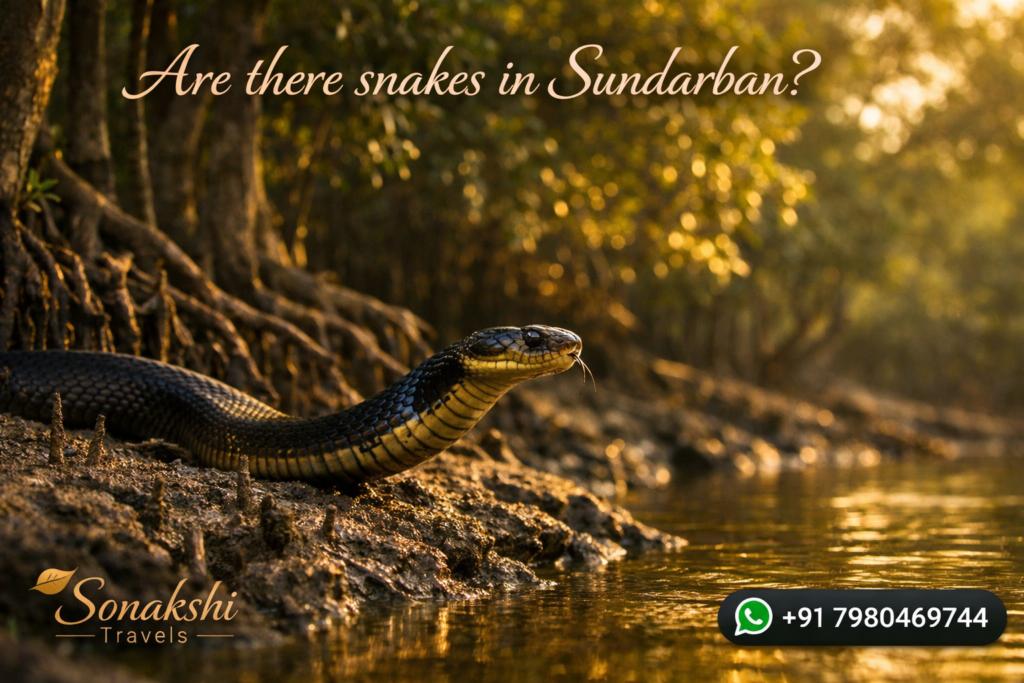
Yes, there are snakes in the Sundarban. This is a true and important part of the forest. The Sundarban is a tidal mangrove region with mud, creeks, roots, wet banks, grass patches, islands, and thick vegetation. A landscape like this naturally supports many forms of reptile life, including snakes. So the right answer is not a dramatic one. It is a calm and factual one. Snakes do live there, but that does not mean a person will constantly see them or that the whole forest is filled with visible danger at every step.
The fear often becomes larger than the reality because the word “snake” creates a strong picture in the mind. Many people imagine that snakes are waiting on every path, every branch, and every boat landing. That picture is not accurate. Snakes are part of the ecosystem, but they are usually hidden, quiet, and defensive. Like most wild animals, they do not spend their time searching for human contact. They remain where food, shelter, shade, and safety exist. In a forest like this, that can mean creek edges, leaf cover, mangrove roots, higher dry patches, old wood, or places where small prey is present.
This question becomes especially common when someone is planning a Sundarban tour or reading a serious Sundarban travel guide. People want to know not only whether snakes exist, but also what their presence really means. That second part matters more. A truthful answer should not create panic, and it should not hide reality either. The forest contains snakes because it is still a living habitat. Their presence is a sign of ecological complexity, not a sign that human movement is impossible.
Why snakes live well in the Sundarban
The Sundarban gives snakes many things they need. It offers water, cover, humidity, prey, and a large number of sheltered spaces. Mangrove forests are not open dry woods. They are layered places. There is mud below, roots above, water beside, and dense plant structure around. This creates many micro-habitats. Some zones stay wetter. Some become drier during low tide. Some hold crabs, fish, frogs, rodents, or birds. Such variation allows different reptiles to survive in different ways.
Snakes are not all the same. Some prefer wetter conditions. Some remain near brackish channels. Some move through bushes and ground litter. Some are more active at certain hours. Some are rarely noticed because their body color blends with mud, bark, leaves, or shadow. In a forest where surfaces are always changing with tide and light, camouflage becomes very effective. That is one reason why people may pass through an area and still never see a snake even when snakes are present in the wider region.
The mangrove system also shapes movement. A snake in such terrain does not move in the same way it would in a dry village field. It adjusts to waterlogged ground, roots, soft banks, and tidal edges. The forest teaches every animal a rhythm. In this sense, snakes in the Sundarban are part of a larger pattern of adaptation. They belong to the grammar of the place.
Are all snakes in Sundarban dangerous?
No, all snakes in the Sundarban are not equally dangerous. This is one of the most important points. People often use the word “snake” as if it means one single risk. In reality, snake species differ greatly. Some are venomous. Some are not. Some are small and shy. Some may stay far from regular human movement. Some are more likely to flee than confront. To speak honestly, the forest may contain venomous snakes, but it is not correct to assume that every snake seen in the region is a direct life threat.
At the same time, it would also be careless to dismiss the issue. A mangrove forest is not a place where people should become casual about reptiles. The correct mental position is balanced respect. One should neither panic nor become careless. The presence of snakes in the Sundarban means the landscape must be read with attention. Where there is thick vegetation, wet embankment, fallen wood, or hidden ground cover, visibility is naturally low. In such places, the risk comes less from attack and more from accidental proximity.
That is why trained local handling of movement matters much more than tourist imagination. Whether a person is on a shared outing or a Sundarban private tour, the wise approach is the same: the forest should be entered with discipline, not with overconfidence.
Why most visitors do not often see snakes
Many first-time visitors expect visible wildlife in every hour of observation. But snakes are masters of concealment. They are often noticed only when surprise happens. In fact, the absence of a sighting does not mean the absence of snakes. It often means the snakes remained undisturbed. This is normal. Wild reptiles usually avoid exposure when they can. Remaining unseen protects them from larger animals and from unwanted disturbance.
Human presence also changes animal behavior. Vibration, sound, engine movement, footsteps, and group activity can make many reptiles withdraw. The Sundarban is a place where silence carries meaning. A branch movement, mud shift, ripple line, or quick retreat under cover can be more common than a full open sighting. Therefore, people sometimes leave the forest saying they saw birds, deer, and water channels, but no snakes. That experience is possible and common. It does not cancel the truth that snakes are part of the region.
In this way, the question “Are there snakes in Sundarban?” should be separated from the question “Will I definitely see one?” The first answer is yes. The second answer is no. Wildlife does not perform on command. It lives by its own need for concealment, feeding, rest, and survival.
Where the idea of danger becomes larger than reality
The Sundarban carries a powerful image in public imagination. People connect it with wildness, uncertainty, and hidden life. That image is not false, but it can become exaggerated. The forest is real, not theatrical. Danger in such a place usually comes from misunderstanding the landscape, not from constant dramatic encounters. With snakes, the human mind often adds fear before observation begins. A root becomes a body. A rope becomes a coil. A shadow becomes movement. This is common in dense natural spaces.
Part of mature travel writing is to reduce false drama. A truthful Sundarban tour package article should not use snakes only to create sensation. It should explain that reptile presence is natural in mangrove ecology. The deeper lesson is not terror. It is ecological humility. The forest is shared by species that lived there long before modern travel narratives began. Humans are temporary visitors in that system.
That understanding changes the emotional tone of the question. Instead of asking only, “Are there snakes?” one begins to ask, “What kind of forest must this be if snakes can live here?” That second question leads to a richer understanding. It points toward habitat health, food webs, shelter, moisture balance, and wild continuity.
Snakes as part of the food web
Snakes play an ecological role. They are not accidental creatures in the forest. They help regulate populations of smaller animals. In many habitats, snakes feed on frogs, fish, rodents, lizards, eggs, or other available prey. That means they participate in balance. Remove reptiles from a wetland system, and the chain of effects can spread outward. The Sundarban is already a highly dynamic environment shaped by tide, salinity, silt, and vegetation stress. In such a place, each living group matters.
To understand snake presence properly, one must stop seeing snakes only through fear. They are also indicators of habitat function. A forest that can support reptiles usually still has layers of life below the visible surface. Mud life, insect life, amphibian life, bird life, and small mammal life all form links. The snake stands somewhere inside that structure. It is both hunter and hunted. It is both hidden and necessary.
This is why serious ecological observation avoids moral language such as “good animal” and “bad animal.” The forest does not work through moral labels. It works through relation, pressure, movement, and adaptation. A snake is not in the Sundarban to threaten the story of human travel. It is in the Sundarban because the habitat allows its life to continue.
How snake presence affects human movement in the forest
Snake presence teaches caution. It does not automatically stop movement, but it changes the quality of movement. In wild terrain, safe behavior is often simple behavior. Controlled steps, attention to the ground, respect for boundaries, and avoidance of careless touching all matter. What causes trouble in many natural areas is not the mere existence of snakes. It is human haste, curiosity without judgment, or a false feeling of control.
That is one reason why an organized forest visit feels different from casual wandering. Whether someone chooses a standard journey or a Sundarban private tour package, the deeper value of guided structure is that it reduces unnecessary exposure to uncertain ground situations. The issue is not luxury or style. The issue is environmental reading. A knowledgeable person sees not only beauty, but also patterns of risk.
Even then, snake awareness should remain calm. The forest should not be reduced to one fear. The Sundarban contains many textures of life, and snake presence is only one part of that reality. When handled with seriousness, it becomes a matter of respect, not panic.
Why mangrove silence makes snake questions stronger
In open landscapes, people rely on distance. They look far and judge what is ahead. In mangrove terrain, distance often disappears. Vision is broken by roots, bends, reeds, bushes, channels, and uneven ground. This changes the mind. When a person cannot see clearly into the next section of land, imagination grows stronger. Silence then becomes active. It fills with possible movement. That is one reason snake questions feel intense in the Sundarban.
The forest does not reveal everything at once. It keeps much of its life behind pattern and shadow. That hidden quality affects the human nervous system. A place becomes more powerful when it cannot be fully read. The Sundarban has that effect. It asks the visitor to accept partial knowledge. Snakes belong naturally to that hidden world. They are among the animals that remind us that the forest is not arranged for complete human certainty.
This is also why the subject often appears in a thoughtful Sundarban tourism discussion. People are not asking only about biology. They are also asking about what kind of mental state the forest creates. The snake becomes a symbol of what remains unseen, quiet, and close to the ground.
Should travelers be afraid?
Fear is not the best response. Awareness is the better response. Fear makes people imagine too much and observe too little. Awareness does the opposite. It keeps the mind steady. A visitor who understands that snakes exist, but also understands that most wildlife avoids unnecessary contact, is in a more truthful position than a person who either panics or dismisses the matter.
The useful question is not whether the forest can be made totally free of risk. No real wild habitat can offer that promise. The useful question is whether the environment can be approached responsibly. In the Sundarban, the answer is yes. Snake presence should be understood as part of the forest’s natural character. It asks for respect, not obsession.
For this reason, the question fits naturally into a serious Sundarban luxury tour or wildlife-focused conversation too. Comfort does not remove ecology. A better boat, a cleaner stay, or a more private arrangement does not erase the truth of the land. The mangrove remains a living habitat. The most responsible form of travel is the one that keeps that fact visible.
The real meaning of the answer
So, are there snakes in Sundarban? Yes. That answer should be accepted plainly. But the larger meaning is this: their presence tells us the forest is still functioning as a complex natural system. It tells us that life exists there not only in the obvious forms that attract cameras, but also in the quieter forms that maintain ecological balance. A mangrove without reptiles would be a diminished mangrove.
To ask about snakes is, in the end, to ask whether the forest is truly wild. The answer again is yes. The Sundarban is not a decorative landscape. It is a working habitat of mud, tide, root, hunger, concealment, stillness, and survival. Snakes belong to that truth. They do not define the whole forest, but they do help reveal what kind of forest it is.
A mature understanding of the Sundarban therefore avoids two mistakes. The first mistake is denial: pretending snakes are not really there. The second mistake is exaggeration: pretending the forest is nothing but danger. Between those two errors lies the honest view. Snakes live in the Sundarban because the ecology supports them. Most remain unseen. Some may be venomous. All deserve distance and respect. Their presence should make human movement more careful, but not irrational.
That is the clearest answer. The Sundarban contains snakes because it is alive in a full ecological sense. To know this is not to fear the forest more. It is to understand it better.