Updated: April 1, 2026
Are Sundarban Luxury Tours Safe for Children?
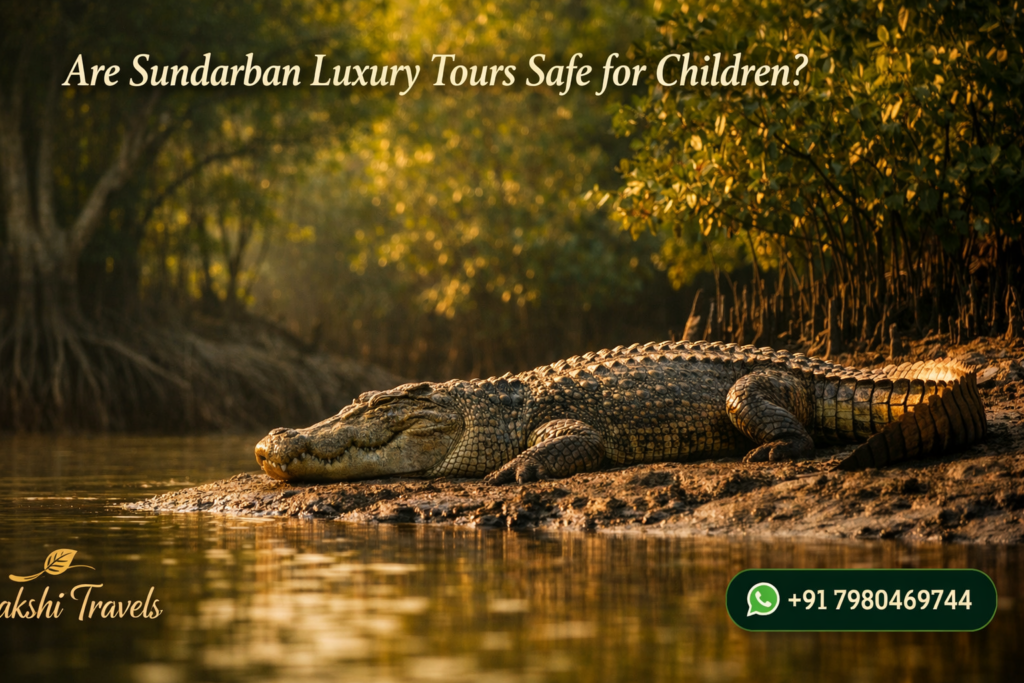
Yes, Sundarban luxury tours can be safe for children, but the answer depends on how the tour is designed, how carefully the family is guided, and how seriously the operator treats safety as a daily practice rather than a selling point. A child does not judge safety in the same way as an adult. An adult may look at a clean room, a good boat, and polite service and feel assured. A child feels safety through smaller signs. The child notices whether movement is calm, whether adults stay attentive, whether food is fresh and easy to eat, whether steps are stable, whether rest comes on time, and whether the environment feels ordered rather than chaotic.
That is why the question is not simply whether a Sundarban luxury tour looks comfortable. The deeper question is whether that comfort is supported by real systems that protect children. In a well-managed journey, luxury is not only soft bedding, cleaner washrooms, or better meals. True luxury, especially for parents, means controlled movement, lower stress, good hygiene, patient staff, safer boarding, and enough personal space for a child to remain calm. When those things are present, the experience can feel secure and deeply rewarding. When they are absent, even an expensive tour can feel tiring and uncertain.
Families often feel safer when the journey has a slower rhythm and fewer unknowns. That is why many parents prefer a Sundarban private tour or a carefully managed luxury format instead of a crowded mixed-group arrangement. The reason is simple. Children respond better when noise is low, supervision is easier, meal timing is flexible, and the family can maintain its own pace. Safety is not only about preventing danger. It is also about preventing exhaustion, confusion, hunger, overexcitement, and careless movement. For children, those are often the real causes of trouble.
Why Families Ask This Question
Parents ask whether the Sundarban is safe for children because it is not a controlled city space. It is a tidal mangrove region where land, water, mud, and movement remain part of one living system. That fact naturally creates concern. The environment feels beautiful, but it also feels serious. Water is always near. Boats are central to the experience. Surfaces may sometimes be damp. Sounds are unfamiliar. The setting asks adults to remain alert. This concern is reasonable, and it should never be dismissed.
Yet this same environment does not automatically make family travel unsafe. In fact, when managed well, the river-based setting can create a more enclosed and supervised experience than many noisy tourist zones. A child on a properly run luxury tour is often within sight of parents, staff, and boat crew for long periods. The movement is slower. The setting is more controlled. The number of people around the child is smaller. In a refined Sundarban luxury tour package, safety often improves because the journey is built around order rather than rush.
Children also benefit from emotional safety. A peaceful environment reduces panic, crankiness, and sensory overload. A child who can sit quietly, eat on time, sleep properly, and move in a clean space is easier to supervise and less likely to act impulsively. This is one reason why quality matters so much in family travel. What looks like comfort on the surface often supports safety underneath.
The Real Meaning of Safety on a Child-Friendly Luxury Tour
Safety has several layers. The first is physical safety. This includes stable boarding areas, life jackets, guarded edges where needed, non-slip walking zones, clean sleeping spaces, safe food preparation, and responsible staff behavior. The second is health safety. This includes drinking water quality, meal cleanliness, restroom hygiene, and the ability to respond quickly if a child feels unwell. The third is behavioral safety. This includes how adults guide children, how staff communicate with families, and whether the tour format encourages discipline without fear.
The fourth layer is environmental safety. The Sundarban is not a place where children should be allowed to run freely in every direction. A well-run tour makes that clear in a calm and respectful way. Good staff explain boundaries without creating fear. They help parents understand which parts of the experience need close supervision and which parts allow relaxed enjoyment. This clear structure is essential. Children feel more secure when rules are simple, consistent, and quietly maintained.
On a good Sundarban tour, family safety does not depend on luck. It depends on preparation, design, and trained habits. That is what separates a serious operator from a casual one.
Why Luxury Format Often Improves Child Safety
Luxury travel in this context can support child safety in very practical ways. Better boats usually have more space, cleaner seating arrangements, and a more orderly flow of movement. Better stays usually offer cleaner rooms, more reliable washrooms, quieter sleeping conditions, and more controlled food service. Better staffing often means people are more attentive, more patient with families, and more used to dealing with special needs such as mild motion discomfort, food preferences, or early rest times.
A private or premium format also reduces crowd pressure. Crowding is not a small issue when children are involved. In tight and noisy spaces, adults lose visual control more easily. Children become restless faster. Meals get delayed. Boarding and getting off become more difficult. Instructions are harder to hear. In contrast, a Sundarban family private tour allows parents to manage the child’s mood, routine, and movement with greater ease. Less crowding means fewer sudden risks.
Luxury also supports cleaner food handling and better rest. These two things matter more than many people realize. A tired or hungry child becomes impulsive, irritable, or weak. A child who sleeps badly and eats badly is less steady on moving surfaces and more likely to resist instructions. So, in a family setting, a premium arrangement is not merely about style. It can directly reduce stress-based risk.
Boat Safety and the Child’s Experience of Water
Because the landscape is river-based, boat safety stands at the center of the question. Children are usually fascinated by the boat. They enjoy the motion, the breeze, the changing light on water, and the constant sense of discovery. But fascination must remain inside clear limits. The safest tours are those where the boat is not treated as a casual platform but as a carefully supervised living space.
Families should expect life jackets in child sizes, clear guidance on where children may sit or stand, and close adult watch during boarding and movement. The best operators do not wait for parents to ask. They make these measures visible and normal. Crew members remain attentive without becoming intrusive. They understand that children may move suddenly, lean toward railings, or become excited when they see birds or ripples in the water. Good crew behavior anticipates this.
On a refined Sundarban private boat tour, the family can often maintain a safer arrangement because the adults control where the child stays, when snacks are served, when rest is needed, and how closely movement is watched. This matters greatly. In shared settings, a parent’s attention is often divided by noise, conversation, and group movement. In a quieter private setting, attention can remain on the child and the environment together.
Boat safety also includes simple design details. Steps should be manageable. Deck surfaces should not feel risky underfoot. Sitting spaces should allow children to remain comfortable without constant shifting. Shade matters too. A child who becomes overheated or uncomfortable may start moving aimlessly. Good tour design prevents this before it begins.
Food, Water, Cleanliness, and Health Safety
For families, health safety is just as important as physical safety. Children are more sensitive than adults to water quality, food freshness, irregular meal timing, and poor hygiene. A luxury tour should therefore be judged by the cleanliness of its unseen systems, not only by visible decoration. A polished room means little if the food handling is careless. Attractive service means little if the drinking water is uncertain.
Parents should feel comfortable because well-run luxury arrangements usually place greater emphasis on filtered or packaged water, cleaner kitchen practice, and fresher meal service. Children often need simpler food, lighter spice levels, and predictable meal timing. An experienced family-oriented team understands this. They do not force the child to adapt to an adult dining pattern. They adapt the service to the child’s comfort.
This is another reason many families prefer a premium or private format over a generic Sundarban tour package. When the environment is more controlled, parents can ask for softer food, quicker serving, cleaner arrangements, and more flexible breaks. These small responses reduce the chance of stomach discomfort, dehydration, or fatigue. In child travel, such details are not secondary. They are central.
Psychological Safety Matters as Much as Physical Safety
Children do not only need protection from accidents. They also need emotional steadiness. The Sundarban is beautiful, but it is also wide, quiet, and unlike everyday life. Some children find this exciting. Others may feel uncertain at first. They may react to silence, darkness after sunset, unfamiliar sounds, or the sight of endless water in different ways. A safe tour gives children time to adjust instead of forcing constant activity.
Luxury, when done properly, creates this space. It allows the child to experience the place without pressure. The child can ask questions, sit beside a parent, eat quietly, watch birds, listen to water, and slowly feel at ease. Safety grows when the child’s mind feels settled. Panic, overstimulation, and exhaustion often lead to unsafe movement. Calmness supports good judgment, even in young children.
In a carefully managed Sundarban luxury private tour, the family atmosphere can remain more gentle and predictable. That predictability helps children behave better. They know where to sit, when to eat, whom to follow, and when to rest. This is one of the less discussed but most important parts of family safety.
When a Tour Becomes Less Safe for Children
It is equally important to state the limits clearly. A tour becomes less safe for children when the operator treats safety as a slogan and not as a discipline. Warning signs include overcrowded boats, unclear supervision, slippery unmanaged spaces, delayed meals, poor communication, and staff who seem impatient with family needs. A family should also be cautious if the setup feels rushed, noisy, or disorganized. In such environments, even small problems grow quickly.
Children are not unsafe simply because they are in the Sundarban. They become less safe when adults fail to create boundaries around them. No child should be treated as self-managing in a river landscape. Parents still carry the first responsibility. A good operator supports that responsibility, but cannot replace it. The safest journeys happen when both sides work together: the family remains alert, and the operator remains prepared.
What Makes a Family-Oriented Luxury Operator More Trustworthy
A trustworthy operator shows care in practical ways. Staff speak clearly and patiently. Safety instructions are simple. Child life jackets are available. Food requests are handled without irritation. Cleanliness is visible not only in guest spaces but in service behavior. The crew appears used to families. The overall rhythm feels stable rather than improvised.
This is where the difference between a generic tour and a well-designed Sundarban private tour package becomes clear. A serious family-focused operator understands that parents do not buy luxury only for comfort. They buy control, cleanliness, responsiveness, and peace of mind. Those elements build trust more than any marketing phrase.
Families may also feel more secure when the operator understands that children need pauses. Safety improves when the team does not turn the journey into a nonstop performance. Children need stillness between moments of interest. They need water, food, shade, and emotional quiet. The best operators recognize this naturally.
Is the Experience Suitable for All Children?
Not every child responds to travel in the same way. Some children are calm observers. Some are highly active. Some adapt quickly to new places. Others need more reassurance. So the question should not only be, “Are these tours safe for children?” It should also be, “Is my child suited to this type of landscape and rhythm?”
A child who can follow simple rules, stay close to adults, and tolerate a slower river environment will often do very well. Such a child may even gain a rare kind of experience from the journey. The child learns patience, silence, careful looking, and respect for nature. But a child who strongly resists boundaries, runs impulsively, or becomes highly distressed in unfamiliar environments may need closer judgment from parents before travel is chosen.
This does not mean the place is unsafe. It means safety always depends on fit between the child, the family, and the quality of the tour design. Even the best Sundarban travel guide cannot change the fact that parental understanding of the child remains essential.
Final Answer
So, are Sundarban luxury tours safe for children? Yes, they can be safe, and in many cases they are safer than people first imagine, especially when the journey is handled by a careful operator and the family chooses a quiet, well-managed format. Safety becomes strong when the tour provides controlled boat movement, child-size protective measures, clean food and water, patient staff, hygienic rest spaces, and enough privacy for parents to supervise without distraction.
The best answer is not based on fear and not based on blind confidence. It is based on quality. A properly managed Sundarban luxury tour can give children a rare experience of calm nature, close family time, and disciplined exploration in a way that feels secure and meaningful. But the safety lies not in the word luxury alone. It lies in the habits behind it: order, cleanliness, patience, trained care, and respect for the child’s pace.
When those things are present, the journey does not feel reckless or difficult. It feels sheltered, thoughtful, and deeply memorable for both children and parents. That is the standard families should look for, and that is what makes the real difference between a beautiful trip and a truly safe one.