Updated: March 28, 2026
A Royal Treat Awaits: Ilish Paturi at Sundarban Hilsa Festival 2026
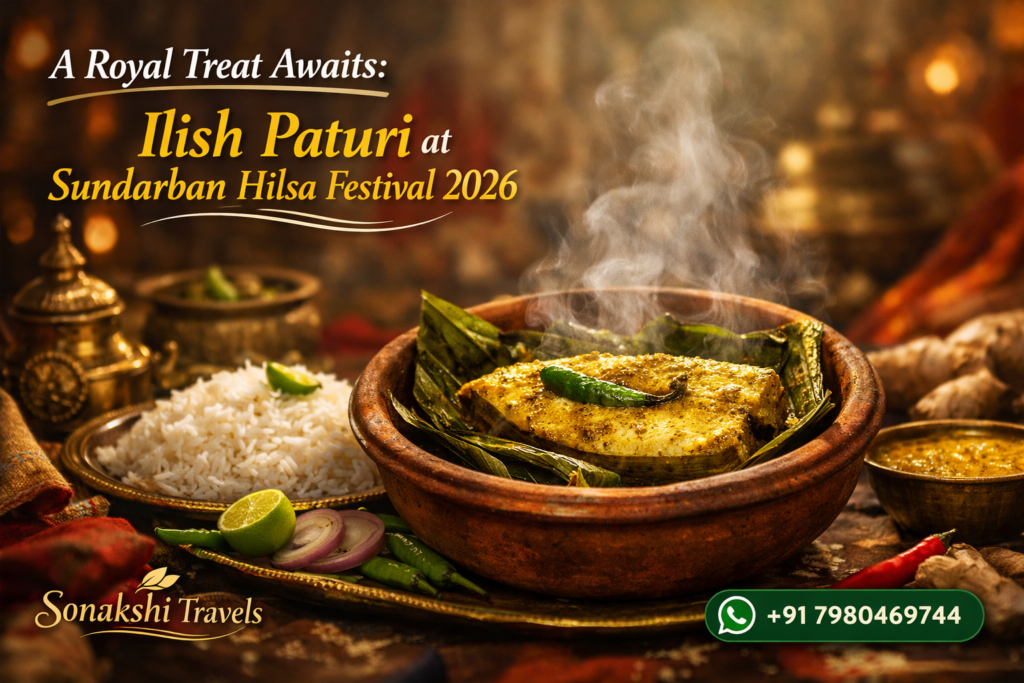
There are some dishes that feel complete even before the first bite. They arrive with a presence. Their fragrance reaches the table first. Their shape, color, and method already suggest patience, skill, and memory. Ilish Paturi belongs to that rare class of food. It is not loud. It does not depend on heavy spice or rich decoration to make an impression. Its beauty lies in balance. Soft hilsa, sharp mustard, gentle green chili, a little oil, the sweet warmth of banana leaf, and careful steaming come together in a way that feels simple on the surface but deeply refined in experience. At the Sundarban hilsa festival 2026, this dish becomes more than a traditional Bengali preparation. It becomes one of the clearest expressions of taste, place, and cultural memory.
Ilish has always carried prestige in Bengal. It is linked with season, river, family meals, celebration, and respect for fine cooking. Yet among the many famous hilsa dishes, Paturi holds a special place because it relies on restraint. It does not break the fish apart with too many additions. It protects the natural character of hilsa. The banana leaf does not only wrap the fish. It creates a quiet chamber of aroma, heat, and moisture. Inside that wrapping, the fish cooks slowly in its own richness. The mustard paste speaks clearly, but it does not drown the flesh. The result is elegant and controlled. That is why Ilish Paturi feels royal. Not because it is excessive, but because it shows confidence.
Why Ilish Paturi Feels So Refined
Many celebrated foods become popular because they are strong, rich, and immediate. Ilish Paturi moves in the opposite direction. Its power is subtle. The fish remains soft and almost silk-like. The bones remind the eater to slow down and pay attention. The mustard brings heat and depth, but the leaf adds a rounded warmth that changes the whole experience. Steam becomes the hidden artist of the dish. Nothing is burnt, broken, or overworked. Everything stays close to its original form. This care gives the dish a refined quality that very few preparations can achieve.
The greatness of Paturi also lies in its discipline. Good cooks know that hilsa needs respect. The flesh is delicate. The fat inside the fish is already rich and expressive. If the seasoning becomes too aggressive, the natural beauty of the fish gets lost. In Ilish Paturi, the cook works with measured intelligence. The mustard must be smooth, not harsh. The salt must be exact. The chili must wake the tongue, not dominate it. The banana leaf must be heated just enough to soften, so it can hold the fish gently without tearing. These are small details, but together they create greatness.
When such a dish is served during the Sundarban ilish utsav, it gains another layer of meaning. It stands before visitors not as a random menu item, but as a complete culinary statement. It says that local food culture is not only about eating well. It is about knowing how texture, aroma, memory, and place can meet in one careful preparation.
The Importance of the Banana Leaf
It is impossible to understand Ilish Paturi properly without understanding the banana leaf. The leaf is not packaging. It is part of the cooking language. When heat enters the leaf, it releases an earthy sweetness that no metal pot or open pan can provide. It protects moisture. It shields the fish from direct heat. It also creates a sealed environment where aroma builds slowly and stays close to the flesh. This is why opening a Paturi parcel feels almost ceremonial. The fragrance rises first. Then the mustard, leaf, and fish reveal themselves together.
The leaf also changes the psychology of the meal. A plated curry speaks openly from the start. Paturi remains hidden until the last moment. That small act of opening creates expectation. It gives drama without noise. It reminds the eater that food can arrive with rhythm. There is waiting, then release, then tasting. In that sense, Paturi is not only a recipe. It is a structured experience.
At a festival setting, this matters even more. Large events often push food toward speed and display. But Ilish Paturi resists speed. It asks the eater to pause. It asks for attention to smell, warmth, softness, and the quiet pleasure of uncovering what has been carefully wrapped. That is one reason it stands out so strongly at the Sundarban hilsa festival. It restores slowness inside a public celebration.
How Taste and Texture Work Together
The first strength of Ilish Paturi is aroma. The second is texture. Hilsa has a distinctive oil content that makes it one of the most valued fish in eastern India. In Paturi, that richness stays protected. The steaming process allows the flesh to remain soft and moist. When cooked well, the fish almost yields on its own. Yet that softness is balanced by the grainy intensity of mustard paste and the slight pressure of chili. This meeting of softness and sharpness gives the dish its personality.
There is also an important contrast between surface and interior. The outer coating of mustard looks strong. One may expect a forceful bite. But inside, the fish remains gentle. This contrast creates surprise. It is one reason the dish stays memorable. Many foods reveal everything at once. Ilish Paturi reveals itself in stages. First the leaf, then the steam, then the mustard, then the soft fish, and finally the deep aftertaste of hilsa oil mixed with leaf aroma. A great dish is often one that changes across the bite, and Paturi does exactly that.
This layered tasting experience makes it especially suitable for a festival devoted to hilsa. The Sundarban hilsa festival 2026 is not only a place to eat a famous fish in many forms. It is also a place to understand the range of the fish. Ilish can be fiery, rich, brothy, smoked by leaf, or softened by steam. Paturi shows one of the most graceful sides of that range.
A Dish of Memory, Not Only Flavor
Traditional Bengali dishes often carry family memory inside them, and Ilish Paturi is a strong example. For many people, it recalls meals prepared for guests, festivals at home, careful cooking in the kitchen, and the quiet respect given to a prized fish. Because the dish depends on technique and timing, it often passes from one generation to another through observation, correction, and repetition. People learn not only the recipe, but the judgment behind the recipe. How thin should the mustard be? How much oil is enough? How long should the fish stay wrapped? How should the leaf be softened? These are not always written instructions. They are inherited knowledge.
That is why seeing Ilish Paturi presented at a festival has cultural importance. A festival can become meaningful when it protects living knowledge, not only when it displays popular food. In this dish, one can see the value of domestic wisdom, regional taste memory, and culinary discipline. The parcel contains more than fish. It contains method. It contains continuity. It contains the survival of a food culture that still believes patience matters.
In the setting of the Sundarban ilish utsav 2026, this memory becomes public without losing intimacy. That is a rare achievement. The dish remains personal even when it is shared by many. Each parcel still feels like something prepared with care for a single person.
The Role of Mustard in Bengali Culinary Identity
No serious discussion of Ilish Paturi is complete without mustard. In Bengali cooking, mustard is more than an ingredient. It is an identity marker. Its sharpness, depth, and slight bitterness carry a regional signature. Yet using mustard well is difficult. If handled poorly, it becomes harsh and unpleasant. If balanced well, it gives structure, warmth, and a powerful but elegant finish.
In Paturi, mustard has a special role. It must hold the fish without overpowering it. It must stay active but not rough. Some cooks mix black and yellow mustard for balance. Some adjust the texture carefully to avoid bitterness. Some add a little coconut, poppy seed, or curd in other regional variations, but the classic form remains centered on mustard and restraint. The best versions show control. They do not try to impress by force. They achieve depth through proportion.
This is where the dish becomes truly royal. Royal food is often misunderstood as heavy or luxurious in a loud way. But many of the world’s finest traditional foods are royal because they show mastery over balance. Ilish Paturi belongs to that category. It feels distinguished because nothing is wasted, and nothing is exaggerated.
The Festival Table as a Cultural Space
Food festivals are often judged by crowds, menus, and spectacle. But the deeper value of a culinary event lies in what kind of attention it creates. A meaningful festival allows a dish to speak in its own language. Ilish Paturi needs that kind of space. It needs people to notice its wrapping, its steam, its softness, its clean finish, and the quiet confidence of its method.
At the festival table, the dish also creates conversation. People compare the aroma of the leaf, the sharpness of the mustard, the tenderness of the fish, and the quality of the steaming. Such discussion is important because it keeps taste culture alive. Good food does not survive only through recipes. It survives through shared standards. When people know what makes a Paturi excellent, they help protect the future of the dish.
This is why a celebration like the Sundarban hilsa festival matters beyond enjoyment. It creates a public space where culinary judgment, local pride, and food memory can work together. The festival does not merely serve hilsa. It invites people to read it, compare it, and value its finer forms.
Why Ilish Paturi Belongs to the Mood of the Delta
Some foods feel separated from their surroundings. Others seem shaped by the mood of a place. Ilish Paturi belongs to the second kind. Its softness, moisture, layered aroma, and quiet intensity suit the emotional character that many people associate with river culture. It is a dish of enclosure, warmth, and inner richness. It does not shout. It unfolds. That slow unfolding feels deeply appropriate in a landscape and culture shaped by water, waiting, and attention.
Even the method of wrapping has symbolic force. The fish is held, protected, and transformed inside the leaf, much like how many traditional cultures protect value through careful containment rather than open display. The leaf hides and preserves. The steam works invisibly. Only at the end does the full meaning appear. This structure gives the dish a poetic depth that goes beyond taste.
That is one reason Ilish Paturi often leaves a stronger impression than more visibly dramatic foods. Its beauty is inward. The eater must discover it. In a festival setting, that inward beauty becomes even more precious because it offers a counterpoint to noise, speed, and distraction.
A Royal Dish Because It Demands Respect
Not every famous dish deserves to be called royal. Ilish Paturi does. It deserves that name because it cannot be treated casually. The fish itself demands skill. The mustard demands judgment. The wrapping demands care. The steaming demands patience. The eating demands attention. Even the bones, which are a natural part of hilsa, require calm and awareness. This is not a food to be rushed. It teaches discipline to the cook and to the eater.
That discipline is part of its charm. In a world where meals are often consumed quickly, a dish like this restores seriousness to eating. It reminds us that food can still be an act of attention. The first bite is not enough. One must continue carefully, respecting the bones, tasting the mustard, noticing the leaf, and allowing the aftertaste to remain. The meal becomes slower, and in becoming slower, it becomes richer.
For this reason, Ilish Paturi fits the idea of a royal treat in the truest sense. It does not offer empty luxury. It offers value built from care, heritage, and precision. That kind of value lasts longer in memory.
The Lasting Appeal of Ilish Paturi at the Festival
Many festival foods are exciting in the moment but fade quickly afterward. Ilish Paturi stays with the mind. One remembers the fragrance released from the warm leaf. One remembers the golden mustard clinging to the fish. One remembers the softness of the flesh and the calm richness that follows. The dish leaves behind not only taste, but atmosphere.
That lasting quality is the sign of a great traditional food. It means the dish carries form, mood, memory, and method together. At the Sundarban hilsa festival 2026, Ilish Paturi stands as one of the clearest examples of how a regional dish can feel both rooted and elevated at the same time. It is deeply local, yet universally graceful. It is simple in ingredients, yet rich in understanding. It is modest in appearance, yet grand in effect.
A royal treat truly awaits in this preparation because Ilish Paturi does something rare. It gives pleasure without losing dignity. It offers comfort without becoming ordinary. It reveals tradition without turning stiff or distant. In one carefully wrapped parcel, it brings together taste, aroma, memory, and cultural intelligence. That is why its place at the festival feels fully deserved. Among the many celebrated forms of hilsa, Ilish Paturi remains one of the most refined, most thoughtful, and most unforgettable expressions of Bengali culinary art.