Sundarban luxury tour among mangrove whispers – Forests speak without sound
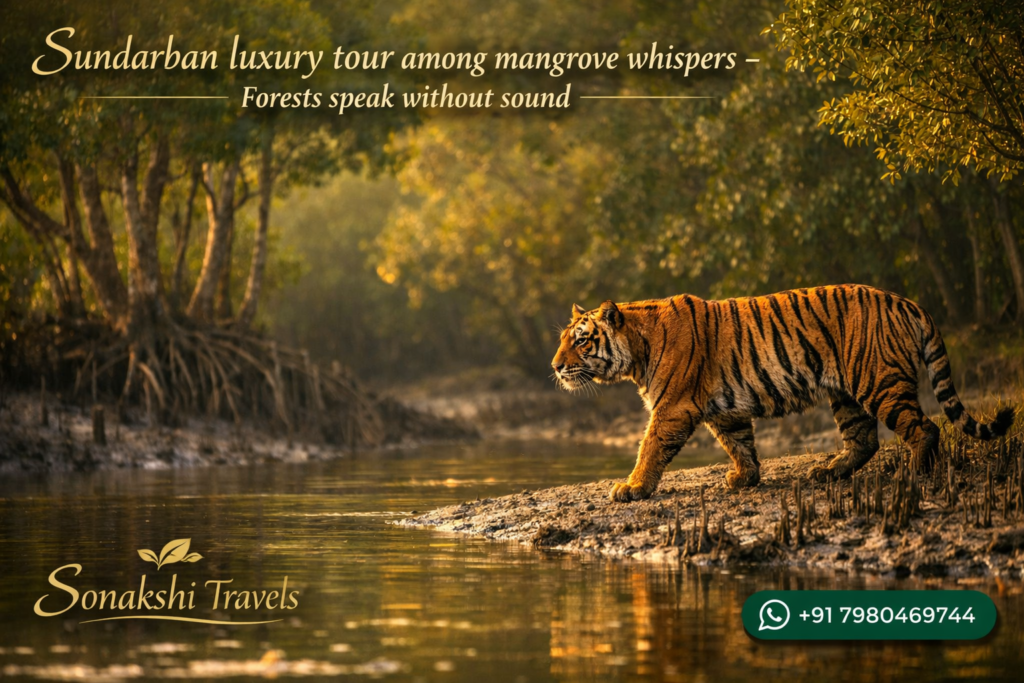
There are some landscapes that impress through scale, color, or sudden drama. Then there are landscapes that work in a quieter way. They enter the mind slowly. They do not announce themselves with noise. They do not hurry to explain their meaning. A Sundarban luxury tour among the mangroves belongs to this second kind of experience. It is not defined by loud movement or constant spectacle. It is defined by attention. The forest seems to say very little, yet the traveler begins to feel that something important is being communicated all the time.
That silent communication is the true center of the journey. In the mangrove world, the eye notices still water, layered roots, leaning branches, soft mudbanks, and narrow channels that seem to drift into secrecy. The ear notices less than expected, yet that absence becomes meaningful. The place is not empty. It is deeply active. Water rises and falls. Sediment moves. Leaves respond to salt and moisture. Crabs work below the surface. Birds pause, wait, and then cut across the air in a single sharp line. The whole environment is speaking through form, spacing, rhythm, and restraint. That is why a refined Sundarban luxury tour package feels so unusual. It gives room for the traveler to notice what ordinary travel often hides beneath speed.
The meaning of quiet in a tidal forest
Silence in the Sundarban is not the silence of emptiness. It is the silence of concentration. Mangrove forests exist in an environment shaped by tidal motion, changing salinity, unstable ground, and constant adaptation. Scientific studies on mangrove ecology have long shown that these forests survive through specialized root systems, salt management strategies, sediment capture, and a close dependence on tidal exchange. In simple terms, the forest is always working. Yet most of that work happens without visible display. The result is a rare atmosphere in which life feels hidden, patient, and intelligent.
On a Sundarban tour of ordinary pace, a traveler may simply register greenery and river channels. But in a more thoughtful and spacious experience, the same landscape begins to show its deeper structure. The breathing roots seem less like a botanical detail and more like a language of survival. The stillness of the water appears less passive and more observant. The dark edges of the forest feel less decorative and more like thresholds. What first appears quiet gradually reveals itself as disciplined life. This is why the whispering quality of the mangroves matters. The forest does not need to shout because its strength is already present in every line of its form.
A serious Sundarban travel experience becomes memorable when the traveler begins to sense this discipline. The mind slows down because the place itself is not arranged for hurry. The river bends gently. The forest does not offer instant clarity. Distance remains soft. Shapes appear, withdraw, and reappear. The eyes learn patience. The body becomes less restless. The mind becomes more receptive. In such a setting, luxury is not only about comfort. It is about freedom from interruption. It is about having the space to witness delicate realities that are usually overlooked.
Why the mangroves seem to whisper
The phrase “mangrove whispers” is not merely poetic. It describes the way this environment communicates through subtle signals rather than loud events. Mangrove branches do not create the same voice as a mountain pine forest or a dry woodland under strong wind. Their expression is softer, lower, and more fragmented. Water absorbs and reshapes sound. Mud softens impact. Dense vegetation interrupts long echoes. Open sky above the channels creates pause between one sound and the next. As a result, the landscape does not form one continuous voice. It forms a series of hints.
Those hints are important to the feeling of a Sundarban travel experience. A distant wingbeat may stand out more than a long conversation. The small collapse of wet soil at the river edge may feel more meaningful than a busy crowd in a city space. Even the movement of the boat through quiet water can create a controlled, respectful sound, as if the journey is passing through a place where the correct response is not noise but listening. In this sense, the whispers of the forest are not only acoustic. They are emotional. They ask the traveler to reduce internal noise as well.
This is where the value of a carefully composed luxury Sundarban cruise becomes especially clear. Comfort matters because physical ease allows deeper perception. When movement is calm and the environment is not crowded by distraction, the traveler can notice how the forest changes minute by minute. Light touches one root network differently as the boat turns. Reflections break and reconnect. A muddy bank that looked flat from a distance begins to show tracks, indentations, and the memory of passing life. A silent forest is never without evidence. It is simply selective in how it reveals itself.
The psychology of a soundless landscape
Modern life trains people to expect constant stimulation. Many travelers arrive carrying noise inside the mind even when the surroundings are calm. At first, the quiet of the mangroves can feel unusual because it offers fewer obvious commands for attention. Yet this is exactly why the landscape becomes restorative. Psychological research on attention and natural environments has often suggested that soft fascination helps the mind recover from fatigue. A place does not need to overwhelm a person to affect them deeply. It may do the opposite. It may hold attention gently, allowing the mind to reorganize itself.
A Sundarban luxury private tour among whispering forests works in this precise way. The mind stops jumping from one signal to another and begins to follow slower patterns. It starts to notice shape, interval, reflection, stillness, and pause. This does not produce boredom. It produces clarity. Thoughts lose some of their pressure. Perception becomes more exact. The traveler begins to understand that silence can sharpen awareness rather than reduce it.
In the Sundarban, this sharpened awareness is not abstract. It is anchored in the real behavior of the environment. Tidal forests require alertness. Salinity changes. Water lines shift. Edges are unstable. Life survives through timing and adaptation. When a human being enters such a place respectfully, the mind often responds by becoming more precise. That is why the forest seems to speak without sound. Its message is carried not by words but by the discipline it demands from anyone who truly observes it.
Luxury as stillness, not display
The word luxury is often misunderstood. In many travel settings, it is connected with excess, visual abundance, and obvious display. But in a tidal forest, that kind of idea feels misplaced. Here, true refinement comes from harmony with the mood of the landscape. A Sundarban luxury tour feels most meaningful when it respects quiet rather than competing with it. The finest quality is not noise dressed as comfort. It is thoughtful simplicity, measured pace, and uninterrupted attention.
This is why a well-shaped luxury Sundarban river cruise can feel more intimate than many grander travel experiences elsewhere. Instead of standing outside the environment, the traveler feels gently placed within it. Comfort becomes a frame for perception. It allows the body to relax while the senses remain active. A smooth passage through calm channels, a clean line of sight toward shadowed mangroves, and the absence of restless crowd energy all contribute to a more serious encounter with place.
In that context, the idea of a luxury mangrove forest tour becomes richer than a marketing phrase. It suggests a form of travel in which elegance comes from restraint. The river is allowed to remain the central presence. The forest is allowed to retain its mystery. The traveler is not pushed into the landscape through forceful narration. Instead, the landscape is given time to enter the traveler’s mind through slow recognition.
Reading the shapes of mangrove life
One of the most rewarding aspects of this theme is the visual intelligence of the forest. Mangroves are among the most structurally fascinating ecosystems in the world. Their roots rise, spread, arch, and grip in ways that seem almost sculptural. These are not random forms. They are solutions to environmental pressure. Aerial roots assist breathing in oxygen-poor soils. Prop roots stabilize against movement. Salt tolerance mechanisms make life possible where many other plants would fail. What the traveler sees as beauty is also adaptation made visible.
That is why a contemplative Sundarban travel guide to perception would begin not with facts alone, but with looking. The leaning branch over a creek is not just picturesque. It is part of an ecological negotiation. The exposed roots at low tide are not simply dramatic shapes. They are evidence of a demanding habitat. The mudbank holding prints and impressions is not just texture. It is a surface written on by movement. Forests speak without sound because their forms record the terms of survival.
For the traveler on a Sundarban luxury wildlife safari, this creates a special kind of excitement. The eye begins to read the environment as text. Every curve of the shoreline, every broken branch, every tangle of roots suggests a hidden story. Yet none of this feels loud. The atmosphere remains composed. Discovery happens through inference, not through constant revelation. That slow interpretive process is one of the deepest pleasures of the journey.
Water as the carrier of silence
In the Sundarban, water is not merely background. It is the medium through which the character of the forest becomes legible. The channels hold reflections, separate distances, soften sound, and control access. Water also changes meaning from moment to moment. A surface that seems calm may be carrying a strong tidal intention beneath it. A narrow creek that appears enclosed may still feel open because of the way light enters it. A broad river may feel intimate when the forest edges close in under fading brightness.
This is why a quiet Sundarban private boat tour can feel like passage through thought itself. The boat moves, but the movement is rarely aggressive. The traveler progresses through fluid corridors that seem to rearrange vision. Water allows the forest to whisper because it breaks directness. It reflects instead of declaring. It carries impressions instead of fixed statements. A tree appears once in the bank itself and again in trembling reflection. A mud edge appears solid, then softens into mirrored uncertainty. The entire experience becomes an education in subtle perception.
Within a refined private Sundarban river cruise, this fluid quality becomes part of the emotional architecture of the journey. There is no need to fill every moment with speech. The water already provides sequence. It creates pause, transition, interval, and expectation. The traveler learns that silence has structure. It is not blankness. It has direction and depth, much like the tidal current that seems quiet on the surface yet continues to shape the world beneath.
How the forest changes human scale
Another reason the whispering mangroves leave such a strong impression is that they quietly correct the human sense of proportion. In cities, human intention dominates the visual field. Buildings, roads, and signals are designed to direct behavior. In the mangroves, that control weakens. The traveler enters a place where rhythm is not produced by human planning. It is produced by tide, root, sediment, and organic patience. This shift can be humbling in the best sense.
A serious Sundarban nature tour does not have to lecture the traveler about humility. The landscape performs that lesson by itself. The creeks do not open because a person wishes them to. The banks do not remain stable simply because they were stable yesterday. The forest does not reveal everything at once. It remains partially withheld. That withheld quality is important. It protects the dignity of the place. It reminds the traveler that not every environment exists to become instantly readable or fully possessed.
This is one reason a Sundarban premium wildlife tour feels different from travel based only on quick consumption. The value lies not in conquering a checklist but in accepting a slower relation with place. The traveler is not the center of the forest. The traveler is an attentive guest within a living system that has its own priorities. That realization often brings calm. It reduces the need to dominate experience and increases the desire to understand it.
The emotional aftertaste of whispering landscapes
Some places remain in memory because of one dramatic event. Others remain because they alter the mood of thought long after the journey is over. The whispering mangroves belong to the second category. Their effect is slow but lasting. Long after the traveler leaves, certain impressions continue to return: the layered stillness of the roots, the quiet shine of tidal water, the tension between softness and survival, the sense that the forest was never mute at all. It was simply speaking in a form that required patience.
This is the deeper promise of a Sundarban luxury travel experience. It is not merely the enjoyment of a beautiful setting. It is the chance to enter a different mode of perception. In that mode, small details recover importance. Silence becomes informative. Shape becomes expressive. Movement becomes meaningful even when it is slow. The traveler comes away with more than images. The traveler comes away with a changed sense of how landscapes can communicate.
Even the phrase Sundarban travel agency feels too small to contain this dimension of the place, because the finest experience here is not transactional. It is interpretive. It depends on mood, pacing, and the willingness to encounter quiet as a form of knowledge. When that happens, the forest no longer appears distant. It begins to feel like a presence with its own reserved but unmistakable voice.
Forests that speak without sound
At the heart of this title lies a simple truth: the Sundarban does not need loudness to become unforgettable. Its authority comes from quiet complexity. Its beauty is inseparable from adaptation. Its atmosphere is shaped by tidal intelligence, ecological discipline, and visual restraint. The mangroves seem to whisper because they are full of life that does not waste energy on display. They hold themselves with a rare seriousness, and that seriousness changes the traveler who pays attention.
That is why a Sundarban luxury tour among mangrove whispers can feel so profound. It invites a form of travel in which comfort supports awareness, not distraction. It leads the eye toward subtler meanings. It teaches the mind to listen to forms, intervals, and quiet evidence. The forest speaks through roots that rise from mud, through water that reflects more than it reveals, through channels that bend away from certainty, and through a silence that is never empty.
In the end, the traveler does not remember only a forest. The traveler remembers a conversation that happened without words. That conversation was carried by light, tide, shadow, texture, and patience. It was held in the soft authority of a living mangrove world. And it remains powerful because it proves that some of the deepest journeys are not the ones that speak the loudest, but the ones that teach us how to hear what quiet has been saying all along.