Updated: March 29, 2026
What are the main threats to Sundarban?
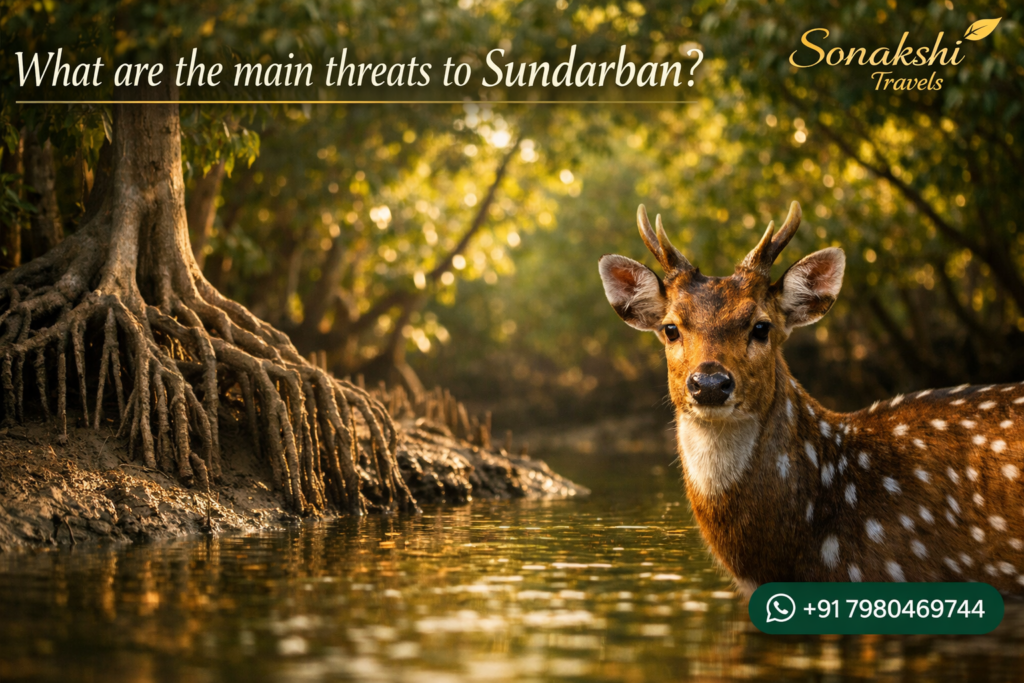
The main threats to the Sundarban do not come from one single source. They come from many pressures acting together on a very delicate mangrove system. The forest lives between river and sea. It depends on balance. It needs the right flow of water, healthy soil, living roots, breeding grounds for fish, safe mudbanks for crabs, quiet creeks for birds, and enough forest cover for large animals. When that balance weakens, the damage spreads through the whole landscape. A threat in one part of the system does not remain there. It moves through water, mud, vegetation, and food chains.
To understand these dangers, it is necessary to look beyond the surface beauty that many people know through a Sundarban tour. The Sundarban is not only a scenic forest. It is a living shield of mangroves, tidal rivers, mudflats, islands, fish nurseries, bird habitat, and human settlements at the edge of risk. When we ask what threatens the Sundarban, we are really asking what weakens this shield from inside and outside at the same time.
The largest threats include rising salinity, riverbank erosion, loss of mangrove cover, pollution, overuse of natural resources, climate pressure, shrinking habitat for wildlife, and careless human activity around the forest and its waterways. These are not separate stories. They are deeply connected. One problem makes the next problem stronger. That is why the Sundarban must be understood as a fragile web, not as a collection of isolated features.
Loss of mangrove cover is one of the deepest dangers
The first major threat is the loss of mangrove vegetation itself. The Sundarban depends on mangrove roots more than most people realize. These roots hold wet soil in place. They slow wave action. They trap sediment. They make shelter for fish, prawns, crabs, insects, reptiles, and birds. They also help reduce the force of tidal water. When mangrove cover declines, the land becomes more open, more unstable, and more exposed.
Mangrove loss can happen in many ways. Trees may die from increased salinity. Young plants may fail to grow because the soil chemistry changes. Shoreline cutting, embankment pressure, settlement expansion near forest edges, and extraction of local resources can also reduce the strength of natural vegetation. Once a patch weakens, it becomes easier for tides to eat into that land. That is why forest loss in the Sundarban is not just a problem of fewer trees. It is a problem of structural collapse in the ecosystem.
Many visitors who come for a Sundarban tourism experience see only the standing forest from the boat. They may not notice where the forest line has thinned, where seedlings are missing, or where the mudbank shows signs of root failure. But ecologically, these are serious warning signs. A mangrove forest does not need to disappear fully before danger begins. Even partial weakening changes everything around it.
Rising salinity changes the life of water, soil, and trees
Another major threat is rising salinity. The Sundarban is a tidal mangrove system, so saline influence is natural. But when the salt level increases beyond the range that local plants and aquatic life can handle, stress begins to spread. Some species are better able to survive strong salinity. Others are not. This changes which plants dominate the forest and which areas begin to decline.
Salinity is not only a plant issue. It affects the entire web of life. Soil condition changes. Freshwater-dependent fish and smaller aquatic organisms suffer. Breeding patterns can weaken. Food availability for larger species changes. In such a system, even a small shift in salinity can move through the food chain and reduce long-term ecological stability.
The problem becomes more serious because the Sundarban is built on constant exchange between land water and sea water. If that exchange becomes unbalanced, the forest slowly loses its internal rhythm. Some areas become harsher, less productive, and less able to support mixed biodiversity. In easy words, too much salinity makes the forest more narrow in character and less rich in life.
Erosion breaks land faster than many people imagine
Riverbank erosion is one of the most visible threats to the Sundarban. In a tidal delta, land is never fully still. Yet there is a difference between natural change and severe destabilization. When banks collapse faster than the forest can recover, habitat disappears. Mudflats shift. Island edges retreat. Creeks widen in damaged zones. The roots that once held soil together become exposed, then broken, then gone.
Erosion also affects human life at the forest edge. Homes, fields, embankments, and village land in the wider region may be damaged. But even within the ecological core, erosion changes the shape of habitat. Nesting grounds may vanish. Feeding areas may shrink. The relation between vegetation, mud, and channel movement becomes unstable.
This is why erosion should not be seen as only a land problem. It is also a wildlife problem, a vegetation problem, and a survival problem for the entire delta system. A forest with weakening edges is always more vulnerable. That vulnerability enters the system quietly, then grows season after season.
Pollution harms the forest in slow and direct ways
Pollution is another serious threat. It may not look as dramatic as a broken bank or dead tree line, but it can be deeply harmful. Plastic waste in waterways, fuel leakage from boats, chemical runoff, oily discharge, and unmanaged garbage all put pressure on the mangrove environment. Water channels that seem calm on the surface may carry toxic material in ways that affect fish, crabs, shell life, and birds.
In a mangrove system, pollution does not simply float away. Much of it settles into mud, roots, shallow water, and creek margins. This means the damage can stay inside the ecological body of the forest for a long time. Small organisms absorb pollutants. Larger organisms feed on them. Over time, toxic stress rises through the system.
Pollution also changes the human relationship with the region. A place that should remain biologically rich begins to carry the signs of neglect. Even a responsible Sundarban travel guide will recognize that the true danger is not only visual dirt. The larger danger is ecological poisoning that weakens the forest quietly.
Overuse of natural resources weakens ecological resilience
The Sundarban supports human life around it, and that reality cannot be ignored. People depend on fish, crabs, honey, fuelwood, and other natural materials. But when extraction becomes too heavy, too frequent, or poorly regulated, the pressure on the forest increases. A sensitive ecosystem can support livelihood only when use remains within ecological limits.
If fish are overharvested, breeding cycles weaken. If crabs are removed too heavily, the mud ecosystem changes. If wood is cut beyond safe levels, shoreline and soil strength decline. If fragile zones are entered again and again, recovery becomes slower. The problem is not livelihood itself. The problem is ecological load beyond the carrying capacity of the place.
This creates a difficult moral and environmental situation. The forest is needed, yet the forest is stressed by the very dependence placed upon it. That is why long-term protection of the Sundarban must include both conservation and humane livelihood planning. Without that balance, people and forest both remain at risk.
Habitat pressure makes wildlife survival harder
Wildlife in the Sundarban lives within narrow ecological margins. Animals here are already adapted to tide, mud, salinity, and shifting ground. That means extra pressure can have severe effects. Habitat loss, disturbance in breeding zones, changes in prey availability, and human intrusion all reduce the stability needed for wildlife survival.
This is especially serious in a forest known for its complex predator-prey system. When habitat becomes fragmented or disturbed, movement patterns change. Animals may enter new areas in search of food or safer cover. That can increase conflict, stress, and biological imbalance. A healthy habitat is not only a matter of space. It is a matter of continuity, quietness, and food-chain stability.
Many people imagine wildlife danger only from the viewpoint of humans. But the forest must also be read from the viewpoint of animals. What happens when hiding cover shrinks? What happens when prey zones change? What happens when noisy movement enters sensitive creek lines? A forest under such pressure becomes more unstable for all life forms within it.
Even tourism-linked activities, if careless, can add to this problem. The goal of a true Sundarban wildlife safari or Sundarban nature tour should be observation with restraint, not intrusion. When ecological respect weakens, the forest pays the price first, and wildlife pays it most directly.
Climate pressure multiplies existing weakness
Climate-related stress is now one of the strongest background threats to the Sundarban. It does not act alone, but it makes other problems worse. It can intensify salinity pressure, increase shoreline instability, damage vegetation, and reduce the recovery power of fragile zones. The danger here is cumulative. A forest already stressed by human action becomes less able to absorb climate shocks.
The Sundarban is especially sensitive because it is low-lying, water-shaped, and dependent on precise ecological balance. A strong event may cause visible damage in a short time, but the deeper concern is long-term weakening. Repeated pressure can leave parts of the mangrove system less dense, less stable, and less diverse than before.
This means the question is not only whether the Sundarban can survive one episode of stress. The question is whether it can continue to recover after many pressures return again and again. Resilience is the key word here. The main danger is the loss of resilience itself.
Careless development around the region can disturb the ecological balance
Another threat comes from development that ignores the special nature of the delta. The Sundarban cannot be treated like ordinary land. Heavy intervention, poor planning, waste-producing structures, or land pressure near sensitive zones can damage the logic of the landscape. In a place ruled by tides, roots, water movement, and soft banks, rigid human activity often creates hidden costs.
When development expands without ecological understanding, the effects may include polluted channels, disturbed drainage, increased traffic, noise, and greater pressure on edges already at risk. This is why the Sundarban must not be managed through short-term thinking. It requires planning that respects mud, water, roots, and wildlife together.
Even sectors linked with Sundarban eco tourism need strict care. The phrase sounds positive, but it becomes meaningful only when operations remain truly low-impact. If the language of eco-tourism is used without ecological discipline, the result can still be damage. Responsible management must be stronger than attractive branding.
Tourism pressure becomes a threat when it loses discipline
Tourism itself is not automatically a threat. It can build awareness and support livelihoods. But uncontrolled tourism can harm the Sundarban in direct ways. Too much noise, litter, plastic use, careless boating behavior, crowd pressure, and disrespect for ecological limits all put stress on the forest. A quiet landscape begins to absorb repeated disturbance.
This is important because the Sundarban is often approached through commercial language such as Sundarban tour package, Sundarban tour from Kolkata, or Sundarban private tour. Such travel forms are not harmful by definition. The real question is how they are conducted. Do they reduce waste? Do they maintain distance from wildlife? Do they avoid noise? Do they teach visitors how fragile the mangroves are? Do they treat the forest as habitat first and destination second?
A disciplined operator can reduce harm. An irresponsible one can multiply it. The same is true for visitors. The Sundarban cannot defend itself from plastic, fuel, noise, and casual damage. Human behavior therefore becomes part of the threat map. Every careless act may seem small, but in a fragile estuarine system, small acts accumulate quickly.
The danger is not only physical but also ecological and moral
One of the most serious misunderstandings about the Sundarban is the idea that threat means only visible destruction. In truth, some of the deepest threats are slower. A forest may still look green and yet be under strong ecological stress. A creek may still appear calm while carrying polluted sediment. A mudbank may still stand while losing root strength beneath the surface.
This is why the Sundarban must be read carefully. A place can remain beautiful and still be in danger. In fact, that is often how ecological decline begins. Beauty continues for a while, but the hidden systems underneath start failing. By the time the damage becomes obvious to everyone, recovery may already be difficult.
There is also a moral side to this issue. The Sundarban protects coastlines, holds biodiversity, supports fisheries, shelters wildlife, and carries deep human dependence around it. To weaken such a landscape through neglect, overuse, or careless policy is not only an environmental mistake. It is also a failure of responsibility.
Why these threats must be understood together
The main threats to the Sundarban are connected. Mangrove loss increases erosion. Erosion weakens habitat. Salinity reduces plant stability. Pollution harms aquatic life. Resource pressure lowers resilience. Climate stress intensifies all of these. Careless tourism adds disturbance. Poor planning increases exposure. This chain effect is what makes the situation so serious.
For that reason, the answer to the title question cannot be reduced to one line. The main threats are many, but they work as one combined force. The Sundarban is threatened whenever balance is replaced by pressure. It is threatened whenever ecological rhythm is replaced by extraction, waste, noise, or short-term use.
Anyone who values the forest, whether through research, local life, conservation, or a thoughtful Sundarban luxury tour, must begin with this understanding: the Sundarban survives only when its limits are respected. The roots, the mud, the tidal water, the breeding life, the silence, and the forest cover all belong to one living system. The main threat is anything that breaks that system faster than it can heal.
So, what are the main threats to the Sundarban? They are the forces that reduce balance: salinity rise, erosion, mangrove decline, pollution, overuse of natural resources, habitat pressure, climate stress, careless development, and uncontrolled human activity. These are not abstract risks. They are active pressures on one of the world’s most delicate mangrove landscapes. Protecting the Sundarban therefore means protecting its ecological balance at every level, before visible damage becomes irreversible.