Updated: March 29, 2026
What are the main threats to Sundarban?
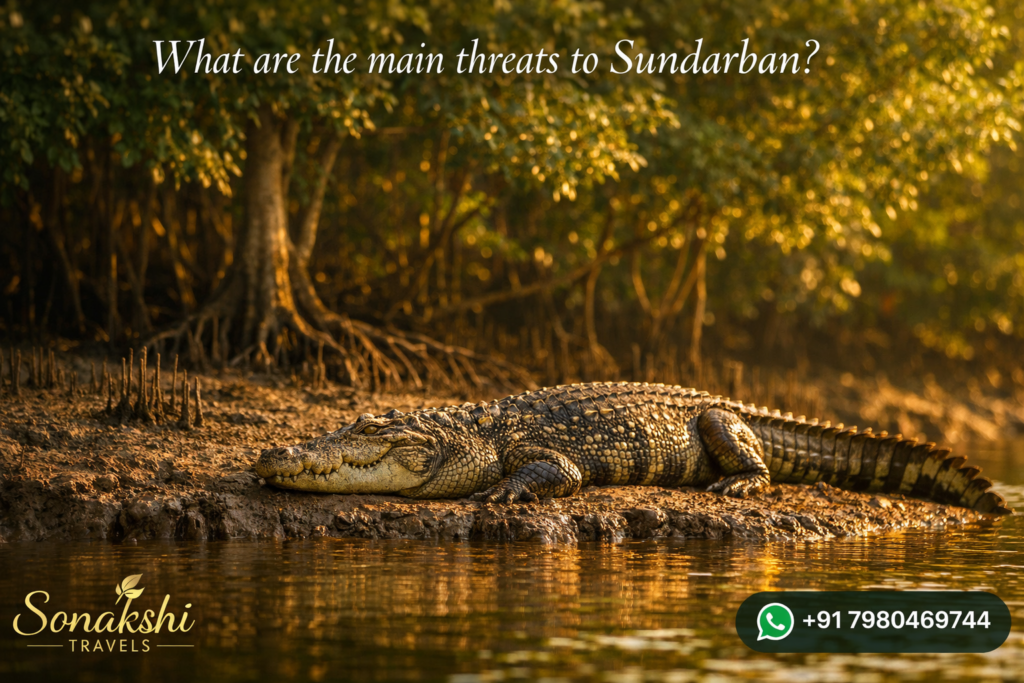
The main threats to the Sundarban come from many pressures working together on one fragile mangrove system. This is not a forest that can stay healthy through strength alone. It survives through balance. The rivers must carry the right flow. The mud must remain stable enough for roots to hold. Salinity must not rise too far. Tidal creeks must stay alive. Fish must breed in safe water. Crabs must find secure mudflats. Birds must keep their feeding grounds. Large animals must keep enough cover and enough quiet space. When this balance weakens, the whole forest begins to change.
The danger becomes greater because the Sundarban is not made of one fixed landmass. It is a living delta. Water moves in, water moves out, banks break, channels shift, soil settles, roots grip and release. In such a place, even a small pressure can spread across many parts of the ecosystem. One damaged creek does not remain only one damaged creek. It can affect fish movement, soil condition, plant regeneration, and food patterns for other species. That is why the threats to this region must be understood as connected threats, not isolated ones.
People often speak about the Sundarban only in terms of beauty, mystery, or wildlife. But a serious Sundarban travel guide should also explain what puts this landscape at risk. To understand the main threats to the Sundarban, one must look carefully at erosion, rising salinity, habitat loss, climate stress, human pressure, pollution, resource extraction, and the weakening of ecological balance. Each of these does harm on its own. Together, they create a deeper crisis.
Loss of land through erosion
One of the clearest threats to the Sundarban is erosion. The edge of this forest is never fully still. Tidal water cuts into mudbanks. River currents strike exposed shores. Storm tides push with sudden force. When embankments fail or natural river edges weaken, land can disappear fast. In a normal inland forest, the ground remains in place for long periods. In the Sundarban, land itself can shrink, shift, or break away.
This matters because mangrove life depends on stable but flexible ground. The trees need mud that can hold roots. Young saplings need a chance to settle before the next heavy wash. Nesting birds need safe patches. Small animals need cover near the waterline. If erosion grows stronger than natural recovery, the forest loses the very base on which life stands. A collapsing bank is not only a change in shape. It is a loss of habitat, shelter, feeding ground, and breeding space.
Erosion also makes the forest more exposed. When one edge breaks, nearby roots may lose support. When roots loosen, the next section becomes easier for water to take away. The process often moves step by step. What begins as a narrow cut can become a wider wound. In this way, erosion is both immediate and spreading. It reduces land, but it also reduces resilience.
Rising salinity in water and soil
Another major threat is rising salinity. The Sundarban is naturally a tidal region where freshwater and saline water meet. But when saline influence becomes too strong, the system begins to suffer. Not every plant, fish, crab, insect, or soil organism can tolerate the same level of salt. Some species adjust. Some weaken. Some leave. Some fail to reproduce properly. The result is not always dramatic at first. Often it appears as slow change, thinning diversity, and silent ecological stress.
Salinity affects the roots of mangroves, the texture of mud, and the condition of shallow water. It can alter which plant species dominate and which begin to decline. If plant composition changes too much, that change moves upward through the food web. Insects respond. Fish nurseries respond. Bird feeding patterns respond. Animals that depend on dense cover may find that the structure of the forest is no longer the same.
The deeper problem is that salinity does not remain one simple chemical fact. It changes the living logic of the delta. The Sundarban depends on a moving balance between river flow and marine force. When that balance shifts too far, the forest may still look green from a distance, but inside it becomes less supportive to many forms of life. A healthy mangrove system is not defined only by the presence of trees. It is defined by the richness of life those trees can support.
Damage to mangrove vegetation
The mangrove trees themselves face pressure. The Sundarban is a root-bound world. Its strength lies below the surface as much as above it. The roots trap sediment, slow water, hold banks, and create nursery habitat for aquatic life. When mangrove vegetation is damaged, the loss is not only botanical. It is structural. It affects the engineering of the whole ecosystem.
Damage can happen through cutting, trampling, bank disturbance, polluted water, changing salinity, and repeated stress from storms. Even when a tree does not fall at once, long-term stress may weaken its growth, reduce seed production, or limit regeneration. A mature mangrove stand can take years to form, but it can be damaged in a much shorter time.
Young mangrove growth is especially important. If new plants cannot establish themselves, the forest loses its future capacity to repair its own edges. A mangrove forest survives partly because it constantly renews itself through sediment capture and plant regeneration. When this cycle breaks, the system becomes older, thinner, and more vulnerable. This is one reason why damage to vegetation is one of the main threats to the Sundarban. It attacks the forest’s natural method of self-defense.
Even people interested in Sundarban tourism should understand that the beauty of this region depends first on the health of its mangroves. Without strong vegetation, the landscape loses not only visual richness but also ecological function.
Climate stress and sea-level pressure
The Sundarban is also under climate stress. This includes sea-level rise, changing rainfall patterns across the larger delta, stronger tidal impact in some areas, and repeated extreme weather events. Climate pressure is especially dangerous here because the land is low, soft, and water-shaped. A forest on high ground may resist some shocks with less visible damage. The Sundarban has far less margin for error.
Sea-level pressure can increase salinity, deepen erosion, and place more force on riverbanks and islands. Low-lying areas may remain waterlogged for longer periods. Soil chemistry may change. Recovery after severe flooding may become slower. Trees already under stress may become less able to cope with the next event.
Climate stress is not always one sudden disaster. Often it is a series of repeated pushes. A bank weakens a little more. A creek silts differently. A patch of vegetation fails to return with the same strength. A nesting ground becomes less reliable. This kind of slow pressure is dangerous because it changes the baseline condition of the forest. Over time, what was once normal becomes rare.
The Sundarban has always lived with movement and risk. That is part of its nature. But climate pressure makes the system more unstable than its old ecological rhythm was designed to handle. This is why climate-related stress stands among the most serious threats to the region.
Habitat fragmentation and shrinking safe zones
Wildlife in the Sundarban does not depend only on raw space. It depends on connected space. Animals move along creeks, through tree cover, across feeding zones, and between shelter areas. Birds need feeding flats, resting branches, and breeding places. Reptiles need secure banks and shallow edges. Aquatic species need channels that remain ecologically alive. When habitats become fragmented, this movement becomes harder.
Fragmentation may happen through land loss, vegetation damage, repeated disturbance, embankment pressure near forest edges, or changes in hydrology. When one habitat block is cut off from another, species may still survive for some time, but their long-term security becomes weaker. Breeding may decline. Food search may become harder. Competition may rise in the remaining good patches.
The problem is not only the size of habitat but also its quality. A patch of land may still exist, yet if it is too disturbed, too saline, too exposed, or too poor in food, it stops functioning as true habitat. In this way, the Sundarban can appear present on a map while becoming thinner in ecological value on the ground.
Pressure from human use of resources
Many communities around the Sundarban depend on rivers, creeks, mudflats, and forest-linked resources for daily survival. Fishing, crab collection, honey gathering, fuel use, and other forms of extraction are tied to real human need. But when pressure grows beyond what the ecosystem can recover from, the forest begins to pay the cost.
Overuse of fish breeding zones can reduce aquatic stocks. Excessive crab collection can disturb mudflat ecology. Repeated entry into sensitive areas can disturb wildlife movement and nesting behavior. Cutting wood, even at small scales in many places, can weaken vegetation structure. When large numbers of people depend on limited resources, the pressure becomes cumulative.
This is a difficult issue because it is not only about rule-breaking. It is also about livelihood. That makes the threat more complex. Yet ecological truth remains the same: if extraction rises faster than recovery, the system declines. The Sundarban cannot remain healthy if every part of it is used without enough restraint, enough protection, and enough long-term thinking.
Any serious discussion around Sundarban tour or nature-based appreciation should therefore begin with respect for the forest as a living system, not as an endless resource field.
Pollution in water and sediment
Pollution is another major threat, and it often goes unnoticed because it may not always create immediate dramatic scenes. Waste in water, oil traces, chemical runoff, plastic material, and contaminated sediment can slowly affect aquatic life and bird life. Shallow tidal systems are especially vulnerable because pollutants can spread across creeks, settle into mud, and enter food chains.
Fish eggs and larvae are sensitive to water quality. Crabs and mud organisms live close to sediment where pollution often settles. Birds feeding along banks may consume contaminated prey. Mangrove roots themselves interact closely with waterlogged soil. When pollution enters this cycle, it does not remain on the surface. It moves inward.
Plastic waste adds a physical danger as well. It can choke channels, trap smaller creatures, and reduce the cleanliness of feeding grounds. Oil and chemical pollutants create another layer of risk by changing water condition in ways that are harmful but not always easy to see. The Sundarban is a place where life depends on intimate contact between water, mud, and roots. Pollution harms exactly that contact zone.
Decline of biodiversity
All the threats mentioned above finally lead toward one wider danger: biodiversity decline. The strength of the Sundarban lies in its variety of life forms and ecological roles. Mangroves hold soil. Plankton support aquatic food webs. Small fish feed larger fish and birds. Mud organisms recycle nutrients. Birds spread ecological activity across zones. Predators shape balance from the top. Remove too much from any layer, and the structure becomes less stable.
Biodiversity decline may show itself as fewer sightings of certain species, weaker breeding success, altered migration or feeding patterns, and loss of locally adapted organisms. Sometimes the first loss happens among smaller creatures that receive little public attention. But these smaller losses matter deeply. A strong ecosystem is built from countless small relationships.
When biodiversity falls, the forest becomes simpler. A simpler ecosystem is often a weaker ecosystem. It has fewer backup systems, fewer alternative food paths, and less capacity to recover after shock. In a place already exposed to erosion, salinity, and climate stress, such simplification is dangerous.
Threats do not stay separate here
The most important truth is that the threats to the Sundarban are linked. Erosion can damage vegetation. Damaged vegetation can worsen erosion. Salinity can weaken plant communities. Weaker plant communities can reduce habitat quality. Pollution can stress aquatic life already under pressure from changing water conditions. Human extraction can become more harmful when climate stress has already reduced resilience. Nothing stands alone for long in this delta.
This is why the Sundarban must be read as a connected ecological body. Its silence may look calm, but inside that silence many processes are working together. The roots, mud, tides, fish nurseries, saline pulses, and forest edges form one moving whole. Harm to one part often becomes harm to several others.
That is also why language matters. A shallow description may say the forest is threatened by one thing. A truthful description must say it is threatened by an accumulation of pressures. The crisis is layered. Some threats strike from outside. Some rise from repeated human use. Some come from changing water. Some come from the weakening of recovery itself.
Why this question matters so much
To ask what the main threats to the Sundarban are is to ask what this forest needs in order to remain alive as a true mangrove ecosystem. The answer is not only protection in the legal sense. It is ecological balance in the deepest sense. The forest needs stable sediment processes, controlled salinity, strong mangrove regeneration, low pollution, protected habitat, and careful limits on extractive pressure. Without these, the Sundarban may remain visible on maps and in memory, yet become poorer in function year after year.
Even those who first come to know the region through a Sundarban tour package or a broader Sundarban travel package should understand that the real value of the place lies not in scenery alone but in ecological integrity. The mangrove, the mudbank, the creek, the bird call, the hidden movement in the roots, and the breathing rhythm of the tide all depend on that integrity.
So the main threats to the Sundarban are not abstract ideas. They are real forces that reduce land, damage roots, change water, disturb habitat, pollute food systems, and weaken biodiversity. The forest is delicate, but not weak. It has survived through adaptation for a very long time. Yet adaptation has limits. When too many pressures arrive at once, even a resilient delta can begin to fail.
The most honest conclusion is simple. The Sundarban is threatened most by imbalance. Erosion, salinity, vegetation damage, climate stress, habitat fragmentation, human overuse, pollution, and biodiversity decline are all different faces of that imbalance. To protect the Sundarban, one must protect the relationships that allow water, soil, root, fish, bird, and forest to continue working together as one living system.