Updated: April 1, 2026
What Wildlife Can You See During a Sundarban Luxury Tour?
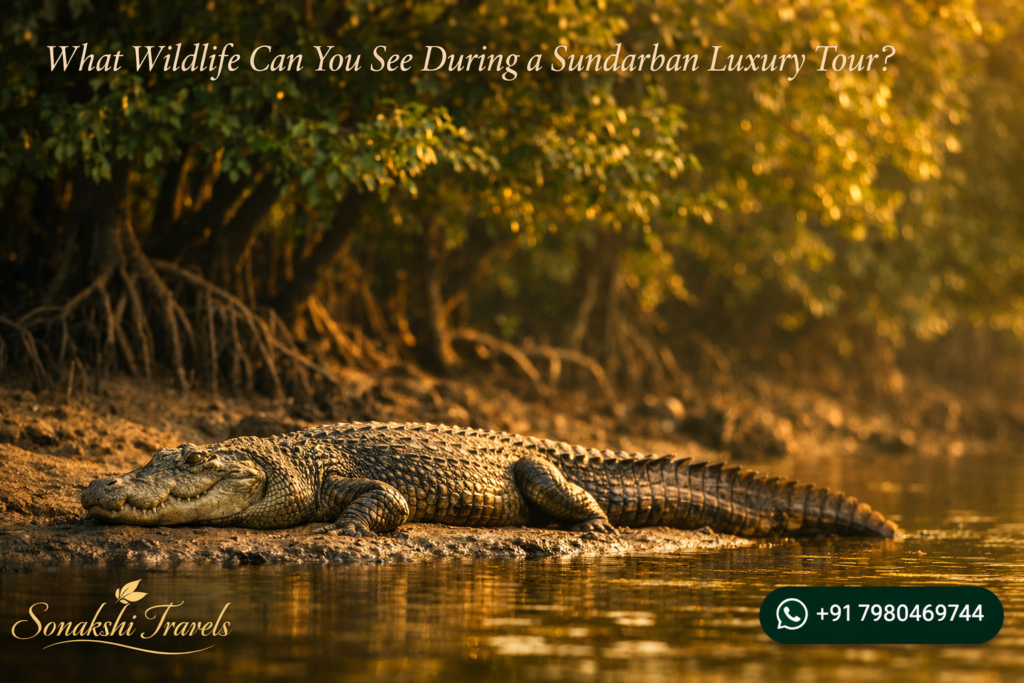
The wildlife seen during a Sundarban luxury tour is not limited to one famous animal. The forest is known around the world for the Royal Bengal tiger, but the living world of the delta is much wider, richer, and more layered than that single image. A careful traveler may see deer standing at the forest edge, crocodiles resting in mud, monkeys moving through branches, kingfishers flashing over water, egrets feeding in silence, and raptors circling over tidal channels. The beauty of this landscape is that wildlife does not appear in a fixed pattern. It rises slowly from water, mangrove shade, mudbank, sky, and tide.
That is why the question is important. People often ask what they can see, but the deeper answer depends on how they learn to look. In this forest, wildlife is not always dramatic. It may be still, distant, brief, half-hidden, or silent. A refined journey through this landscape gives more than comfort. It gives the calm conditions needed for careful observation. In that sense, a Sundarban luxury private tour can make the experience of wildlife more intimate because the traveler is not forced into noise, hurry, or crowd movement. The mind becomes quieter, and the forest begins to reveal more.
Unlike many inland forests, the Sundarban is a tidal mangrove world. Land and water are always in dialogue. That ecological condition shapes the animals that live here and also shapes the way visitors encounter them. The wildlife of the delta must survive in salt, mud, shifting banks, exposed roots, strong current, and changing water levels. This creates a community of life that is both tough and subtle. A traveler on a Sundarban tour who pays close attention will understand that every sighting belongs to a larger rhythm of habitat, feeding, waiting, and movement.
The Royal Bengal Tiger and the Meaning of a Rare Sighting
No animal dominates the imagination of the Sundarban more strongly than the Royal Bengal tiger. It is the most desired sighting, yet also the least certain. That uncertainty is part of its power. The tiger in this mangrove forest is not easily visible. It moves through dense cover, muddy banks, creeks, and remote ground that human visitors can never enter freely. Even when a tiger is nearby, it may remain unseen. Sometimes the forest gives only signs: pugmarks in soft mud, alarm calls from deer, sudden silence, or a feeling that the edges of the landscape have become alert.
When a tiger is seen, the sighting is often brief. It may appear at a creek edge, cross open mud, pause near roots, or move through the green-brown shadow of mangrove growth. This is not a zoo-like encounter. It is a rare meeting between watcher and wild authority. The tiger of the Sundarban has adapted to an unusually hard environment. It lives in saline conditions and travels through channels and swampy ground. That ecological adaptation is one reason why the animal holds such scientific and emotional importance.
During a Sundarban wildlife safari, many travelers hope for this single animal, but a mature understanding of the forest asks for a wider vision. The tiger matters deeply, yet the delta should not be reduced to tiger desire alone. A luxury journey becomes meaningful when it teaches patience rather than disappointment. The tiger is one part of the forest’s truth, not its whole truth.
Spotted Deer: The Most Common Large Mammal You May Notice
If the tiger is the symbol of hidden power, the spotted deer is often the most visible large mammal in the landscape. Herds or small groups may be seen near open banks, grassy edges, and transitional spaces where forest cover meets light. Their bodies bring softness to a severe environment. The white spots catch the eye, and their alert movements often reveal the emotional climate of the forest. When deer are calm, the place feels open. When deer freeze, stare, or suddenly move, the whole scene changes.
These deer play an important ecological role. They are grazers and browsers, and they are also prey within the broader food web. Their presence supports tiger behavior and reflects the health of the habitat. For visitors, they are often one of the first animals that create a direct feeling of wildlife richness. A Sundarban nature tour becomes more than a visual journey when the traveler understands that even a graceful deer at the waterline is part of a much larger chain of survival.
In good light, deer sightings can be especially memorable. A herd standing against low mangrove growth, with river reflection below and open sky above, creates a picture of calm that feels almost painted. Yet even this calm carries tension. In the Sundarban, prey species live with constant awareness. That emotional pressure is part of what gives the forest its unusual psychological depth.
Saltwater Crocodiles and the Heavy Silence of the River Edge
Another major animal of the delta is the estuarine or saltwater crocodile. This reptile belongs naturally to a mangrove system where brackish water, tidal movement, and muddy banks create ideal conditions. Crocodiles may sometimes be seen resting on exposed mudflats, half-submerged near creek mouths, or lying so still that they first appear to be part of the bank itself. Their stillness is deceptive. It contains force, patience, and ancient design.
For many travelers, crocodile sightings are deeply striking because they show a different form of wild power than a tiger does. The tiger represents movement through hidden ground. The crocodile represents waiting inside the border between land and water. That border is one of the most important ecological spaces in the Sundarban. Many animals feed, hide, or pass through such transitional areas, and the crocodile is one of its strongest guardians.
On a quiet Sundarban travel experience, a crocodile sighting can change the entire mood of observation. People speak less. They begin to notice the mud texture, the slope of the bank, the colour of the tide, and the still line of the reptile’s back. Good wildlife observation often grows from such moments, when one sighting teaches the eye how to see the landscape more seriously.
Water Monitor Lizards, Snakes, and Lesser Seen Reptiles
The reptile life of the Sundarban is not limited to crocodiles. Water monitor lizards are also part of this ecosystem and may be seen moving over mud, swimming between edges, or climbing in search of safety and warmth. Their bodies suit the mangrove world well. They are strong swimmers, skilled scavengers, and alert survivors in a habitat where quick adaptation matters.
Snakes also belong to the delta, though they are much less commonly seen by visitors. The Sundarban has several snake species, including venomous ones, but most tourist observations remain distant or accidental. Their relative invisibility reminds us of an important ecological fact: a great deal of wildlife exists beyond direct human sight. A Sundarban exploration tour does not reveal the whole forest. It reveals fragments, signs, and moments. That partial knowledge is not a weakness. It is part of the honesty of the wild.
Even when reptiles are not seen clearly, their ecological presence matters. They regulate prey populations, contribute to food balance, and occupy vital links in the mangrove system. Serious wildlife appreciation means respecting what is present, not only what performs itself for the eye.
Monkeys, Otters, and the Livelier Side of the Forest
Among mammals other than deer and tiger, rhesus macaques are among the more noticeable animals in many parts of the forest zone. They may be seen in branches, near banks, or moving in quick social groups. Their energy creates a different visual rhythm from the stillness of deer or crocodiles. They bring noise, play, argument, and movement. For travelers, monkey sightings often give the landscape a more immediate sense of life.
There are also reports of otters in the broader delta ecosystem, though they are not guaranteed sightings and are far less commonly observed by general visitors. When seen, they add another layer to the understanding of this watery habitat. Otters represent intelligence, movement, and feeding skill within the tidal environment. Their presence points toward the richness of aquatic life that supports the whole system.
During a carefully designed Sundarban private wildlife safari, these smaller and mid-sized mammals often become important because the atmosphere is calmer and the traveler has more time to pay attention. In shared or noisy conditions, people often wait only for the biggest headline species. In a more private setting, the forest is allowed to speak in many voices.
Birdlife: One of the Greatest Wildlife Riches of the Sundarban
For many serious observers, birdlife is one of the true treasures of the delta. The Sundarban supports a wide range of resident and visiting birds linked to mudflats, tidal creeks, open sky, forest edges, and aquatic feeding grounds. Kingfishers are among the most loved. Their sharp colours and sudden flight bring brightness to the muted tones of mangrove mud and water. Egrets and herons are also common visual presences, often standing with great patience in shallow areas as they hunt.
Raptors may be seen above channels or tree lines, watching for prey and using the open airspace above the tidal world. Cormorants, sandpipers, plovers, and other water-associated birds may also appear depending on location and ecological conditions. The emotional effect of birdlife in the Sundarban is special because birds often reveal the changing mood of the place. A silent bank with one white egret feels very different from a channel alive with wing movement and calls.
A Sundarban bird photography tour would find great value in such variety, but even a general traveler can feel its depth. Birds make the forest readable. They show feeding zones, hidden water movement, safe perches, and moments of tension. When a kingfisher dives, when a heron lifts slowly from mud, or when a raptor circles against afternoon light, the ecosystem becomes visible in action rather than theory.
Why Bird Sightings Matter So Much
Birds are not just decorative life around the main animals. They are ecological indicators. Their diversity can reflect habitat health, water condition, prey presence, and seasonal productivity within a wetland system. In a mangrove forest, bird behavior is a constant form of environmental language. The traveler who learns to notice birds learns to notice the logic of the place itself.
This is one reason a refined Sundarban luxury wildlife safari can feel intellectually satisfying as well as beautiful. It is not only about seeing more. It is about understanding more. Birdlife rewards patience, and patience is one of the main strengths of a quiet, high-quality wildlife journey.
Fish, Crabs, Mudskippers, and the Hidden Base of the Food Web
When people ask what wildlife they can see, they often think only of large animals. Yet the Sundarban lives from a much wider biological base. Fish, crabs, mollusks, prawns, and amphibious species such as mudskippers are part of the visible and invisible engine of the delta. Mudskippers are especially interesting because they seem to belong to two worlds at once. On exposed tidal flats, their strange movements show how life adapts creatively in a harsh intertidal environment.
Crabs also shape the mud surface, the nutrient cycle, and the general productivity of the mangrove ground. Small creatures leave tracks, holes, ripples, and signs everywhere. These details may appear minor at first, but they sustain the larger predators and bird populations that visitors admire. A truthful account of wildlife on a Sundarban tour package must include these lower and middle layers of life, because without them the famous species could not survive.
The delta is therefore not a stage where a few big animals perform. It is a living network. Every fish movement under water, every crab hole in mud, and every feeding bird at the edge is part of one connected ecological structure.
How Luxury Changes the Experience of Seeing Wildlife
Luxury in the Sundarban should not be understood only as comfort. In a serious wildlife context, luxury means controlled disturbance. It means less noise, better pace, clearer attention, and more emotional ease. When a visitor is not tired, crowded, rushed, or distracted, the senses become sharper. The eye notices smaller movement. The ear catches more subtle sound. The mind has enough stillness to remain present.
That is why wildlife observation during a exclusive Sundarban private tour often feels more rewarding even when sightings are not dramatic. The traveler has room to absorb mood, form, spacing, and silence. Instead of collecting animals like items on a list, one begins to read the environment as a living text.
A high-quality Sundarban luxury tour package also creates a better mental state for observation. In wildlife travel, mental comfort is not superficial. It affects perception. A peaceful viewing condition can turn a distant deer, a passing kingfisher, or a resting crocodile into a deeply memorable encounter because the mind is fully available to the moment.
The Psychology of Wildlife in a Mangrove Forest
The Sundarban produces a special kind of attention. In open grasslands, wildlife may be seen from far away. In mountains, form is often shaped by height and distance. In the mangrove delta, everything feels closer to concealment. Water bends, roots hide, channels narrow, and mudbanks break the line of vision. This creates a psychological atmosphere of expectancy. The traveler feels that something may appear at any moment, but nothing is guaranteed.
That feeling is central to the wildlife experience here. One does not simply look at animals. One waits with the landscape. The mind becomes slower and more observant. Even silence becomes active. A rustle in branch cover, a deer turning its head, birds rising suddenly, or a mark in wet mud can all carry meaning. In this way, the Sundarban trains perception itself.
A thoughtful Sundarban travel guide should help visitors understand this emotional structure. The value of the forest lies not only in rare sightings but in the discipline of attention it creates. The wildlife becomes meaningful because it is embedded in tension, uncertainty, and ecological truth.
What Makes the Wildlife of the Sundarban Distinct
Many forest destinations have mammals, birds, reptiles, and aquatic life. What makes the Sundarban different is the mangrove setting itself. Salinity, tide, mud, shifting waterlines, exposed roots, and unstable edges create a difficult habitat. The animals here are not simply present in the forest. They are shaped by the forest’s unusual demands. Tigers move in mangrove terrain. crocodiles rest in estuarine channels. Birds feed in tidal flats. Fish and crabs support the whole system from below.
This makes the wildlife experience of the delta both beautiful and intellectually serious. It is a place where adaptation is visible. Even when travelers do not use scientific terms, they feel this truth. The animals look fitted to struggle, caution, and change. That gives the forest a strong emotional identity.
Seen in this light, a Sundarban luxury nature tour becomes more than a comfortable escape. It becomes an encounter with one of the world’s most unusual wetland ecosystems, where every animal lives in negotiation with water, salt, concealment, and hunger.
The Real Answer to the Wildlife Question
So, what wildlife can you see during a Sundarban luxury tour? You may see the Royal Bengal tiger if fortune, timing, and forest mood allow. You are more likely to see spotted deer, crocodiles, monkeys, water birds, kingfishers, egrets, herons, raptors, and the many smaller creatures that make a tidal ecosystem alive. You may also see traces rather than bodies, and those traces matter. Tracks, calls, movement in branches, and sudden silence are part of wildlife knowledge too.
The deepest answer, however, is that the Sundarban does not offer wildlife as a simple display. It offers a living environment where sighting, waiting, and interpretation all belong together. A rich journey through this landscape teaches that wildness is not always loud. Sometimes it stands still on a mudbank. Sometimes it flashes blue over water. Sometimes it watches from cover and never fully appears.
That is why the wildlife of the Sundarban stays in memory. It is not only diverse. It is atmospherically powerful. During a refined and quiet Sundarban private tour package, the traveler does not merely search for animals. The traveler enters a world where river, mud, root, and silence are all part of how wildlife is felt. That deeper experience is what makes the delta unforgettable.