Updated: March 24, 2026
Is it Safe to Bring Children on a Sundarban Private Tour?
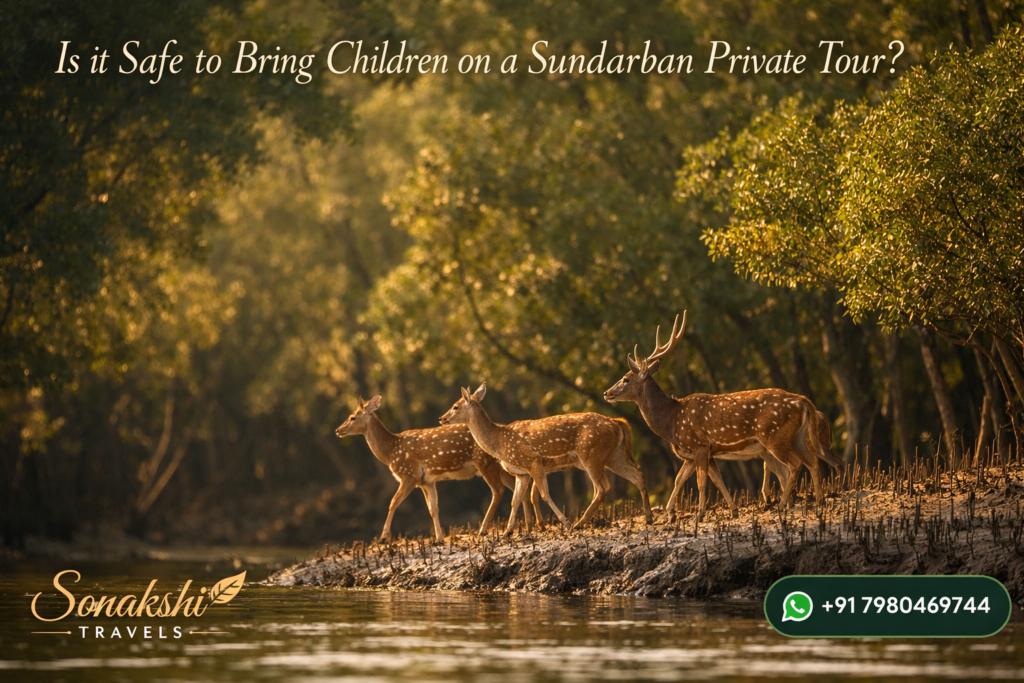
The question deserves a careful answer. Parents are not only asking whether a place is beautiful or whether a journey is memorable. They are asking whether the experience can protect a child’s body, attention, comfort, emotional balance, and daily rhythm. In the case of the Sundarbans, that concern becomes even more important because this is not a loud amusement destination, a simple city break, or a fixed sightseeing circuit. It is a tidal forest landscape where silence, water, distance, and ecological discipline shape the experience. So the answer is yes, children can be brought on a Sundarban private tour, but only when the journey is planned with maturity, close supervision, and a clear understanding of what children actually need in a sensitive natural environment.
Safety here should not be measured by fear alone. Many parents think first about wild animals, remote waterways, or the idea of being inside a forest region. Those concerns are understandable, but child safety in the Sundarbans depends just as much on quieter things: the quality of supervision, the stability of the boat setting, the behavior of adults around the child, the pace of the day, hygiene standards, food suitability, rest, and the ability to reduce unnecessary physical strain. A poorly planned trip can feel difficult even for adults. A well-managed private journey, however, can become calm, structured, and surprisingly child-friendly.
Why a Private Setting Changes the Safety Question
The word private matters. In a shared journey, families often have to adapt to the needs, noise, timing, and movement patterns of strangers. That can make it harder to regulate a child’s comfort. In contrast, a private setting gives parents greater control over space, schedule, food timing, rest breaks, and the emotional atmosphere around the child. That is one reason many families prefer a Sundarban family private tour instead of a crowded arrangement where the day moves according to a group rhythm rather than a child’s rhythm.
Children do not respond well to avoidable chaos. They feel secure when movement is predictable, when adults remain calm, and when they are not constantly pushed between unfamiliar people and loud environments. A private arrangement allows the family to manage this more intelligently. A child can sit close to parents, move less anxiously, eat when needed, rest without embarrassment, and experience the landscape without the social pressure that often comes with large mixed groups. This does not remove all responsibility. It simply creates better conditions for responsible parenting.
That is also why many parents view a carefully arranged Sundarban private tour package as safer than an ordinary shared outing. The value is not luxury for its own sake. The value lies in control. Control over surroundings often leads to better observation, better discipline, and quicker adult response if a child becomes tired, restless, hungry, or overstimulated.
Physical Safety Depends on Supervision, Not Assumption
When children travel in a river-and-forest environment, adults must reject casual thinking. A child should never be treated as safe merely because the place feels peaceful. The Sundarbans can look quiet, but quiet environments still demand alertness. Water edges, moving decks, boarding points, slippery surfaces, and moments of distraction require constant adult attention. Safety improves when the adults themselves are disciplined. That means holding a younger child close during movement, making clear rules about where the child may sit or stand, and never allowing exploratory wandering just because the atmosphere appears gentle.
Children are naturally curious. They lean, point, run, bend, and turn suddenly. In ordinary urban life, adults may tolerate this with little concern. In a boat-based environment, such spontaneity must be guided. A responsible parent on a Sundarban private boat tour does not wait for danger to appear. The parent reduces risk before it appears. This includes keeping life jackets properly fitted where appropriate, ensuring the child is never left near an edge without direct supervision, and avoiding the false confidence that comes from a smooth early experience.
One of the most important truths is that child safety is rarely created by a single rule. It is created by many small disciplined actions repeated throughout the day. A private setting helps these actions remain consistent because the family does not need to constantly negotiate with group behavior.
The Emotional Safety of a Child Matters Too
Parents often focus on physical protection, but emotional safety matters just as much. Children do not experience a landscape the way adults do. An adult may interpret silence as peace, distance as beauty, and stillness as depth. A child may at first interpret the same conditions as strange, boring, uncertain, or intimidating. This does not mean the journey is unsuitable. It means the experience must be emotionally translated for the child.
A child feels safer when adults remain steady in tone and expression. If the parent behaves as though the place is threatening, the child may absorb that fear. If the parent behaves as though the place must constantly entertain, the child may become restless and disappointed. The healthiest approach is calm orientation. Let the child understand that this is a quiet natural world, that the day moves gently, and that watching, listening, and noticing are part of the experience. In that setting, the child does not merely stay safe. The child begins to feel secure inside the unfamiliar.
This is where a well-managed Sundarban tour differs from a hurried outing. The experience can teach patience, observation, and respect for nature, but only when the child is not emotionally overwhelmed. Parents should therefore pay attention to mood changes, fatigue, hunger, and overstimulation. A child who becomes irritable is not necessarily misbehaving. The child may simply be tired from constant unfamiliarity.
Age Matters, but Maturity Matters More
There is no single age that automatically makes a child ready or unready. Two children of the same age can respond in very different ways. One may remain calm, curious, and responsive to instruction. Another may resist sitting still, reject unfamiliar food, become frightened by silence, or struggle with long stretches of observation. Parents know their own child best, and that knowledge should guide the decision more than general assumptions.
Very young children usually require the highest level of logistical care because their physical and emotional needs change quickly. They need food at the right time, proper hydration, rest, and close holding during movement. School-age children often do better because they can understand instructions, ask questions, and engage with the landscape more consciously. Yet even older children need boundaries. A child’s intelligence should never be mistaken for environmental judgment.
In this sense, the question is not simply whether children can join a Sundarban private wildlife safari. The deeper question is whether the adults can match the environment to the child’s maturity. A child who is naturally observant, patient, and comfortable with slow travel may respond beautifully. A child who needs constant running, noise, or digital stimulation may find the setting more difficult unless the adults frame the journey thoughtfully.
Hygiene and Food Safety Are Central to Child-Friendly Travel
For children, safety is also biological. A journey can appear smooth and still become unpleasant if food is too spicy, meal timing is irregular, drinking water is uncertain, or hygiene standards are poorly maintained. Parents should think beyond the visual charm of the experience and ask practical questions: Is the drinking water reliable? Can simple child-friendly meals be arranged? Are utensils, wash areas, and food handling kept clean? Can the child eat without digestive stress?
Children often struggle not because the destination is unsafe in a dramatic sense, but because their bodies respond quickly to disruption. Irregular eating, dehydration, heat strain, or unsuitable meals can turn a beautiful journey into a difficult one. On a carefully arranged Sundarban private tour package, these issues can usually be managed better because meal planning and pacing can be adapted to the family. That adaptability is one of the strongest hidden safety advantages of a private setup.
Parents should also remember that children may not be able to clearly describe early discomfort. A child may become quiet, clingy, sleepy, or unusually irritable before openly saying that something feels wrong. In a good family journey, adults keep reading those signals throughout the day.
The Boat Environment Can Be Child-Friendly When Managed Properly
Many parents worry most about the boat, and that is reasonable. The boat is not dangerous by definition, but it is an environment that requires rules. The reassuring truth is that a stable and responsibly managed private boat can actually create a more contained and controlled space than many crowded group arrangements. Children usually do better when they have a defined place to sit, familiar adults nearby, and a quieter atmosphere around them.
On a private journey, parents can reduce unnecessary movement and keep the child’s attention focused outward rather than allowing random wandering. The child can watch the water, birds, changing banks, and mangrove textures from a supervised position. This often creates a calm learning experience. The landscape becomes something to observe, not something to rush through.
That is one reason some families prefer a private Sundarban eco tour or a private Sundarban river cruise-style experience over noisier formats. The child is less likely to be overwhelmed by crowd behavior. The adults can keep the mood quieter, the instructions clearer, and the physical space more orderly. Safety improves when the environment does not constantly invite distraction.
Nature Can Be Deeply Enriching for Children
Safety is not the only point. Parents also ask this question because they want to know whether the journey is meaningful enough to justify the care it demands. In many cases, it is. A child who experiences the Sundarbans in the right way may gain something rare: direct contact with a landscape that teaches attention rather than consumption. The child sees that nature is not always loud, immediate, or staged for entertainment. The child learns that wonder sometimes arrives quietly.
This matters in modern childhood. Many children live inside fast cycles of screens, traffic, noise, and fragmented attention. A slow natural space can reset perception. On a well-designed Sundarban travel experience, the child may begin noticing patterns that urban life hides: bird movement, changing water textures, mudbanks marked by tide, silence broken by a single call, the feeling of waiting and seeing rather than demanding instant stimulation.
Such experiences can support emotional development when they are handled with patience. The child learns restraint, listening, and environmental respect. These are not abstract educational ideals. They are lived forms of awareness. Yet this enrichment becomes possible only when the child first feels secure.
Parents Must Adjust Their Own Expectations
One mistake some adults make is expecting a child to behave like a miniature nature enthusiast. That is unrealistic. A child may not admire every moment of silence. A child may ask repetitive questions, grow restless, or want breaks from observation. This does not mean the trip is failing. It means childhood is present inside the journey, and the adults must adapt with grace.
A child-safe journey is never built on perfection. It is built on flexibility. Parents should allow the child to engage in phases. There may be moments of excitement, moments of quiet attention, and moments of boredom. All three are normal. The goal is not to force constant fascination. The goal is to support a stable, healthy, manageable encounter with the landscape.
That is why a family should not judge the success of the trip only by how much the child “saw.” The real measure is whether the child remained comfortable, secure, curious, and well-supported. A truly child-friendly Sundarban tour package for a private family journey should protect the child’s limits rather than ignore them.
When Bringing Children May Not Be the Right Choice
It is equally important to be honest. There are cases where bringing a child may not be the best decision. If a child has severe difficulty with unfamiliar food, cannot tolerate long periods of supervised stillness, becomes distressed in natural silence, or has specific medical needs that are hard to manage during travel, parents should think very carefully. The issue is not whether the destination is “good” or “bad.” The issue is fit.
Similarly, if the adults themselves are not prepared for constant supervision, the idea of a private nature trip may be more appealing in imagination than in practice. A child in the Sundarbans cannot be managed casually. Adults must remain mentally present. If the plan depends on the assumption that the child will somehow adjust automatically, that is not good planning.
There is also a difference between taking a child for the child’s experience and taking a child simply because the family does not want to travel separately. The better journeys happen when the adults genuinely intend to include the child with care, not merely carry the child through an adult plan.
So, Is It Safe?
Yes, bringing children on a Sundarban private tour can be safe when the journey is approached with realism, discipline, and child-centered planning. It is not safe because the destination is simple. It is safe when the adults create conditions that reduce risk and support comfort at every stage. The private format helps because it gives parents more control over environment, pace, food, rest, and supervision. That control can make a major difference.
But the most important truth is this: child safety in the Sundarbans is not only about avoiding danger. It is about protecting the child’s whole experience. A safe journey is one where the child is physically guarded, emotionally settled, hygienically supported, and gently introduced to the landscape without pressure. When those conditions are met, the trip can become not only safe, but deeply valuable.
For the right family, the Sundarbans can offer a rare kind of shared memory. Not a noisy memory of excess activity, but a quieter one shaped by water, attention, closeness, and discovery. A child may not remember every detail of the forest, but the child may remember the feeling of being held safely inside a different world. In the end, that is what responsible family travel should achieve.