Private Sundarban Wildlife Safari: How to Plan Around Tides, Routes and Forest Timings
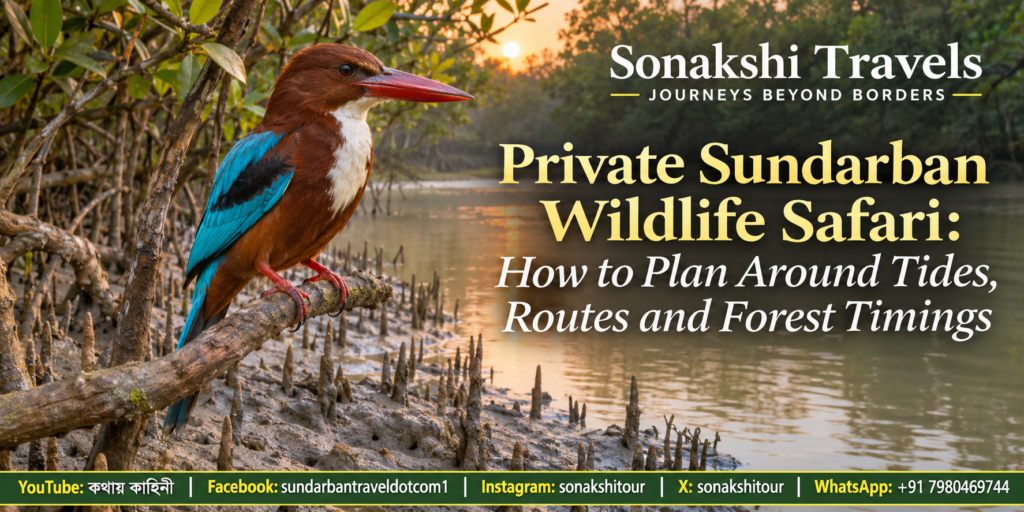
A private wildlife safari in the Sundarbans requires a different approach to travel planning. Unlike a conventional national park where visitors follow established roads in safari vehicles, the Sundarbans are explored primarily by boat, moving through a vast network of tidal rivers and mangrove-lined waterways.
Here, the river is not simply part of the scenery. It influences the journey itself.
Changing water levels, tidal currents, navigation conditions, permitted forest routes and official operating hours all affect how a Sundarban wildlife safari can be organised. Even a carefully prepared itinerary may need adjustments when natural conditions or forest regulations require them.
For travellers planning a private Sundarban wildlife safari, understanding these factors is essential. It helps distinguish a realistic, well-organised journey from an itinerary that promises more than can reasonably be delivered.
A private boat can offer greater comfort, quieter wildlife observation and more control over personal arrangements. However, it does not provide unrestricted access to protected forests or the freedom to ignore official timings.
This guide explains how tidal movements affect navigation, why authorised routes matter, how forest operating hours influence the schedule and what visitors should confirm before booking.
1. Why a Sundarban Wildlife Safari Must Be Planned Around Nature
The Sundarbans form an extraordinary mangrove environment at the meeting point of river systems and the Bay of Bengal. Their landscapes are shaped by water, sediment, vegetation and the continuous interaction between freshwater and saline tidal influences.
For wildlife travellers, this creates an experience very different from visiting a dryland tiger reserve.
Instead of following a road through woodland, tourists observe the forest from navigable rivers and authorised visitor facilities. Wildlife may appear along muddy riverbanks, within mangrove vegetation or close to exposed tidal flats.
However, these environments are constantly changing.
Water Levels Influence the Appearance of the Landscape
As the tide rises, water may cover sections of exposed mud and the lower portions of mangrove roots. During falling or lower water conditions, previously submerged surfaces may become visible.
The result is a landscape that can look noticeably different over the course of a single safari day.
Visitors interested in wildlife photography may appreciate the changing textures and colours of the riverbanks. Those interested in ecology can observe how mangrove vegetation exists within an environment repeatedly influenced by tidal flooding.
Nevertheless, visible mudflats do not automatically mean wildlife will be present, and higher water does not guarantee better sightings.
Navigation Conditions Influence the Schedule
Tidal currents, water depth, wind and the characteristics of individual waterways affect boat operations.
A route that is straightforward under one set of conditions may require a more cautious approach at another time.
Experienced boat crews consider these circumstances alongside the approved tourism route and instructions from the Forest Department.
Visitors should therefore regard departure times and sightseeing sequences as carefully planned arrangements rather than promises that natural conditions will always cooperate.
2. Understanding High Tide and Low Tide in the Sundarbans
Tides are among the most important natural processes affecting the Sundarbans.
The region generally experiences two high-water and two low-water phases during a lunar day. The timing shifts from day to day, while the tidal range varies with location, lunar conditions, weather and the characteristics of individual channels.
Consequently, a visitor cannot assume that high tide will occur at the same clock time throughout a holiday.
What Happens During High Tide?
During rising and higher water conditions, tidal water extends farther across the margins of many channels.
Some roots and mudbanks become submerged, changing the appearance of the forest edge. Depending on the specific waterway, greater depth may assist navigation in certain shallow sections.
However, high tide should not be described as universally ideal for boating. Currents can remain strong, submerged hazards may be less visible and particular routes may present other operational considerations.
The appropriate decision belongs to the authorised boat crew, operating within forest regulations.
What Happens During Low Tide?
As water levels fall, exposed mudbanks, mangrove roots and sediment surfaces become more noticeable.
Visitors may observe the characteristic structure of the tidal forest more clearly, including the exposed root systems associated with different mangrove species.
Some birds may forage on exposed or shallow-water surfaces under suitable conditions.
At the same time, reduced water depth can create navigation limitations in particular channels. A boat cannot safely enter a waterway merely because a photographer wants a closer view.
Are Spring Tides and Neap Tides Important?
Yes, although visitors do not need to become tidal-navigation specialists.
Spring tides occur around the new and full moon, when the difference between high and low water is generally greater. Neap tides occur around the first and third quarter moon, when the tidal range is generally smaller.
These patterns can influence current strength and water levels, but local conditions remain important.
For practical travel planning, the most useful approach is to ask whether the operator has reviewed suitable local tidal information for the proposed dates and routes.
Travellers should not attempt to select supposedly perfect wildlife-viewing days solely from a lunar calendar.
3. How Tides Affect Wildlife Observation and Photography
Wildlife observation in the Sundarbans requires patience, and tides are only one part of the environment influencing what visitors may see.
Animals respond to food availability, shelter, disturbance, weather, seasonal conditions and their own behavioural patterns.
As a result, no single tidal phase guarantees a successful sighting.
Watching Birds Along Tidal Riverbanks
Birdwatchers may encounter kingfishers, herons, egrets, raptors and other species associated with wetland or forest habitats.
The opportunities for observation vary according to location, season and the behaviour of individual species.
When mudflats become exposed, certain feeding birds may be easier to observe. In other circumstances, birds may remain perched among vegetation or move across the waterways.
A knowledgeable naturalist can help visitors interpret what they are seeing without presenting every animal movement as a direct consequence of the tide.
Observing Crocodiles and Other River Wildlife
Saltwater crocodiles are among the animals associated with the Sundarbans’ aquatic environment.
They may sometimes be observed basking or resting near suitable river margins, but their appearance is unpredictable.
Water level, temperature, disturbance and individual behaviour can all influence visibility.
The boat must maintain a safe distance, and passengers should never request a closer approach that could disturb an animal or compromise safety.
What About Royal Bengal Tiger Sightings?
The Royal Bengal tiger is one of the most celebrated inhabitants of the Sundarbans, but it is also difficult to observe reliably.
Dense vegetation, extensive habitat, tidal waterways and naturally elusive behaviour make sightings uncertain.
Additional safari time may create more opportunities for observation, but it cannot guarantee that a tiger will appear.
Claims that a particular tide, time or route ensures tiger sightings should be treated cautiously.
A responsible wildlife safari is successful when it provides a meaningful experience of the ecosystem, even without a rare animal encounter.
Photographic Planning Without Disturbing Wildlife
Photographers may benefit from early daylight, quieter conditions and the changing appearance of the mangrove riverbanks.
However, there is no justification for leaving approved routes, entering closed creeks or approaching animals too closely.
Longer lenses, binoculars and patience are better tools than attempting to alter an animal’s behaviour.
The most rewarding photographs often document natural interactions between vegetation, water, birds and changing light.
4. Choosing the Right Safari Route in the Sundarbans
Route planning is central to any private Sundarban wildlife safari.
Visitors sometimes assume that hiring a private boat allows them to select any creek or river. In reality, tourism inside the protected area operates according to designated routes, permits and official instructions.
The Forest Department may restrict movement for conservation, security, management or safety reasons.
A responsible operator should explain the intended route before booking and identify which attractions are included, subject to operational conditions.
Sajnekhali: An Important Tourism and Administrative Location
Sajnekhali is a recognised visitor location associated with forest tourism arrangements and nature interpretation.
Depending on the permitted itinerary, visitors may encounter facilities connected with the region’s wildlife and mangrove environment.
It is important, however, to distinguish an administrative or visitor stop from extended wildlife exploration on the river.
A route containing several named stops is not necessarily superior to one that allows more time for quiet observation.
Sudhanyakhali: Forest Observation Opportunities
Sudhanyakhali is another established tourism location frequently associated with Sundarban sightseeing programmes.
It may provide opportunities to observe the surrounding environment from designated visitor facilities when access is permitted.
Nevertheless, sightings cannot be predicted, and access depends on current regulations and operational conditions.
Dobanki: A Different Perspective on the Mangroves
Dobanki is well known among visitors for its designated forest observation facilities, including an elevated walkway environment where open to tourism.
Such facilities can provide a different perspective from watching the forest entirely from a moving boat.
Yet the inclusion of Dobanki depends on the authorised route, available time and current access arrangements.
Travellers should not assume that every private itinerary includes it.
Why More Destinations Do Not Always Mean a Better Safari
Trying to include too many locations in a limited period may create an unnecessarily rushed experience.
Long-distance movement between visitor points can consume time that might otherwise be used for wildlife observation.
A well-designed route should balance travel distance, available sightseeing hours, permitted access, passenger comfort and the natural conditions of the day.
For serious nature enthusiasts, fewer stops with more thoughtful observation can sometimes be more satisfying than an ambitious itinerary dominated by transit.
5. Forest Timings: Why the Safari Cannot Continue After Dark
The Sundarbans are not an unrestricted sightseeing destination where visitors can continue exploring the protected forest whenever they wish.
Tourism is subject to official operating hours, authorised routes and instructions from forest personnel.
These conditions must be considered before finalising the daily programme.
Daylight Is a Fundamental Planning Consideration
Wildlife excursions should be planned within the officially permitted tourism period.
The exact entry, exit and visitor-facility timings should be confirmed for the particular route and travel date rather than relying on a universal clock-time claim.
Even when daylight remains, boat movements may be constrained by the authorised operating window or specific instructions.
A responsible itinerary includes sufficient time to return without placing the crew under pressure to travel beyond permitted conditions.
Why Night Safaris Should Not Be Promised
Visitors may be interested in the possibility of seeing nocturnal animals. However, a conventional private tourist booking does not authorise night exploration inside the protected forest.
Operators should not advertise unrestricted night safaris, spotlighting wildlife or extended travel through closed forest waterways.
Evening activities outside the reserve, such as relaxing at accommodation or enjoying a meal, are different from an authorised forest safari.
Check Weekly and Special Closures
Official tourism notices have identified Tuesday as a regular closure day for the Sundarban Tiger Reserve.
Travellers should verify whether that restriction remains applicable for their specific dates and planned route.
Additional limitations may arise from forest management decisions, severe weather, emergencies or other official requirements.
A booking should not be considered fully planned until the operator has addressed these restrictions.
Build a Return-Time Buffer
A sensible safari schedule does not attempt to use every remaining minute inside the forest.
Water conditions, navigation speed, checks and unforeseen delays can affect the return journey.
It is preferable to finish the excursion comfortably within permitted hours than to organise an unrealistic route requiring the boat to rush back.
6. High Tide, Low Tide and Forest Timings: Practical Comparison
The following table explains how different operating conditions may influence safari planning. It provides general guidance rather than site-specific navigational instructions.
| Planning Factor | Possible Benefit | Potential Limitation | Recommended Approach |
|---|---|---|---|
| Higher water levels | Additional depth in some channels | Submerged banks and potentially strong currents | Follow the crew’s route assessment |
| Lower water levels | Visible mudflats and mangrove roots | Reduced depth in some waterways | Do not insist on entering shallow channels |
| Early daylight | Soft photographic light and comfortable observation conditions | Fog, visibility limitations or access restrictions | Coordinate departure with permitted hours |
| Afternoon daylight | Changing light and further observation opportunities | Limited time before the required return | Allow a substantial return buffer |
| Spring tides | Pronounced tidal variation | Potentially stronger currents and changing water levels | Use location-specific tidal information |
| Private boat booking | Greater control over group comfort and some scheduling preferences | No exemption from forest rules | Agree on flexibility within permitted routes |
The fundamental principle is that tides, routes and forest timings must be considered together.
A favourable photographic tide is of little practical value if the relevant area is closed, unreachable or outside the approved route.
Likewise, an attractive destination is not a sensible choice if reaching it leaves insufficient time for a safe return.
7. How to Build a Realistic Private Wildlife Safari Itinerary
Good itinerary design begins with priorities rather than a long collection of destination names.
The first step is to decide whether the main purpose of the journey is wildlife photography, birdwatching, family relaxation, learning about mangrove ecology or a general introduction to the Sundarbans.
Step 1: Select an Appropriate Starting Point
Visitors travelling from Kolkata commonly use road transfers towards established boarding locations such as Godkhali, while other arrangements may involve Dhamakhali or travel through Canning.
The appropriate starting point depends on the selected itinerary and operator.
Travel time before boarding must be considered when calculating the realistic amount of daylight available for the safari.
Step 2: Decide How Many Days Are Available
A shorter private safari can provide an introduction to the mangrove landscape, but substantial travel time may be consumed on arrival and departure days.
Longer programmes can create more opportunities for extended observation, particularly when a middle day is available for authorised forest exploration.
Travellers deciding between the common itinerary lengths may consult 1 Night 2 Days vs 2 Nights 3 Days: Which Sundarban Private Tour Is Better? for a focused comparison of available sightseeing time, comfort and practical value.
Step 3: Review the Intended Route
Request a written description of the planned waterways, authorised visitor locations and approximate sightseeing sequence.
Ask whether the itinerary has been developed with realistic travel distances and time allowances.
If the operator mentions specialised wildlife areas, confirm that they are accessible under the applicable tourism permissions.
Step 4: Coordinate Tides and Operating Hours
The boat operator should consider relevant local tidal predictions, expected weather and the permitted tourism window.
Tourists do not need to calculate currents independently, but they should understand that some itinerary changes may be necessary.
An operator’s willingness to explain these limitations is more reassuring than an inflexible promise to visit every destination regardless of conditions.
Step 5: Keep the Observation Schedule Flexible
Private arrangements can make it easier to spend an appropriate amount of time observing an animal from a safe position, pause for photographs where permitted or adjust meal timing.
However, the boat must continue to follow official instructions and maintain a realistic schedule.
Flexibility should improve the experience without compromising conservation or safety.
8. Advantages and Disadvantages of a Private Sundarban Wildlife Safari
Private boats are increasingly considered by travellers who value personal space and greater control over the arrangements. Their advantages are meaningful, but they should be assessed alongside their limitations.
Advantages of Private Safari Arrangements
- Greater privacy: The passenger accommodation is reserved for the booked party, subject to the agreed arrangement.
- Personalised observation priorities: Birdwatchers, photographers and general visitors can discuss their interests with the guide.
- Flexible meal arrangements: Food preferences and meal scheduling may be organised in advance.
- Comfortable group management: Families can select arrangements suited to their travelling companions.
- Less competition for viewing space: A suitable private boat can reduce the inconvenience of sharing observation areas with unrelated passengers.
- Better communication: Guests can discuss realistic route preferences and practical concerns directly with the operating team.
Disadvantages and Limitations
- Private boat operation can be relatively expensive for small groups.
- The boat still requires an authorised crew and guiding arrangements.
- Private booking does not permit access to restricted waterways.
- Wildlife sightings remain unpredictable.
- Bad weather, tides and official restrictions can change the itinerary.
- Not every private boat provides the same level of comfort, accessibility or facilities.
These limitations do not reduce the potential value of a private safari. They simply reinforce the importance of selecting arrangements that match the traveller’s actual requirements.
Considering Parents and Senior Travellers
For family groups, the right boat and schedule can be particularly important when parents or senior relatives are travelling.
Some guests may prefer comfortable seating, predictable meals, fewer boarding transfers and convenient toilet access rather than spending every possible hour sightseeing.
The guide Travelling With Parents? Why a Private Sundarban Tour Gives You More Control explores how private arrangements can accommodate these priorities while respecting the practical limits of travelling through a tidal environment.
When mobility is a concern, the operator should be asked about the exact boat, boarding point and accommodation facilities rather than relying on general descriptions such as comfortable or luxury.
9. Essential Checklist Before Booking a Sundarban Wildlife Safari
A short written checklist can prevent misunderstandings between travellers and tour operators.
Forest Permissions and Route Planning
- Confirm that the proposed tourist boat is appropriately registered and authorised.
- Ask how the required forest permissions will be arranged.
- Verify that an authorised ecotourism guide will accompany the safari.
- Check whether the proposed visitor points are open for the selected dates.
- Confirm any Tuesday closure or special restrictions.
- Request a realistic itinerary showing the intended waterways and visitor stops.
Tides, Weather and Timing
- Ask whether relevant local tidal conditions have been considered.
- Verify the proposed boarding time and return arrangements.
- Check how the operator handles severe weather or poor visibility.
- Ensure the itinerary remains within authorised forest operating hours.
- Allow flexibility if navigational conditions require changes.
Boat Safety and Passenger Comfort
- Confirm suitable life jackets for every passenger, including children.
- Check whether first-aid and fire-safety provisions are available.
- Ask for current photographs of the actual boat.
- Review seating, shade, handrails and toilet facilities.
- Discuss any mobility limitations or special boarding requirements.
- Confirm passenger capacity and that the boat is not overloaded.
Food, Drinking Water and Personal Preparation
- Clarify the number of meals included.
- Discuss dietary restrictions and allergies beforehand.
- Arrange drinking water in compliance with forest plastic restrictions.
- Carry essential medicines and appropriate sun protection.
- Bring binoculars or a camera where desired.
- Avoid bringing unnecessary disposable packaging into the reserve.
Passengers must also respect conservation rules. Loud music, littering, swimming, fishing, unauthorised drone use and disturbing wildlife are not acceptable tourist activities inside the protected area.
10. Frequently Asked Questions About Sundarban Safari Planning
What is the best tide for a Sundarban wildlife safari?
There is no universally best tide for wildlife sightings. Higher and lower water conditions change the appearance of riverbanks and can influence navigation, but animal sightings depend on several additional factors. An experienced crew should assess local tides for safe and permitted travel rather than promise wildlife based on a particular tidal phase.
Can a private boat enter narrow creeks during high tide?
Only when the waterway is authorised for tourism and the crew considers navigation appropriate. Higher water does not make a restricted creek accessible to visitors. Forest permissions and safety requirements remain decisive.
What time does a Sundarban safari begin?
The departure time depends on the selected boarding point, itinerary, daylight, forest permissions and local operating conditions. Travellers should request the actual schedule for their dates instead of relying on a generic departure time published by an unrelated operator.
Are night safaris allowed in the Sundarbans?
A standard private tourist booking does not authorise unrestricted night safaris inside the protected reserve. Wildlife tourism must follow the applicable forest operating rules and official instructions. Evening activities at accommodation should not be confused with night entry into the forest.
Is Tuesday a suitable day for forest sightseeing?
Official tourism information identifies Tuesday as a closure day for the Sundarban Tiger Reserve. Travellers should check the current notification before scheduling a visit and plan the forest portion of the journey accordingly.
Can I choose my own safari route?
Travellers may discuss their interests and request an itinerary, but the final route must remain within the authorised tourism network and comply with forest regulations. Private hiring does not permit unrestricted exploration.
Does low tide increase the chances of seeing a tiger?
There is no reliable basis for guaranteeing a tiger sighting at low tide. Water levels can influence how exposed riverbanks appear, but tiger movements and visibility are affected by many natural factors. Any claim of guaranteed tiger sightings should be avoided.
Which is better for wildlife photography: two days or three days?
Three days can offer more time for patient observation, particularly when the itinerary includes a substantial middle-day safari. However, the actual permitted route, photographic conditions, guiding quality and available daylight matter more than the number of nights alone.
What happens if tides or bad weather affect the planned route?
The operator and boat crew may need to alter the schedule, subject to official restrictions and operational safety requirements. Travellers should clarify cancellation, alternative-route and rescheduling policies before making payment.
How can I make a Sundarban safari more responsible?
Choose authorised boats and guides, remain within permitted tourism areas, avoid disturbing wildlife, minimise waste and follow the instructions of forest personnel. Responsible tourism places the long-term protection of the mangrove ecosystem above the pursuit of dramatic photographs or unusual sightings.
Plan Around the Sundarbans, Not Against Them
The best private Sundarban wildlife safari is not necessarily the one promising the longest list of watchtowers, the greatest number of creeks or the earliest possible departure.
It is the journey that respects the natural and regulatory conditions of the destination while giving travellers sufficient time to appreciate its remarkable environment.
Tides shape the riverbanks, influence water depth and contribute to the constantly changing appearance of the mangrove landscape. Approved tourism routes determine where boats may travel. Forest operating hours define the limits within which sightseeing must take place.
These factors work together, and none should be considered in isolation.
Private boat travel can provide additional comfort, personal attention and flexibility, but its greatest advantage is the opportunity to organise the permitted experience more thoughtfully.
For travellers interested in wildlife, the most valuable approach is to allow time for quiet observation, follow the knowledge of authorised guides and maintain realistic expectations about animal sightings.
Before booking, confirm the route, registered boat, forest permissions, guiding arrangements, current access rules and the operator’s approach to changing tidal or weather conditions.
When these details are properly considered, a Sundarban wildlife safari becomes more than a sightseeing journey. It becomes an opportunity to understand one of the world’s most distinctive tidal mangrove environments without compromising the very ecosystem visitors have come to experience.