Sundarban Tour Package for Stress Relief – Nature as your quiet therapy
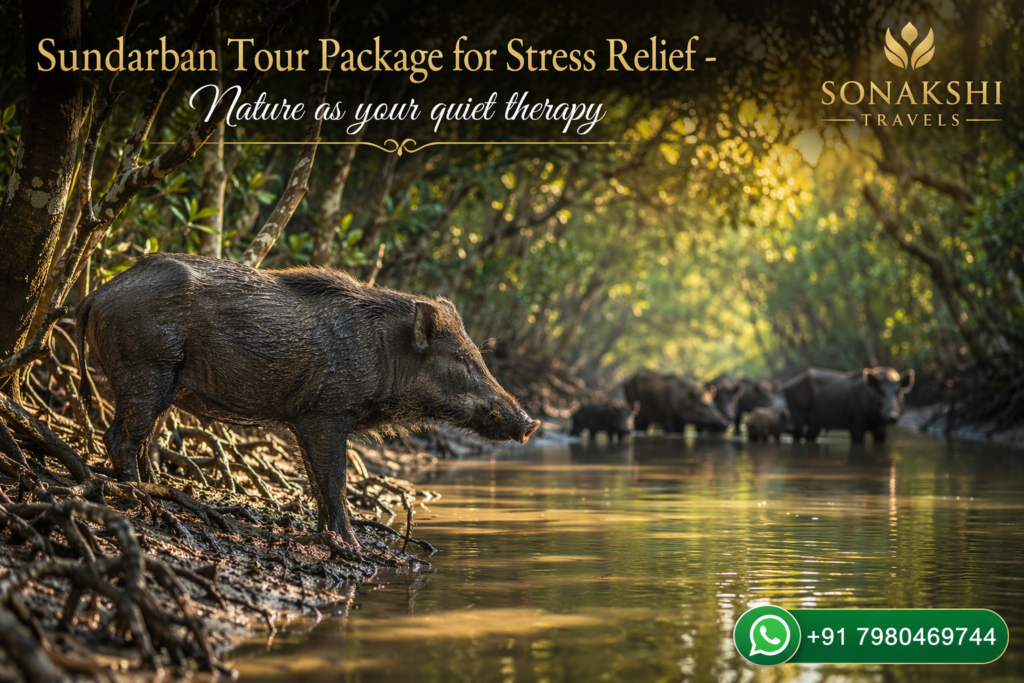
Modern life creates a type of tiredness that is not always visible. A person may sleep enough and still feel restless. Work may be finished, but the mind may continue moving. Noise may stop outside, yet thought may remain crowded inside. This is why many people no longer look at travel only as entertainment. They look at it as a way to recover attention, soften pressure, and return to a more stable inner rhythm. In that sense, a carefully designed Sundarban tour package can be understood as more than a holiday plan. It can become a quiet, environment-based experience of relief, where the landscape itself helps the mind slow down.
The healing quality of the delta does not come from spectacle alone. It comes from repetition, open water, muted sound, long views, tidal movement, filtered light, and the constant presence of living systems that do not hurry for human convenience. This is one reason why a meaningful Sundarban tour feels different from crowded leisure travel. The experience does not push the visitor toward nonstop stimulation. Instead, it removes excess. It reduces visual clutter, lowers conversational pressure, and gives the senses a cleaner field in which to rest.
Why stress responds to landscape
Research in environmental psychology has shown that natural settings help reduce cognitive fatigue. When people remain too long inside environments full of screens, traffic, deadlines, alerts, and repeated decision-making, their attention becomes strained. Natural environments support recovery because they hold interest without demanding constant control. The eyes can move without pressure. The mind can remain awake without becoming defensive. A strong Sundarban travel experience supports this process in a particularly deep way because the mangrove region is not simply green. It is rhythmic. It carries an order that feels calm but never empty.
In the Sundarban landscape, the nervous system meets wide rivers, soft horizon lines, tidal breathing, bird calls, shifting reflections, mudbanks, branches, and moving shadow. These are not aggressive forms of stimulation. They do not compete for dominance in the way urban advertising, horns, or crowded streets do. Instead, they create what many researchers describe as low-pressure fascination. The mind stays engaged, but it is not overloaded. That subtle difference matters greatly for stress relief.
This is why people who choose a thoughtful Sundarban travel plan often describe a special kind of tiredness leaving them after the first sustained hours on water. The change is not dramatic at first. It begins quietly. Breathing becomes slower. Speech becomes less frequent. Observation replaces reaction. The body stops preparing for interruption. That is often the first true sign that mental pressure has started to loosen.
The psychology of silence in the delta
Silence in the Sundarban is not complete silence. It is layered quiet. There may be the soft engine note of a boat, the splash of changing current, the sound of a kingfisher cutting through air, leaves touching one another, or the brief call of a distant bird. But none of these sounds behave like urban noise. They do not crowd the ear. They do not demand emotional readiness. They enter and leave naturally, without tension.
That quality has an important effect on human thought. In ordinary stressful life, the mind is trained to expect intrusion. A notification, a phone call, a task, a demand, a traffic shock, a sudden correction. Over time, the brain remains half-prepared for impact. In a slow river setting, that posture begins to weaken. The result is not only peace. It is also safety felt through the senses. A refined Sundarban travel package centered on restful immersion gives space for this inner reset to happen without forcing conversation or activity.
The therapeutic value here lies in the fact that the environment asks very little from the traveler. One does not need to perform enjoyment. One does not need to keep proving interest. It is enough to sit, look, listen, and notice. The water moves. The light changes. The mangrove edge repeats itself with subtle variation. These simple changes are enough to occupy attention in a healthy way. For people carrying stress, this can feel deeply relieving.
How slow movement helps the mind settle
One of the strongest healing elements in the delta is motion without urgency. On land, movement usually means purpose, destination, and timetable. On a river, movement feels different. It unfolds. It lengthens the sense of time. The body is carried instead of pushed. This matters because much of modern stress comes from compression. Too many tasks are forced into too little time. But on the water, experience expands again.
In a well-managed Sundarban tour package with food and stay included, the traveler is not constantly thinking about the next practical demand. When basic needs are quietly taken care of, the mind is free to register slower things: the softness of reflected sky, the dark geometry of roots, the still patience of the forest line, the widening and narrowing of channels. This slow reception is mentally restorative because it returns attention to the present without forcing a formal method of meditation.
Many people struggle to sit in silence at home because silence there still carries unfinished work. In the delta, silence is connected to place rather than obligation. The river gives the mind a visual rhythm. The tide provides a pattern larger than personal thought. As a result, even people who do not normally describe themselves as calm often begin to experience calm naturally.
The body’s response to water, horizon, and air
Stress is not only mental. It also lives in the body. The shoulders hold it. The jaw holds it. Breathing becomes shallow. Muscles remain prepared. Water environments often help because they widen the field of perception. A narrow room keeps the body attentive to close pressure. A broad river does the opposite. It allows the eye to travel. Horizon lines reduce visual confinement. This can create a measurable sense of ease.
That is one reason why a quiet what is included in Sundarban tour package experience matters beyond logistics. The deeper value lies in how the arrangement supports uninterrupted contact with open space. The mangrove channels do not behave like ornamental gardens. They feel living, tidal, and unarranged. That unforced quality is important. It helps the traveler step outside managed stress and into a system that existed long before personal deadlines.
Air matters too. In urban life, the body rarely gets a full sensory break. Even when one stops working, the environment may remain full of harsh edges, dust, vibration, and compressed movement. In the river forest setting, the atmosphere changes. Humidity holds scent differently. Organic smell replaces mechanical smell. Water carries coolness differently from built surfaces. Even when a person does not consciously analyze these details, the body registers the difference.
Mangrove complexity and emotional balance
At first glance, the Sundarban may appear simple: river, forest, mud, sky. But longer observation reveals extraordinary complexity. Roots rise like carved structures. Channels turn quietly. Bird movement marks unseen layers of habitat. Light reaches one bank and leaves another in shade. This combination of simplicity and complexity is especially effective for emotional balance. The visitor is not bored, yet not overwhelmed.
A serious Sundarban travel guide often explains ecological functions in terms of biodiversity and adaptation, but there is also psychological value in seeing such an environment directly. The forest does not rush, yet nothing in it is idle. This becomes a silent lesson for the stressed mind. Rest does not mean emptiness. Stillness does not mean absence. The landscape shows that life can be active without becoming frantic.
That message can be powerful for people whose stress comes from the feeling that they must always be visibly productive. In the mangrove world, energy is distributed differently. Waiting is part of life. Tidal timing matters. Balance matters. Observation matters. The traveler gradually learns that worth is not always connected to speed. This is one of the deepest therapeutic gifts such a place can offer.
Why a package format can support stress relief
Stress recovery is weakened when a traveler must keep solving practical problems. Too many choices, too many small decisions, and too much planning can recreate the very pressure a person hoped to escape. This is why the structure of a thoughtful best Sundarban tour package matters. The package format, when designed well, protects the traveler from decision fatigue and leaves more room for emotional rest.
It is not the word package that matters. It is the reduction of friction. When the environment, meals, rhythm, and flow are handled smoothly, a visitor can enter the place more fully. That is especially important for those seeking restoration rather than excitement. A well-shaped Sundarban tour package guide should therefore be understood not only as an arrangement of services, but as a support system for mental quietness.
For some travelers, a more secluded format such as a Sundarban private tour deepens this effect. Privacy reduces social fatigue. Fewer voices create more space for listening. The individual or family can meet the landscape without the pressure of constant group energy. In the context of stress relief, this can be especially valuable because emotional decompression often requires less performance and more inward space.
Quiet observation as a form of natural therapy
Not all therapy begins with words. Sometimes it begins with better attention. A person watches a line of mangrove roots holding mud against tide. A bird waits in complete economy of movement. Water changes tone as light shifts. These moments do not solve life in a direct way, but they reorganize the mind. They lower internal noise and improve the quality of thought.
This is one reason the region is so effective for reflective travel. A serious Sundarban tourism experience, when approached quietly, becomes less about seeing many things and more about seeing a few things deeply. Deep seeing has psychological value. It slows reaction and increases presence. It invites patience. It restores a kind of mental dignity that stress often damages.
Many travelers come back describing not only the beauty of the landscape but also the way their own mind behaved differently there. Thoughts became longer and less fragmented. Irritation reduced. Small discomforts lost their sharpness. The need to check time repeatedly became weaker. These are not trivial changes. They show that the environment supported nervous system recovery in a natural and believable way.
The role of companionship, solitude, and emotional space
Stress relief does not look the same for every person. Some recover best in silence. Some recover through quiet companionship. Some need privacy with a partner. Some need a soft family environment without urban interruption. Because of this, the emotional setting matters almost as much as the physical setting. A restful Sundarban travel for couples experience can create shared silence that is difficult to find in ordinary life, where even togetherness is often surrounded by digital distraction.
For families, a calm Sundarban travel for family experience can also work as collective recovery. When everyone moves into the same slower rhythm, relationships often soften. Conversation becomes less rushed. Children observe more. Adults react less. Shared attention turns outward toward water, birds, light, and forest. This outward turning reduces domestic tension because people stop meeting one another only through daily duties.
For those seeking deeper emotional quiet, a more personal arrangement such as an exclusive Sundarban private tour may offer the best setting. Less crowding can mean less emotional guarding. In that condition, nature is not background. It becomes company of another order—steady, nonverbal, and strangely reassuring.
Ecological humility and relief from self-pressure
Another subtle form of healing comes from scale. Human stress often grows when the self becomes too central in experience. Every task feels urgent, every problem feels total, every delay feels personal. In the Sundarban, the visitor is placed inside a tidal ecology larger than personal plans. Channels change with water levels. Roots hold ground in silence. Life adapts continuously. This does not make human problems vanish, but it changes their proportion.
A carefully observed Sundarban nature tour teaches humility without humiliation. One sees that life can remain meaningful without constant assertion. This is mentally healthy because it reduces the burden of self-importance that stress often creates. The forest is not indifferent in a cold way. It is simply larger than one person’s schedule. Many people find that deeply freeing.
That freedom is also why a refined Sundarban luxury travel experience does not need noise or excess to feel rich. True richness here comes from mental spaciousness, ecological depth, and the rare permission to exist without hurry. Comfort can support that state, but the real restorative force remains the environment itself.
Nature as your quiet therapy
The phrase quiet therapy is meaningful because the Sundarban does not heal through instruction. It heals through conditions. Open water reduces compression. Mangrove textures hold the eye gently. Sound becomes softer. Time becomes wider. Thought becomes less crowded. Stress does not always disappear at once, but it begins to lose authority.
This is why a genuinely thoughtful Sundarban tour package for stress relief should be understood as an experience of environment, rhythm, and psychological recovery. The traveler is not only visiting a destination. The traveler is entering a slower order of life where silence carries structure, movement carries calm, and nature offers something modern life often withholds: permission to be still without feeling unproductive.
In the end, the strongest memory may not be a single sight. It may be the feeling of the mind becoming quieter hour by hour. It may be the rediscovery of unforced breathing. It may be the rare comfort of looking at water without needing anything from it. In that sense, the value of a well-conceived Sundarban tour package lies not only in where it takes a person, but in what it gently removes. Noise. Pressure. inner crowding. And when those begin to fall away, nature does what it has always done best. It restores balance, without speaking.