Sundarban luxury tour through silent horizons – Where distance feels infinite
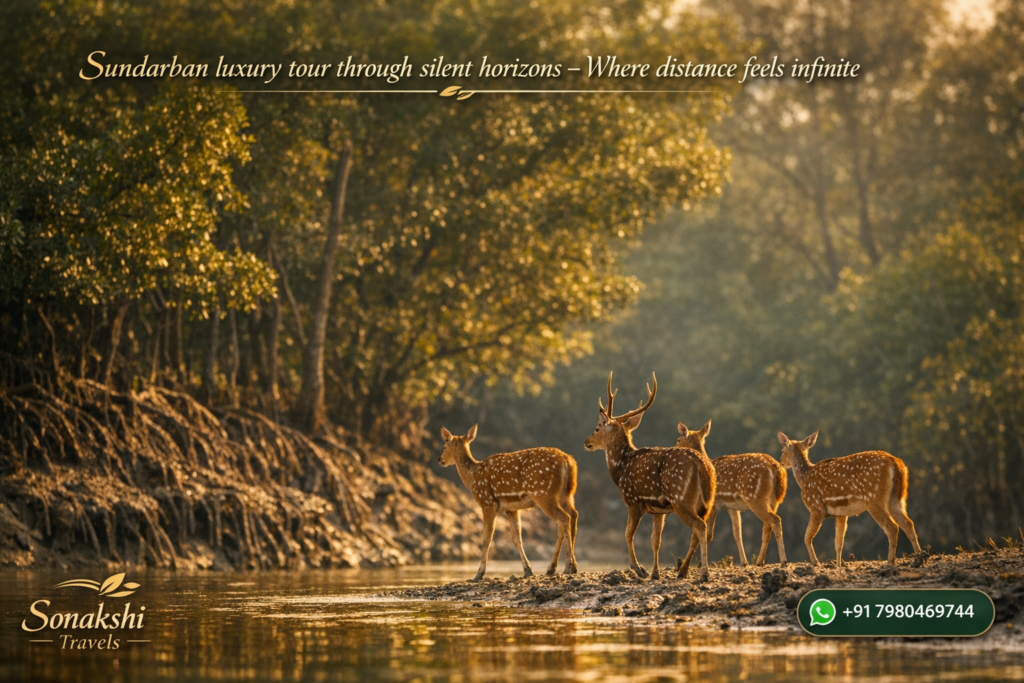
There are landscapes that impress the eye because they are full. Mountains rise. Cities gather shape. Forests close around the traveler and create a strong sense of enclosure. The Sundarban creates the opposite experience. It often feels open in a way that is difficult to describe until a person is physically there, looking out across tidal water where the far line of land stays low, quiet, and uncertain. A Sundarban luxury tour through such space is not only a journey through a mangrove delta. It is also a journey into distance itself. The eye keeps moving. The mind keeps moving with it. The horizon does not arrive quickly. It remains far, fluid, and almost endless.
That is why silence becomes so important in this landscape. Silent horizons are not empty horizons. They are active with slow change. Tide shifts the edges. Light alters the tone of water. Mudbanks appear and soften. Mangrove lines seem still, yet they are part of a breathing ecological system shaped by salinity, sediment movement, river flow, and lunar rhythm. In this environment, distance feels infinite not because the delta is empty, but because it is open enough to reveal scale without noise. A refined Sundarban travel experience in such a setting becomes something more than sightseeing. It becomes an encounter with vastness, patience, and visual calm.
The meaning of a silent horizon
In many places, the horizon is simply a boundary. In the Sundarban, it often feels like a moving idea. Water meets sky, but the meeting is softened by haze, brightness, and low vegetation. Because the land rarely rises high, the human eye is not stopped by sharp elevation. Instead, vision travels outward along river channels and across flat light. This is one of the deepest emotional qualities of the delta. The horizon is present, yet it refuses to become fixed. That refusal creates an unusual psychological effect. It makes the traveler feel small, but not threatened. It creates humility without pressure.
Such an experience matters because modern life usually teaches the eye to focus on interruption. Buildings, screens, traffic, signs, and constant visual compression train attention to stay narrow. In contrast, the long outward view found on a Sundarban private tour releases that compression. The mind begins to widen with the landscape. Research in environmental psychology has repeatedly shown that open natural settings can reduce mental fatigue and restore directed attention. The Sundarban adds a special version of that effect because its openness is joined with silence, slow motion, and ecological complexity. The result is not dramatic stimulation. It is quiet expansion.
That is why the phrase “distance feels infinite” is not an exaggeration when it is used carefully for this landscape. It describes a real sensory condition. The traveler sees long channels stretching away under broad sky. Reflections lengthen space even more. Light on tidal water creates horizontal width. Sound is often reduced to wind, birdcall, engine hum, and soft contact between current and boat. When strong visual interruption is absent, distance becomes a lived feeling rather than a measured fact.
Why openness feels different in the Sundarban
Not all open landscapes create the same emotional response. A desert may feel severe. Open sea may feel exposed. Grassland may feel airy and bright. The Sundarban is different because its openness is threaded with hidden life. Under the broad view there is density. Mangrove roots hold mud. Juvenile fish shelter in tidal creeks. Crabs work the sediment. Birds read current and edge. Estuarine processes never stop. The horizon is wide, but the ecosystem is intricate. This contrast between visual openness and biological density gives the region its distinctive mood.
That mood becomes especially meaningful during a Sundarban tourism experience shaped by care, stillness, and observation. The traveler is not looking at a flat scene that contains little detail. The traveler is looking at a vast field of subtle signs. A change in water color may indicate depth, sediment, or current. A slightly raised line of green can reveal a mangrove island. A distant bird movement can suddenly animate a broad empty stretch. Silence allows these small details to emerge with more power. In noisy places, detail is often overwhelmed. Here, detail enters quietly and stays longer in memory.
The low horizon also changes the sense of time. When the visual world is not broken into short segments, minutes seem to lengthen. Travel across water feels more continuous than travel across roads. There are fewer abrupt stops in perception. This creates a floating quality in thought. The mind moves, but it is not pushed. That is one reason a luxury encounter with this environment feels valuable. Comfort in the Sundarban is not meaningful because it adds display to nature. It is meaningful because it protects attention, allowing the traveler to absorb long silence and long distance without distraction.
Water as the maker of infinite distance
The sense of endless distance in the Sundarban is deeply connected to water. Water does not merely fill channels here. It organizes sight, rhythm, and movement. Because tidal rivers widen and narrow with changing conditions, they create long visual pathways that are never fully stable. The eye follows these pathways far into the scene. Reflections then deepen the effect. Sky doubles in the river. Light stretches across the surface. A bank on one side may feel near, but the open span ahead still carries the eye forward.
This visual experience is also ecological. Estuarine water is never static. It carries salt, sediment, nutrients, and memory of upstream and downstream forces. The traveler may perceive calm, but the water body is dynamic. That hidden motion beneath the quiet surface gives the silent horizon its depth. Silence in the Sundarban is not dead stillness. It is controlled motion. A Sundarban eco tourism perspective helps explain this well. What appears simple from a distance is the visible face of a highly adaptive system where plant structure, shoreline formation, and wildlife behavior are all shaped by water movement.
This is also why the landscape resists quick interpretation. One cannot understand it fully in a single glance. The river line curves. The light shifts. The far bank changes tone. A wide open stretch that seems empty at first may later reveal layers of life and form. The traveler gradually learns that silence is giving information, not withholding it. That lesson deepens the experience of the horizon. Distance no longer feels blank. It feels patient.
The psychology of looking far
Human beings respond strongly to distance. Looking far can calm the nervous system because it reduces the pressure of close visual demand. In crowded environments, attention is repeatedly pulled toward immediate objects. In the Sundarban, the eye is invited outward. This outward movement can create a feeling of release. It can also create introspection. When there is less visual clutter, inner thought becomes more audible.
That is one of the quiet strengths of a Sundarban luxury tour package designed around atmosphere rather than speed. Long views do not simply show the delta. They alter the inner pace of the traveler. Silence becomes easier to hold. Thought becomes less fragmented. Many people discover that the landscape is affecting them emotionally before they fully understand why. The reason is often this relationship between visual openness and psychological spaciousness.
There is also a subtle discipline in such looking. At first, some travelers expect constant visible drama from wilderness. The Sundarban teaches another form of attention. It asks for patience. It asks the eye to remain present without immediate reward. Over time, this patience becomes pleasure. The traveler begins to notice how a soft bank line enters the distance, how the horizon changes under thin cloud, how a faint movement far away can become deeply meaningful because the surrounding field is quiet. This is not a lesser experience than spectacle. In many ways, it is richer because it trains perception instead of overwhelming it.
The role of silence in luxury
Luxury is often misunderstood as decoration, display, or excess. In a landscape like the Sundarban, real luxury can mean something more intelligent and more restrained. It can mean having the conditions necessary to experience the place fully. Silence is part of that. Ease is part of that. Clean sightlines, unhurried movement, and the ability to remain comfortably attentive all matter. A good Sundarban luxury private tour does not compete with the landscape. It creates the calm needed to receive it.
This matters especially in a place where the horizon is one of the main emotional events. If the journey becomes too crowded with interruption, conversation, or unnecessary haste, the silent breadth of the delta is reduced to background. But when movement is measured and the setting is allowed to speak through distance, a traveler can feel the full effect of the wide estuarine world. The value lies not in adding noise to the journey, but in protecting stillness.
There is also an ethical dimension here. A calm, observational mode of travel is often more respectful to sensitive natural spaces than a restless one. The Sundarban is not a stage set. It is a delicate living system. To approach it with patience is not only aesthetically rewarding. It is also appropriate. Silence allows one to feel the dignity of the landscape. Distance allows one to understand that human presence is temporary, while the ecological processes shaping the horizon are older and larger.
How mangrove structure shapes the horizon
The silent horizon of the Sundarban is not created by water alone. Mangrove structure plays a major role. Unlike tall upland forests, mangrove formations often remain low and horizontal when seen from a distance. This preserves the long line of sight. Yet within that low profile there is extraordinary biological intelligence. Mangrove species in estuarine environments develop specialized root systems, salt management strategies, and sediment relationships that allow them to survive where many other plants cannot. The horizon may look simple, but it is supported by a remarkable adaptation system.
That is why a thoughtful Sundarban travel guide perspective should never reduce the landscape to visual beauty alone. The flat line of green on a far bank is not merely scenic decoration. It is habitat, protection, filtration, and shoreline defense. It is part of the reason the horizon feels so calm. Mangroves hold the boundary softly. They do not rise like walls. They remain low, porous, and continuous, allowing distance to stay visible while still giving shape to the scene.
From a compositional point of view, this creates one of the most distinctive visual experiences in eastern India. The sky occupies a major portion of the field. Water opens the lower plane. Mangrove lines rest between them like quiet sentences. Because none of these elements shouts for attention, the total effect is meditative. It is possible to look for a long time without fatigue. In fact, one often looks longer precisely because the scene does not demand quick consumption.
When distance becomes emotional
There comes a moment in many deep landscape experiences when description becomes emotional before it becomes verbal. The Sundarban often creates that moment through distance. A traveler may be unable to point to one dramatic object, yet still feel profoundly moved. The cause is cumulative. Long water. Low green edges. Quiet air. Sparse sound. Slow travel. Broad sky. Together they create an atmosphere where scale enters feeling.
This is why the horizon in the Sundarban can seem almost philosophical. It raises questions without speaking them directly. What does vastness do to ego? What does silence do to thought? What happens when movement continues but urgency disappears? A refined Sundarban luxury travel experience can make such questions vivid because it gives enough stability and time for perception to deepen. The traveler begins with scenery, but often leaves with a changed sense of space.
Distance also produces tenderness. Because the horizon is never fully grasped, it remains slightly beyond possession. One cannot hold it. One cannot reduce it to a single fixed image. That very ungraspable quality makes it memorable. The landscape gives itself through intervals, not through total revelation. It remains partially open, partially withheld, and therefore emotionally alive.
Why silent horizons stay in memory
Many travel memories fade because they are built from quick accumulation. One sight replaces another before the mind has absorbed the first. The Sundarban works differently when experienced through stillness. Silent horizons remain in memory because they are not consumed quickly. They are inhabited. The mind has time to register proportion, texture, and mood. Memory formed in this slower way is often more durable.
The region’s open estuarine character also gives memory a strong visual grammar. People remember the long band of water, the low mangrove line, the soft brightness, and the sense that the world kept opening rather than closing. In that sense, the horizon becomes the true architecture of the journey. Not built architecture, but spatial architecture. It organizes feeling. It gives the experience its shape.
For this reason, a serious reflection on Sundarban travel agency storytelling should pay attention not only to wildlife, activity, or named locations, but also to visual silence and scale. The deepest signature of this landscape may be its ability to make the traveler experience distance as something almost physical. One does not simply see far. One feels the farness.
Through silent horizons, the delta reveals its true character
The Sundarban does not always reveal its deepest meaning through dramatic encounter. Often it reveals itself through sustained quiet. Its distant horizons, low mangrove lines, and flowing expanses of water create one of the most unusual sensory environments in the subcontinent. Here, infinity is not a mathematical idea. It becomes an emotional impression produced by openness, silence, and ecological continuity.
A carefully experienced Sundarban luxury tour through this world shows that distance can be intimate. The farther the eye travels, the calmer the mind can become. The quieter the horizon appears, the more living depth it contains. The less the landscape insists, the more it enters memory. That is the special power of the silent Sundarban horizon. It does not overwhelm the traveler. It expands the traveler. In that expansion, the delta’s true character becomes clear: immense, restrained, alive, and quietly without end.