Updated: March 29, 2026
In the Sundarban Tour, Joy Echoes Louder than Drums
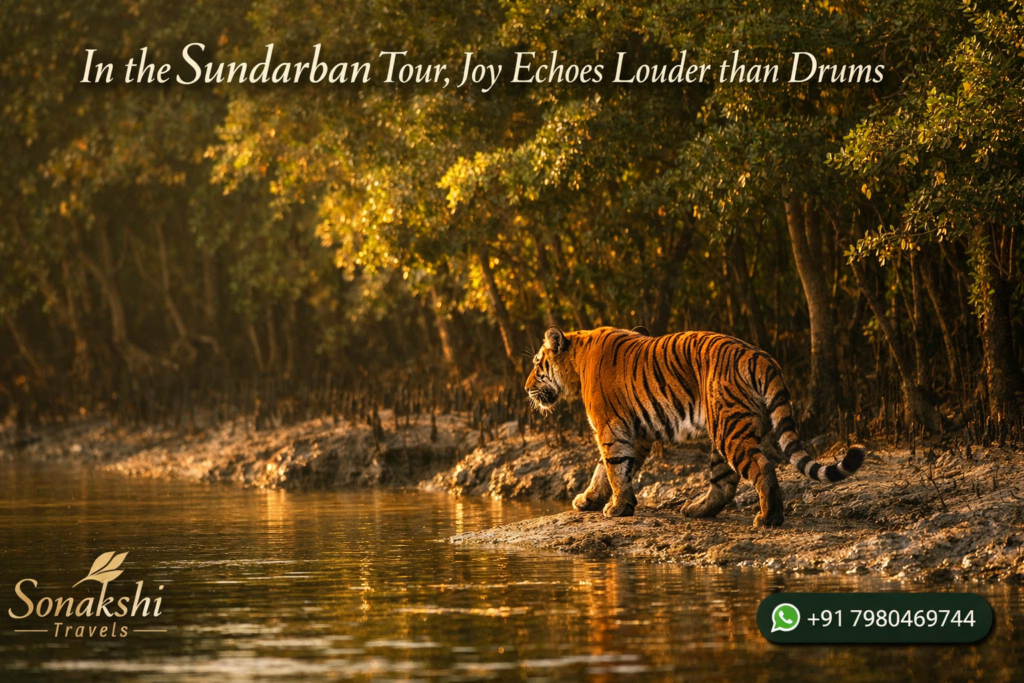
There are some places where joy arrives with noise. It comes through music, celebration, applause, and bright display. Then there are places where joy rises in a quieter way and yet feels deeper, fuller, and more lasting. The Sundarban belongs to the second kind. In a Sundarban tour, happiness does not need a stage. It does not need loud drums, crowded excitement, or restless movement. It grows from water, light, wind, silence, human closeness, and the strange calm of a living forest. That is why the joy felt here often seems louder than sound itself. It spreads through the mind with more force than noise because it rises from something real and shared.
The title may sound poetic, but it holds a clear truth. In the mangrove world, people often discover that the strongest feeling is not fear, not hurry, and not even wonder alone. It is joy. This joy is not childish excitement. It is not shallow pleasure. It is a mature and grounded feeling born from presence. A person stands on a boat, looks across the breathing river, watches the changing edge of the forest, and feels an inner lifting that is difficult to explain in common words. The heart becomes lighter. The mind becomes cleaner. Even speech changes. People speak more softly, but they feel more fully.
Why Joy Feels Different in the Delta
In many travel places, joy depends on activity. People feel happy because they are doing something fast, consuming something new, or collecting visible moments. In the Sundarban, the pattern is different. The landscape slows the body and changes the mind. A river here is never only a river. It carries tide, reflection, silence, memory, salt, and movement. The mangroves are never only trees. They seem to stand and listen. They hold shadows, bird calls, hidden life, and the patient drama of survival.
Because the environment is so alive, human joy becomes more attentive. People do not simply react. They observe. They listen. They wait. This waiting is important. Research in environmental psychology often shows that quiet natural settings help reduce mental overload and restore attention. The Sundarban does this in a rare way because it is not a flat or predictable natural space. It is layered, shifting, and rhythmic. Water rises and falls. Light opens and closes. Sounds come and disappear. The mind begins to follow this pattern, and joy grows not from stimulation but from alignment.
That is why a Sundarban tour package can become much more than a simple outing in memory. The deeper value is not only that one has visited a famous mangrove forest. The deeper value is that one has entered a space where emotion becomes cleaner and more truthful. A smile on the boat is often more natural than a smile in a crowded city celebration because it is not asked for. It rises by itself.
The Sound of Shared Happiness
When people imagine joy, they often imagine loudness. Yet one of the strongest forms of joy is shared quietness. On a Sundarban journey, families, friends, couples, and even strangers often experience this without planning it. Someone points to a bird crossing the river. Another person notices the shine of late light on the water. Someone else becomes silent for a few moments and then smiles. No one has delivered entertainment. No one has performed. Still, everyone feels that something has happened.
This shared stillness creates a special emotional sound. It is not heard through the ear in the way a drum is heard. It is felt through human presence. Laughter becomes softer but more meaningful. Even ordinary talk becomes warmer. A simple meal tastes better. A pause feels richer. The natural world seems to remove the roughness that daily life often puts inside people. That is one reason why the Sundarban travel experience is often remembered with unusual tenderness. People do not only remember what they saw. They remember how lightly and honestly they felt among one another.
In this sense, joy echoes louder than drums because the mind keeps hearing it after the journey ends. Loud sound disappears quickly. Inner gladness stays. Long after returning home, a person may remember the wide river, the smell of mud and leaves, the pattern of roots, the open sky above the boat, and the calm talk among companions. Such memory continues to sound inside the mind, and that quiet echo can be stronger than any festival noise.
Landscape as a Source of Emotional Clarity
The Sundarban creates joy partly because it strips away excess. In city life, the senses are often crowded. There are too many signals, too many demands, too many interruptions. In the mangrove world, the senses are still active, but they are directed toward simpler and more elemental things. The eye follows water lines. The ear follows wind, wings, distant calls, and the soft movement of the boat. The skin feels humidity and breeze. The nose catches wet earth, river salt, and leaf scent. This sensory order helps the mind become more stable.
Stability is an important part of deep joy. A restless mind may feel brief excitement, but it cannot hold quiet happiness for long. The Sundarban environment, with its repeated natural rhythms, gives the mind a gentle frame. People begin to notice details they usually miss. They see how light moves on brown water. They see how roots rise from mud like writing made by the earth itself. They see how one patch of green differs from another. This careful seeing is not a small thing. It is one of the ways human beings return to emotional balance.
That is why some travelers seek a Sundarban nature tour not only for scenery but for a kind of inward repair. The forest does not heal by speaking. It heals by existing. It offers a pattern of life that is older, slower, and more disciplined than our daily habits. When a person stays open to that pattern, joy begins to rise without force.
Joy and the Human Need for Wonder
There is another reason this joy feels so strong. Human beings need wonder, but not the artificial kind. They need contact with something greater than routine. The Sundarban gives this through mystery, but not through empty fantasy. Its mystery is ecological and real. This is a world shaped by tide, salinity, adaptation, erosion, growth, concealment, and survival. Every root, creek, and shadow speaks of a long struggle between land and water. To stand inside such a place is to feel that life is larger and more complex than our usual systems.
When the mind meets this kind of reality, it often responds with joy because it feels reconnected to something meaningful. This is why even a slow river passage can feel emotionally full. A person is not watching a show. A person is entering an ancient living order. The mangrove ecosystem is one of the most remarkable coastal environments in the world, and its structure teaches humility. Trees adapt to salt. Soil shifts. Channels open and close. Life survives through balance, not control. To witness this is to feel both small and deeply alive.
Within such awareness, a Sundarban exploration tour becomes more than movement through place. It becomes movement through layers of feeling. Wonder leads to calm. Calm leads to openness. Openness leads to joy.
The Joy of Moving Without Hurry
Modern life often teaches people to move without rest and to value speed more than depth. The Sundarban quietly resists this habit. Here movement is shaped by water and rhythm, not by impatience. The boat does not cut through the landscape like a machine trying to conquer distance. It glides, pauses, turns, and continues. This slow progress changes the traveler. It teaches a different measure of time.
Joy often grows when hurry falls away. Under pressure, the mind can collect information but cannot fully feel life. In the Sundarban, the slow passage through creeks and open channels allows feeling to mature. One does not only see the delta. One enters its tempo. This creates a rare state in which observation and emotion support each other. The result is not boredom but fullness.
This is why some travelers value a Sundarban private tour so deeply. Privacy in such a landscape is not about luxury alone. It allows the rhythm of the place to be felt more directly. Without crowd pressure, the mind can settle more naturally into the sound of water and the quiet relation between sky and forest. The joy that comes from such stillness is not dramatic, but it is profound.
When Conversation Becomes More Human
One of the finest parts of the journey is how it changes conversation. People in ordinary life often speak while distracted. They answer quickly, speak half-attentively, and move on. In the Sundarban, speech often becomes slower and more sincere. The setting encourages presence. Without realizing it, people begin to say simpler and truer things.
A child asks a direct question about the forest. An older person tells a memory. Two friends laugh over something small. A couple sits in silence and feels no discomfort. Even this is joy. It is the joy of becoming human again without effort. The environment does not entertain the traveler into happiness. It clears space for natural feeling to return.
For this reason, a Sundarban family private tour can carry a special emotional value. Families often live together but do not always experience stillness together. In the delta, shared attention can become shared affection. People stop performing their roles for a while and simply become companions in wonder. That emotional softening is one of the strongest echoes the journey leaves behind.
The Role of Silence in Deep Happiness
Silence is often misunderstood. Many people think silence means emptiness. In truth, some silences are full. The Sundarban contains this kind of fullness. Its silence is made of tiny sounds held inside a larger calm. A bird call, a branch movement, a change in current, a distant splash, the slow engine of a boat, the wind touching leaves: all these create a field of living quiet.
Psychologically, such silence is important because it gives the nervous system a chance to settle. But the effect goes beyond rest. Silence also increases meaning. When there is less noise, each small event becomes more noticeable. A smile matters more. A word matters more. A glimpse matters more. This concentration of meaning is one reason joy can feel so intense here without becoming loud.
That is also why the phrase Sundarban luxury tour can be understood in a deeper way. True luxury in the mangroves is not excess. It is the rare chance to experience unbroken attention, graceful space, and emotional ease in a world that does not demand constant response. The most valuable richness here is often silence held well.
Ecological Beauty and Emotional Respect
Joy in the Sundarban is not separate from ecological awareness. In fact, part of the happiness comes from understanding that this place is delicate, intelligent, and alive in ways that demand respect. Mangrove systems protect coasts, support biodiversity, and create nursery grounds for many forms of life. Their root systems hold soil, filter movement, and respond to difficult environmental conditions. To see such resilience in living form creates admiration.
Admiration often deepens joy. When people feel only pleasure, the feeling may remain shallow. When pleasure is joined by respect, it becomes more durable. The Sundarban gives this combination. Its beauty is not decorative. It is functional, adaptive, and serious. Even the beauty of exposed roots is a beauty of survival. Even the calm river surface hides powerful ecological exchange. This knowledge does not reduce joy. It enlarges it.
Therefore, a thoughtful Sundarban eco tourism perspective is not outside the emotional theme of this article. It belongs inside it. When people understand that they are moving through a sensitive living system, their happiness becomes more careful and more grateful. Gratitude is one of the purest forms of joy, and the Sundarban awakens it naturally.
Why the Memory Lasts So Long
Many cheerful moments in life fade because they are built on surface excitement. The joy of the Sundarban lasts because it is tied to environment, feeling, relation, and meaning all at once. A person remembers not one thing but a whole atmosphere. The memory includes the quality of light, the wide breathing river, the deep green margins, the softness of shared talk, the feeling of time slowing, and the sense that the world had become simple for a while.
This kind of memory remains active because it answers a real human hunger. People long for spaces where they can feel wonder without pressure and closeness without noise. The Sundarban offers this with unusual strength. Even a refined Sundarban luxury private tour is memorable not simply because it is comfortable, but because comfort there allows deeper attention to the emotional truth of the landscape.
The joy echoes because it enters several layers of the self at once. It enters the senses through beauty. It enters the mind through calm. It enters relationships through shared presence. It enters memory through atmosphere. And it enters the moral imagination through respect for nature’s discipline and grace. When one experience reaches all these layers, it is not easily forgotten.
The Meaning of Joy Beyond Celebration
To say that joy echoes louder than drums is finally to say that the deepest happiness does not always announce itself. Sometimes it arrives in still water, in green shadows, in the open face of a loved one looking at the river, in the relief of a quiet mind, and in the humbling beauty of a forest that lives between land and sea. The Sundarban teaches that joy can be low in sound and high in truth.
In a world full of display, this lesson matters. It reminds us that human beings do not live by noise alone. They also live by wonder, rhythm, attention, and belonging. The delta does not flatter the visitor. It invites the visitor into a slower and more exact form of feeling. Those who accept that invitation often return with a happiness that is difficult to measure but impossible to deny.
So the real gift of a Sundarban tourism journey is not only that one has seen a remarkable landscape. It is that one has heard, within silence, a form of joy more lasting than noise. The drums of celebration may stop. The echo of the Sundarban does not. It continues in memory, in speech, in affection, and in the inward space where true travel leaves its mark.