Updated: April 1, 2026
Where Silence Roars and Rivers Dream – Come Drift on a Sundarban Tour Stream
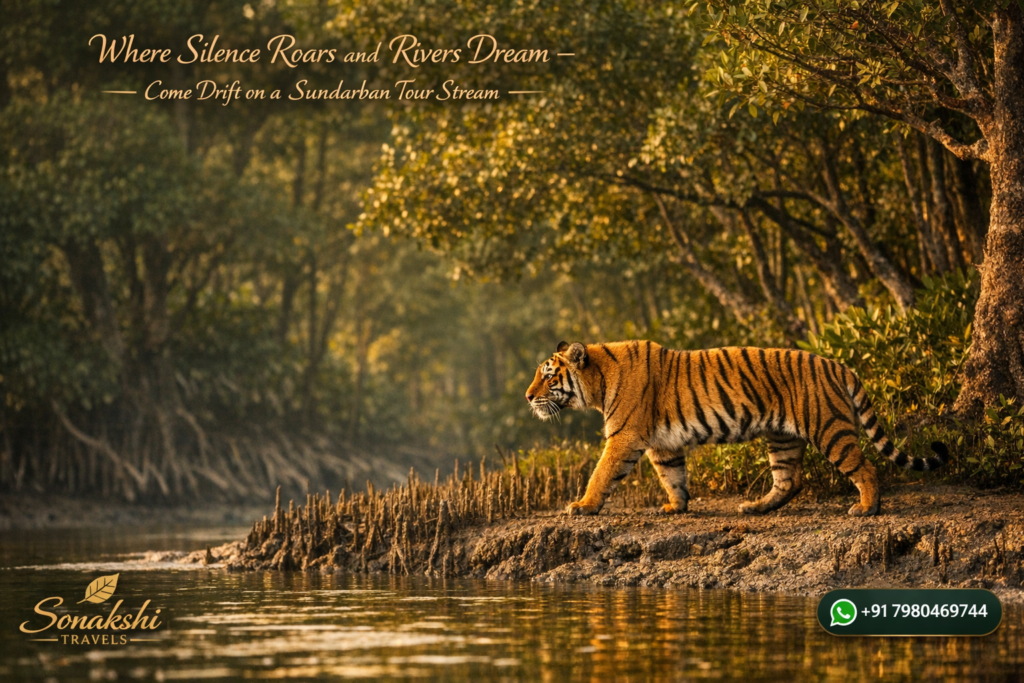
There are places where sound is easy to notice. A road, a market, a machine, or a crowd tells the ear at once what kind of world it has entered. Then there are places where silence appears first, but that silence is not empty. It is full of waiting, depth, pressure, and life. The river world of the delta belongs to that second kind. On a Sundarban tour, silence does not mean absence. It means that louder human noise has stepped aside, and the older language of water, mud, root, wing, and breath has returned to the front.
This is why drifting here feels different from ordinary travel. The boat moves, but the mind slows. The river bends, but thought becomes straighter. The eye stops chasing one large event and begins to notice a hundred small truths. A ripple against the boat, a tremor in a mangrove leaf, the soft mark of tide against dark mud, the pause before a bird lifts itself into air: all these become part of one deep experience. That is the real strength of a Sundarban travel experience. It teaches the traveler that stillness is not lifeless. Stillness is one of nature’s highest forms of attention.
Why Silence Feels So Powerful on the Water
In many landscapes, silence feels weak because something important seems missing. In the mangrove river system, silence feels strong because so much is taking place inside it. This is a tidal environment. Water is always shifting, even when the surface looks calm. The mudbanks are shaped by movement. Salt and fresh water meet, mix, and pull against each other. Roots breathe upward from the soil because the ground below is wet, tight, and low in oxygen. Fish move with hidden purpose below the surface. Crabs work in the mud. Birds listen before they act. Nothing is lazy here. Much of it is simply quiet.
That quiet has a physical effect on the visitor. In noisy places, the mind keeps defending itself. It filters, blocks, and rushes. In the delta, that pressure eases. A person begins to hear distance again. The ear notices how wide a river truly is. It notices how a small splash can travel across open water. It notices how silence can carry a single wingbeat farther than one would expect. This is where the title of the journey becomes true. Silence does not whisper here. Silence roars, but it roars inwardly. It fills the chest, not the street.
That is one reason many people remember a Sundarban nature tour less as a checklist of sights and more as a state of mind. The landscape changes inner rhythm. The body remains on a boat, but attention begins to drift beyond ordinary habit. The traveler stops asking, “What comes next?” and starts asking, “What is happening here right now?”
How Rivers Seem to Dream in the Mangrove World
The rivers of this region do not move like straight roads. They curve, divide, return, widen, narrow, and fold around islands of mud and green. Their shape creates a feeling that is almost dreamlike. One channel opens into another. One bank hides what lies beyond it. One patch of reflected light looks solid until the boat reaches it and finds only moving water. This is why the rivers seem to dream. Their motion is real, yet their appearance is always changing.
Light plays an important role in this feeling. On open water, the sky is not only above. It comes down into the river and begins to live there. The reflections of cloud, sun, shadow, and leaves keep breaking and reforming. A traveler looking at the surface for long enough begins to understand that the river does not merely carry the boat. It carries image, mood, and memory. That is a central beauty of Sundarban travel. The land and water do not stand apart. Each enters the other.
Scientists and field observers often explain mangrove landscapes through salinity, sediment, tidal energy, and ecological adaptation. All of that is true and important. Yet for the traveler, those same facts become emotional without losing their truth. A place shaped by tide will naturally feel fluid. A place built from mud and root will naturally feel half formed, half hidden, always becoming something slightly new. The dreaming quality of the rivers is therefore not fantasy. It rises from real geography.
Drifting Changes the Way the Eye Understands Distance
Walking gives one kind of knowledge. Driving gives another. Drifting gives a slower and often deeper kind. On water, the body does not strike the ground with each step. Movement is smoother, quieter, and less forceful. This changes perception. The traveler has more time to see transitions. A bank is not passed; it is approached. A shadow is not crossed in a second; it slowly opens and then closes. The eye learns patience.
That patience matters in the delta because so much of its truth is gradual. A bird standing on a branch may look motionless, but the water below it is moving. A line of mangroves may appear solid from a distance, but as the boat comes nearer, roots, gaps, textures, and layers begin to appear. A muddy edge may seem empty until one sees small life moving across it. This is why a Sundarban wildlife safari in river country is not only about spotting something dramatic. It is also about learning how to look correctly.
Many modern travelers are trained by speed. They expect quick reward, clear shape, and instant explanation. The mangrove stream asks for another discipline. It asks the eye to remain present even when nothing large is happening. Then it rewards that patience by showing how rich a quiet scene can be. A kingfisher’s sudden dive becomes sharper because of the waiting before it. A deer at the edge of cover feels more moving because the landscape had looked almost empty a moment earlier. Drifting teaches the value of preparation in seeing.
The Ecology of Quiet: Why the Landscape Feels Alive Even in Stillness
The mangrove environment is often described through adaptation, and rightly so. Trees here survive in brackish conditions that many plants cannot tolerate. Their roots perform special work. Their seeds and seedlings follow unusual patterns of growth. The banks are shaped by silt, tide, and erosion. The animals that live here respond to water level, cover, food, and timing with great care. For the traveler, this means that quiet scenes are rarely simple scenes. They are often full of hidden decision and unseen effort.
That is one reason silence feels intelligent in this landscape. A mudflat is not bare. It is a working surface. A stand of mangrove trees is not a wall of green. It is a living system of breathing roots, salt response, shade, shelter, and nutrient exchange. Water that seems slow may still be carrying suspended material, feeding channels, and reshaping edges. On a thoughtful Sundarban exploration tour, one begins to feel that ecology is not only science written in books. It is visible design written into every quiet corner of the place.
This also helps explain why the human visitor often becomes more humble here. The landscape does not perform for the traveler. It exists on its own terms. It asks observation before judgment. It asks stillness before interpretation. In that way, the delta offers an important lesson. Nature does not need noise to show power. Often its greatest authority appears in calm form.
The Psychological Pull of Water, Repetition, and Slow Motion
There is also a mental reason why this journey stays in memory. Repeated soft movement has a strong effect on the human mind. The steady drift of a boat, the recurring sound of water touching wood, the repeated pattern of roots and banks, and the long breathing space between one sound and the next can bring unusual clarity. Thoughts that feel crowded in the city often loosen here. The mind becomes less hard around the edges.
This does not happen because the place is empty. It happens because the place is ordered in another way. The river keeps moving, but it does not rush. The landscape keeps changing, but it does not break its rhythm. The silence keeps returning, but each return is slightly different. In such a setting, inner rest becomes easier. That is why many people come away from a Sundarban tour package speaking not only about scenery but about relief. The relief is real because the environment changes the pattern of attention itself.
The dreaming rivers and the roaring silence work together. One softens the mind; the other deepens it. One draws thought outward into space and reflection; the other draws it inward into careful listening. Between these two forces, drifting becomes more than movement. It becomes a form of reading. The traveler is reading the water, but the water is also reading the traveler, testing whether the person can slow down enough to understand.
Why This Stream-Like Journey Feels Different from Ordinary Travel
Many journeys are built around arrival. They move with force toward a fixed point. This one is built around passage. What matters is not only where the boat is on the map, but how the world reveals itself during the drift. The stream-like character of the journey gives it a special beauty. It does not ask the traveler to conquer space. It asks the traveler to move with it.
That is where the deeper meaning of a Sundarban tour from Kolkata often emerges for people who live among hard schedules and dense urban sound. The change is not only geographical. It is rhythmic. One leaves behind a life built on interruption and enters a landscape built on flow. Even when the boat moves through broad channels, the feeling is intimate. Water carries the body, and the mind begins to follow its pace.
This kind of movement also sharpens emotional memory. People often remember not a single grand moment but a chain of linked sensations: the hush before dawn light opens on water, the low shine on a passing current, the dark under-shadow of mangrove branches, the sudden call of a bird, the long silence after it. Memory holds these fragments together because the journey itself is continuous. It streams through the mind the way the river streams through the land.
Private Drift and the Value of Undisturbed Attention
Because this landscape speaks softly, the quality of attention matters. A quieter, more focused mode of travel allows a person to feel the full character of the place. In that sense, a Sundarban private tour can deepen the river experience because it reduces distraction and lets silence remain unbroken for longer periods. When fewer interruptions stand between the traveler and the landscape, the texture of drifting becomes clearer.
The same is true of a carefully designed Sundarban private boat tour. The river then feels less like a route and more like a room of moving air and water. Each bend can be entered with patience. Each quiet stretch can be allowed to remain quiet. In such a setting, the traveler does not merely pass through the mangrove stream. The traveler settles into it and begins to feel how silence, reflection, and current belong together.
This is not a question of display. It is a question of depth. The more protected the attention, the more fully the dreaming quality of the rivers can be felt. In a place where subtlety matters, even a small increase in quiet can produce a large increase in understanding.
When Comfort Meets the Slow Majesty of the River
There is also a refined side to drifting in the delta when comfort is handled with restraint and respect. A good Sundarban luxury tour does not need to overpower the landscape. Its real success lies in allowing the traveler to remain physically at ease while staying mentally open to the river’s slow language. Comfort becomes meaningful when it supports attention rather than stealing it.
For this reason, a well-shaped Sundarban luxury tour package can suit the spirit of the title very well. When the body is relaxed, the ear grows more sensitive. When movement is calm and well arranged, the eye becomes more observant. The luxury worth valuing here is not noise, decoration, or spectacle. It is the rare ability to drift through a powerful natural world without breaking the delicate quality of its silence.
In such moments, refinement and wilderness do not fight each other. They meet in balance. The traveler remains comfortable, yet the river remains the main speaker. That balance helps preserve the true meaning of the journey: to enter a place where silence has force and the river seems to carry thought itself.
The Moral Weight of a Quiet Landscape
There is one more reason this journey matters. Quiet landscapes often make people more careful. When noise falls away, responsibility becomes easier to feel. The traveler begins to sense that the delta is not just beautiful. It is delicate, layered, and alive with relationships. Water, mud, tree, bird, fish, and tide are not separate pieces. They depend on one another. In such a place, respect grows naturally.
This is why thoughtful forms of Sundarban eco tourism matter in spirit even when one is simply drifting and observing. The lesson of the river is that life here is deeply connected. The silence teaches caution. The dreaming water teaches humility. The mangrove edge teaches that fragile things can also be strong. By the end of the journey, one may feel not only delight but gratitude.
That gratitude is one of the finest outcomes of a Sundarban tourism package when it is experienced with attention. The traveler does not leave with only photographs or pleasant memories. The traveler leaves with a changed sense of scale. Human hurry feels smaller. River time feels larger. One understands that not all power is loud, and not all beauty is immediate.
Come Drift Where Silence Has a Voice
The title speaks truth because the delta itself speaks truth. Here, silence does roar. It roars through depth, not volume. It roars through the removal of distraction. It roars through the return of older sounds that modern life has pushed aside. And here, rivers do seem to dream because they carry light, motion, reflection, and uncertainty in one continuous flow. They do not merely lead the traveler through space. They lead the traveler into another tempo of seeing.
To drift on this stream is therefore to accept a different kind of journey. It is to move without hurry, to observe without force, and to feel without constant explanation. A good Sundarban trip package may bring a person to the water, but the deeper journey begins only when the mind becomes quiet enough to hear what the water has been saying all along.
And what it says is simple, though it takes time to understand. Life is moving even in stillness. Silence can hold immense energy. Reflection is not weakness. Slow observation can reveal more than speed. In the mangrove stream, all these truths gather together. That is why the memory remains. One does not merely visit such a place. One drifts through it, listens to it, and carries its calm roar home.