Updated: March 28, 2026
My Camera Couldn’t Capture It — The Monsoon Mood, The Hilsa Smoke, The River Breeze: Sundarban Hilsa Festival is Beyond Pixels
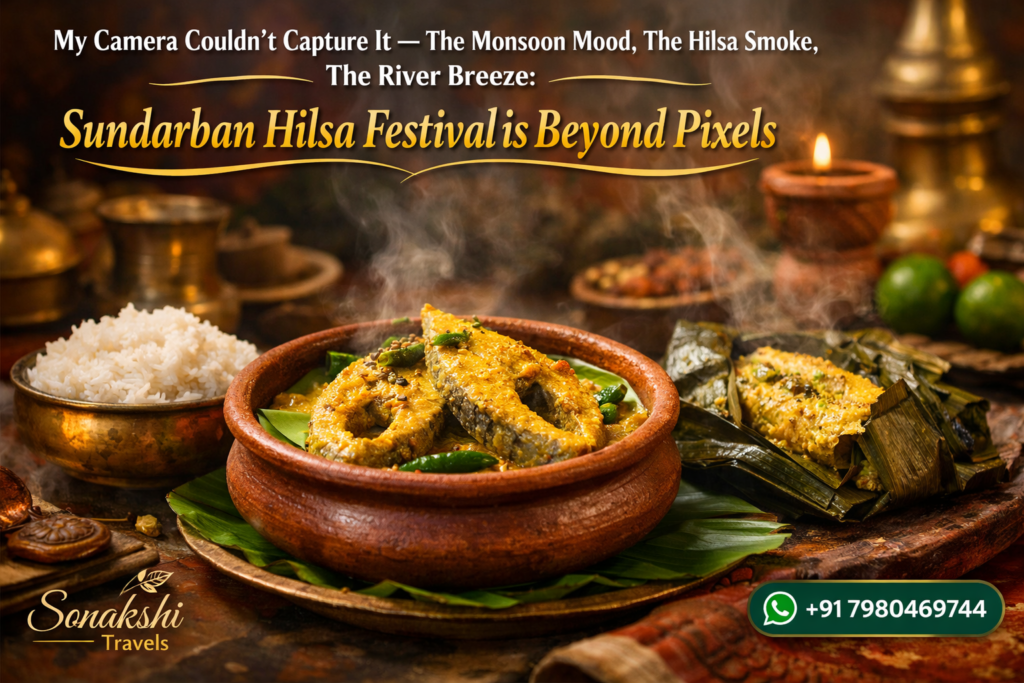
There are moments that look simple in front of the eye but feel much larger inside the body. A hand lifts a camera. A finger waits on the shutter. The frame appears ready. The light is present. The subject is there. Yet something remains outside the picture. That feeling becomes very clear at the Sundarban hilsa festival, where the real experience cannot be held fully by any device. A photograph can record the steam rising from a fresh plate of hilsa. It can show wet air over the river, silver cloud light, or smoke moving slowly from a village kitchen. But it cannot carry the damp smell of monsoon wood, the soft salt in the breeze, the silence between two river sounds, or the strange calm that enters the mind when land and water begin to speak together.
The title of this experience is not an exaggeration. It is a simple truth. My camera could not capture it. The problem was not technical. The lens was clear. The light was rich. The details were sharp. What escaped was the living atmosphere. The Sundarban in monsoon is not a flat scene. It is a moving condition. Air, moisture, smell, smoke, memory, and food meet in one place and create a mood that keeps changing every minute. That is why this festival becomes more than a visual event. It becomes a full sensory field.
The Monsoon Does Not Stay Still for the Camera
In many places, rain is only weather. Here, monsoon becomes a texture that settles on everything. It rests on leaves, sits on bamboo fences, darkens wooden jetties, softens the edges of the riverbank, and changes the color of smoke. It enters cloth, skin, breath, and even thought. A camera can capture drops on a surface, but it cannot show how the air itself feels heavy yet gentle. It cannot show the way sound becomes softer in wet conditions, or how distance seems to fold inward when the sky stays low above the river.
The mood of monsoon in the delta is made of many small changes. The breeze comes with water. The water comes with smell. The smell carries mud, fish, leaf, wood, and kitchen fire together. Clouds do not only cover the sky; they shape emotional space. They make the day slower. They reduce harshness. They bring a kind of inward silence. This is why the festival cannot be read only as a food event. During the rainy season, it becomes a meeting point between landscape and appetite. The plate is important, but the air around the plate is equally important.
That is also why this cannot be understood as a normal Sundarban tour. A simple trip may show scenery. This experience makes the visitor feel how food, season, river, and atmosphere depend on each other. The festival lives inside that bond.
Hilsa Smoke Carries More Than Aroma
Smoke from cooking hilsa is one of the strongest presences at the festival, yet it is difficult to explain through an image. A photograph can show fish on a plate or wrapped in leaf. It can show a fire, a pot, a hand, or a serving moment. But the real power of hilsa smoke is not only visual. It moves through the air and touches memory before thought. It creates expectation. It announces care. It tells the body that food is near, but it also tells something else: that the kitchen is part of the landscape.
In the Sundarban, cooking does not stand apart from nature. Fuel, humidity, vessel, timing, and the softness of the air all affect how a dish feels. When hilsa cooks in this setting, the smell does not remain trapped in one room. It rises, drifts, mixes with monsoon wind, and becomes part of the river mood. That is why the experience feels larger than taste alone. The smoke carries warmth into wet weather. It gives shape to waiting. It joins the human act of cooking to the non-human world outside.
The camera may catch steam above the food, but not the emotional pull of that smell. It cannot record how people become quiet for a moment when the aroma first reaches them. It cannot show how one dish can change the feeling of an entire riverside space. At the Sundarban hilsa festival 2026, hilsa is not only eaten. It is sensed in advance through air, through waiting, through smoke, and through the soft gathering of attention.
The River Breeze Changes the Meaning of the Meal
A meal indoors has one kind of presence. A meal near a tidal river has another. The river breeze at the festival does not work like a background detail. It changes how food is received. It cools the skin after the warmth of cooked fish. It carries smell away and then brings it back. It moves across the table, the plate, the hands, and the face. It creates intervals between taste and breath. Because of that, the act of eating becomes slower and more alert.
This breeze is never empty. It carries signs of the place. There is moisture in it, a trace of salt, a touch of mud, and the freshness that comes from open tidal movement. When it passes through the festival space, it removes the hard border between kitchen and river. The food no longer feels separate from the delta. It feels born from it. That is the key reason the experience moves beyond photography. A still image cannot communicate the way air shapes meaning.
Many travelers try to document everything. That instinct is natural. Yet here, one realizes that the deeper record is not always in the camera roll. It is in the body’s memory of breeze, smell, and changing temperature. In that sense, the festival becomes a rare Sundarban travel experience where the invisible elements matter more than the visible ones.
Why the Festival Feels Larger Than a Visual Event
The modern traveler often trusts images more than slow experience. If there is a good photograph, one feels that the moment has been saved. But the Sundarban resists that habit. This landscape is built from movement, moisture, rhythm, and delay. It often reveals itself not through one perfect scene but through a chain of subtle impressions. The festival follows the same logic. Its beauty is not made from decoration alone. It comes from relation: fish and rain, smoke and wind, waiting and hunger, river and silence.
This is why the event goes beyond the normal idea of a visual memory. The true richness lies in transition. A cloud passes. The breeze shifts. Smoke thins out. The smell deepens. The sound of water touches the ear. Someone opens a fresh serving. The body responds before the mind explains anything. A camera can isolate one point in that chain, but not the whole living sequence.
That is also why the festival should not be reduced to a standard Sundarban tour package idea, where one simply expects listed items and fixed scenes. What matters here is not only what is served or seen, but how the entire atmosphere rearranges feeling.
The Psychology of Why Some Places Refuse to Become Images
There is a deeper reason certain travel moments escape photography. Human perception is not made only of sight. Memory becomes strongest when many senses work together. Smell is especially powerful because it connects quickly with emotion and recall. Air pressure, dampness, sound distance, and bodily comfort also shape experience in ways that the eye alone cannot measure. At the festival, all these layers become active at once.
The mind does not merely observe the Sundarban during monsoon. It adapts to it. The body slows down. Attention becomes softer but deeper. One stops looking for sharp events and starts noticing tonal changes. This is why the camera may fail even when the image looks beautiful. The frame shows appearance, but not adaptation. It shows surface, but not the inner shift caused by the environment.
That inner shift is one of the most important truths of the festival. People arrive expecting fish, rain mood, and riverside charm. They leave with something less easy to name. It may be calm. It may be longing. It may be a quiet form of wonder. Whatever the word, it does not sit fully inside the image file. It stays in the nervous system, in the breath, and in the memory of wet air mixed with hilsa smoke.
Food Here Is a Form of Landscape
At many festivals, food is treated as an attraction placed inside a venue. Here, food feels like an extension of the land-water system itself. Hilsa does not appear as an isolated item. It enters the experience through ecology, season, labor, cooking practice, and river memory. That is why the dish feels different in this environment. Taste becomes place-specific. The palate receives not only flavor, but context.
When visitors speak of the fish, they often begin with softness, oil, aroma, and richness. Those are correct responses, but incomplete. The deeper meaning lies in how the dish belongs to the wider monsoon setting. Rain deepens appetite. Cool breeze sharpens smell. Wetness outside gives warmth inside greater value. Smoke rising through damp air creates visual and emotional thickness. All of this changes the food from a meal into an atmosphere.
For this reason, the festival should be understood as more than culinary display. It is a structured encounter between environment and food culture. In that encounter, taste is only one layer. Sound, moisture, slowness, and expectation complete the experience.
The Soundscape Also Escapes the Lens
Another part that the camera misses is sound. The Sundarban in monsoon does not stay silent, but its sounds are low, spread out, and deeply textured. Water presses softly against wood. Wind touches leaves in uneven patterns. Kitchen activity rises and falls. Voices move, then disappear into open damp air. Somewhere a vessel sounds against another surface. Somewhere steam releases softly. These details create a soundscape that shapes the mood of the meal.
A photograph cannot carry layered sound. Even a video often fails, because microphones flatten space. The ear, however, knows the difference between enclosed noise and open river sound. At the festival, sound does not dominate. It supports. It makes the visitor aware of distance, weather weight, and the human scale of the gathering. That awareness changes how the food is received. It makes each bite feel placed within a larger field of life.
In that sense, the festival becomes a rare form of Sundarban eco tourism experience, not because it lectures the visitor, but because it allows the visitor to feel how food, weather, river movement, and human activity remain connected.
Why the Memory Becomes Stronger Than the Photograph
After returning home, one often looks at the pictures first. The fish looks beautiful. The river looks calm. The sky appears full and soft. Smoke seems almost visible in the frame. Yet after a few minutes, the viewer notices a gap. The image is accurate, but smaller than the memory. The body remembers more than the eye recorded. It remembers damp clothing, a drifting aroma, a mild chill under cloud light, the relief of warmth from fresh food, and the way the breeze kept altering the edges of every moment.
That is why memory becomes stronger than the photograph. The memory is multi-sensory. It includes invisible layers. It includes duration. It includes the slow build-up before the meal and the quiet after it. It includes a feeling that the place had entered the food and the food had entered the place. The camera could not fail more honestly than this. It preserved the visible truth but missed the living totality.
This is where the value of the festival becomes clear. It is not only about taking beautiful content home. It is about encountering a form of reality that reminds us how limited visual capture can be. Some places ask not to be collected, but to be inhabited, even if only for a short time.
Beyond Pixels, the Festival Becomes a Human Experience
To say that the festival is beyond pixels is not to reject photography. Images remain useful. They invite curiosity. They hold fragments. They help preserve a trace of the moment. But the phrase “beyond pixels” points to something larger. It means that the central truth of the experience is embodied, not merely seen. It must be breathed, smelled, heard, and felt in shifting weather and living air.
The Sundarban ilish utsav matters because it returns food to place and place to feeling. It reminds us that taste is never fully separate from season. It shows that smoke can carry cultural memory, that breeze can alter appetite, and that monsoon can change the emotional structure of a meal. It also shows why some of the finest travel moments resist digital capture. They do not exist as objects. They exist as conditions.
Even those who come expecting a simple food gathering often discover something more meditative. The event teaches patience without trying to teach. It deepens attention without making effort visible. It allows the visitor to understand that the river does not act like a backdrop and that the plate does not act like an isolated object. Both belong to one atmosphere. That atmosphere is the true subject. The fish, the smoke, the breeze, and the rain mood all serve it.
So yes, I took pictures. I framed the plate. I captured the waterline. I tried to record the soft spread of smoke and cloud. But later I understood that the most important part had escaped. What stayed with me was not the sharpness of the image, but the softness of the air. Not the color of the fish alone, but the way its aroma moved across wet space. Not the river view by itself, but the river breeze touching the meal and changing its meaning.
That is why the experience deserves to be named carefully. It is not only a festival. It is not only food. It is not only scenery. It is a meeting of season, ecology, appetite, and feeling. And that is why my camera could not capture it. The monsoon mood, the hilsa smoke, the river breeze: they belonged to the living moment, not to the screen.
In the end, the festival remains one of those rare occasions where reality becomes richer than representation. The eye receives beauty, but the whole body receives truth. That truth is what makes the Sundarban ilish utsav 2026 unforgettable. It is seen, but not only seen. It is tasted, but not only tasted. It is remembered because it arrives through many doors at once. And when an experience enters in that way, no photograph, however beautiful, can hold all of it.